The Radical History of New York City's Jewish Women
Over a century ago, Jewish immigrant women arrived in New York’s Lower East Side from the Russian Empire with nothing. Within a generation, they had pulled off some of the most combative and highly organized labor actions in American history.
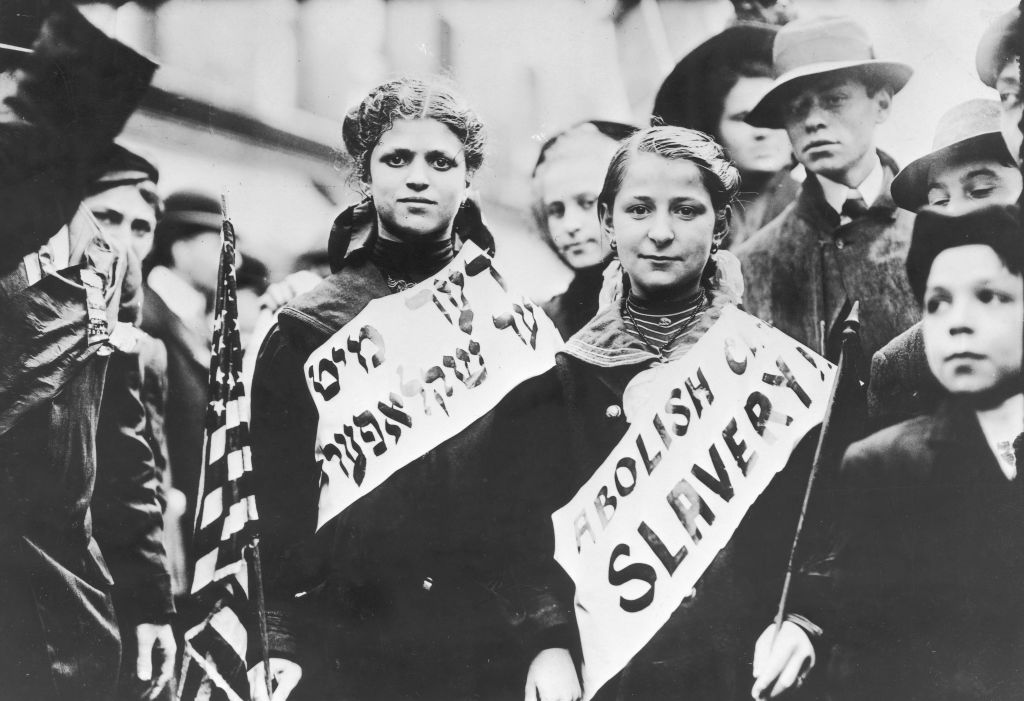
Jewish immigrant women faced a stark reality in New York: “It’s the same fight everywhere. In Russia it is the Czar. In America it is the boss and the boss’s money.” Rather than submit to the new tyranny, they organized mass labor action. (Fotosearch via Getty Images)
In the early twentieth century, Jewish immigrant women on New York’s Lower East Side were at the forefront of some of the most militant labor actions in American history. Most had fled poverty and persecution in the Russian Empire, arriving in a country that offered them grueling work in sweatshops and tenements — and little else. What they built in response, through boycotts, rent strikes, and mass walkouts, was a tradition of working-class feminism that has been largely written out of the standard accounts of both the labor movement and American Jewish life.
The following is an excerpt from the book The Radical Jewish Tradition: Revolutionaries, Resistance Fighters and Firebrands by Donny Gluckstein and Janey Malka Stone (Verso Books, 2026).
“Bravo, Bravo, Bravo, Jewish Women!”
After the turn of the century, the locus of action moved into the community. Home and workplace were, in any case, very intertwined; outwork and sweatshops, peddlers and street shop fronts, seasonal work and a strong sense of community show how important it is to see the Jewish labor movement in New York primarily in terms of the class as a whole, not according to employment status.
The workplace militancy of the 1890s flowed into the meat boycotts and rent strikes of the first decade of the twentieth century. Calling them “great folk struggles,” the radical Yiddish-language newspaper the Forward drew attention to the links: “The meat strike was a child of the trade strikes . . . and the rent strike, in turn, comes from the same source.”
An increase in the retail price of kosher meat from twelve to eighteen cents per pound in May 1902 outraged housewives. A poorly organized boycott by butchers caused Fanny Levy, the wife of a unionized cloakmaker, to respond, “This is their strike? Look at the good it has brought! Now, if we women make a strike, then it will be a strike.” She and another woman mobilized in the neighborhood. A few days later, a crowd of twenty thousand women set out. “They raided butcher’s shops, tore the meat to pieces, flung some into ash barrels, and what they could not carry they sprinkled with kerosene.” One newspaper reported that “an excitable and aroused crowd [mostly of women] roamed the streets . . . armed with sticks, vocabularies and well-sharpened nails.”
Police arrested eighty-five people for disorderly conduct. The Herald reported that the women “were pushed and hustled about [by the police], thrown to the pavement . . . and trampled upon.” The police didn’t have it all their own way, however — one woman retaliated by slapping a cop in the face with a moist piece of liver!
The Forward welcomed the protest with the headline, “Bravo, bravo, bravo, Jewish women!” By contrast, the New York Times called for the repression of this “dangerous class . . . especially the women [who] are very ignorant [and] . . . mostly speak a foreign language.”
When a magistrate asked one woman why they were rioting, she replied: “We don’t riot. But if all we did was to weep at home, nobody would notice it, so we have to do something to help ourselves.”
The mainstream press denounced the women as “a pack of wolves.” The New York Times positively frothed at the mouth:
The class of people. . . who are engaged in this matter have many elements of a dangerous class . . . The instant they take the law into their own hands, the instant they begin the destruction of property . . . They should be handled in a way that they can understand . . . Let the blow fall instantly and effectually . . . They did not get treatment nearly severe enough.
Circulars in both English and Yiddish called upon consumers not to buy meat: “Patience will win the battle.” Although women in synagogues are supposed to be neither seen nor heard, a group stormed the podium during services and lectured the congregation on the boycott.
The boycott spread to other towns. The New York Times screamed, “Brooklyn mob loots butcher shops. Rioters, led by women, wreck a dozen stores. Dance around bonfires of oil-drenched meat piled in the street — fierce fight with the police”:
The mob ran through the street, howling in their peculiar Russian and Polish dialects, wrecking with stones and other missiles, every butcher’s shop in their path.
[When the police arrived the] women threw bottles, stones and whatever they could place their hands on at the policemen. Women shook their fists in the faces of policemen and tore off their shields and buttons from their coats. There was a charge on the mob and night sticks were used freely.
The boycotts drew in widespread participation, with perhaps fifty thousand families abstaining from meat. After about three weeks, there was partial success: the price of meat was reduced to ¢14 per pound. Many of the women involved in these boycotts were the wives of union activists. Their daughters were involved in the major fights in the garment trades in 1909 and later. But, before that, they turned their attention to the other major cost of living — rent.
The Great Rent Wars, 1904–8
With immense pressure on housing in the slums of the Lower East Side, landlords simply increased rent at will, hoping to exploit the downtrodden and submissive foreigners. In 1904, they were to be disappointed. Following rent increases of 20–30 percent, protest spread “like an angry wave.” The Jewish newspaper the Forward declared, “this strike can be as great as the meat strikes” and advised Jewish housewives “to take the rent question into their hands as they did the meat question.”
Many of the tenant activists were garment workers and socialists. Class consciousness is evident even in the language they used — words such as strike, scab, and calling their associations tenants’ unions. The Forward editor Abe Cahan commented:
The trade union movement in the Jewish quarter has been growing apace . . . The spirit which impels one to struggle for his rights, to combat robbery, has imbedded itself in the hearts of our workingmen . . . This is the case with the present rent strikes. They are the outcome of the same spirit, the offspring of that same struggle against Capital.
As with the meat boycotts, women were the main activists. They discussed strategy at meetings, picketed buildings, organized building-level tenant unions and campaigned through the neighborhood:
Local Jewish women . . . began the rent strike and through their efforts and enthusiasm, they spread it. Through their strength, even the blackest strike was won and without their remarkable activities, the strike would not have been possible.
Within weeks, tenant protest had grown so large that the Lower East Side was “seething with activity and protest.”
This first strike did achieve some success in preventing rent increases and evictions, although the formal organizations could not be sustained. Rent strikes occurred over the next several years, coming to a climax with the “greatest rent wars” that New York City had seen, from December 1907 to January 1908. Led by sixteen-year-old Pauline Newman, the strike involved ten thousand families in Lower Manhattan and is remarkable for the way it combined women factory workers and neighborhood networks of housewives. Support from the Socialist Party meant that this strike was also better organized.
Strikers hung their landlords in effigy and flew red flags — actually petticoats dyed red — from windows. Landlords hit back by shutting off water, and magistrates issued several thousand eviction notices, saying that a “rent strike cannot be entertained as an excuse for not paying rent.” This time, there was much more violence, with the police forcibly disbanding gatherings.
The strike spread to Brooklyn, Harlem, and Newark, New Jersey. While strikers received support from socialist unions, the members of the “Hebrew local” of the Teamsters Union refused to dispossess striking tenants. On the other hand, the mainstream media were generally unsupportive. The American Hebrew, a middle-class Jewish newspaper, criticized the rent strikers for “not acting wisely” and called the strike “a typical example of how not to do things.”
Most accounts of the rent strikes conclude that they failed. In terms of their immediate goals, the outcome was very limited; but, viewing them as part of the larger picture, we can see how the community-based action and workplace militancy fed off and reinforced each other. Working-class people gained experience and the confidence to take action. American socialist and feminist Rose Pastor Stokes commented, “The fight itself must result in great good. It makes [the tenants] conscious of the common interests of their class, this fighting together.” As so often happens in the class struggle, participants learned lessons and took them into the next struggle. The issue of housing and rent strikes did not go away. Rent strikers in the 1930s no doubt had memories of the pre–World War I tenants’ actions, and this has in fact been a recurring theme in New York’s working-class history right up to recent times.
The Waist Makers’ Revolt, 1909
The very year after the 1908 rent strike, the fight returned to the workplace.
The most important sector of women’s garment production was the manufacture of shirtwaists, a type of blouse worn by the rapidly increasing numbers of women office workers in the early twentieth century. Five hundred shirtwaist factories in New York employed approximately thirty thousand workers at the time of the strike. The workforce was 80 percent young women between sixteen and twenty-five, most unmarried. Most of the employers were Jewish.
Although production was in factories, conditions were no better than in the sweatshops. All sorts of mean devices reduced pitifully low wages even further. Workers paid for their own needles, for electric power, and even for the boxes they sat on. Bosses used fines and tricks to avoid paying for all the work done. The work day could be up to twenty hours, and the women were subjected to personal humiliations. One of them said, “In the shops we don’t have names, we have numbers.”
Momentum for strike action built through 1908. The rent strikes stoked militancy, and Pauline Newman and other garment workers went around workplaces building support for action. Walkouts and confrontations over issues such as piece rates became increasingly frequent.
A large parade on 8 May 1908 was part of the campaign. Socialists chose the date to honor an 1857 demonstration of New York garment workers, which police had attacked and dispersed. The 1908 march of fifteen thousand women garment workers demanded better pay, shorter hours, voting rights, and an end to child labor. It was so successful that the Socialist Party declared an annual Women’s Day, with the first occurring in 1909. The famous German socialist Clara Zetkin, inspired by this idea, proposed the establishment of an International Working Women’s Day in 1910. This was celebrated for the first time in March of the following year with rallies of more than a million men and women in many countries. Thus, when we celebrate International Women’s Day today, we can trace its roots back to the women garment workers of New York in 1857 and 1908–9.
The period of intensifying conflict came to a head in September 1909. Variously known as the Uprising of the twenty, or thirty, or even forty thousand, the industry-wide strike of New York shirtwaist workers in 1909 is an icon of American women’s labor history. It was the largest strike by female workers in the United States up to that time and has been called “women’s most significant struggle for unionism in the nation’s history.” It is also one of the most significant events of the US Jewish labor movement. The participants were approximately twenty-one thousand Russian Jewish women, six thousand Jewish men, two thousand Italian women and approximately one thousand who were born in the United States. The Jewish women were the militant core of the strike.
The battle started when the Triangle Waist Company locked out their entire workforce of five hundred over union membership. The waist makers local of the International Ladies’ Garment Workers’ Union (ILGWU), in a parlous state at the start of the strike with approximately one hundred members and $4 in the treasury, started an organizing drive. For a month, picketers endured attacks from police and thugs, with dozens fined or sentenced to the workhouse.
Then came a critical mass meeting at which a well-known incident occurred. After two hours of lukewarm speeches from union officials, five-foot-tall Clara Lemlich, who had already been on strike for eleven weeks and had just returned from hospital after a brutal beating, was lifted onto the stage where she made an impassioned speech in Yiddish: “I have listened to all the speakers, and I have no further patience for talk. I am one who feels and suffers from the things pictured. I move we go on a general strike.”
Philip Foner, a leading historian of the US labor movement, describes the response:
Instantly, the crowd was on its feet — adult women, men and teenagers — cheering, stamping, crying approval. [The chairman] called for a vote. Three thousand voices shouted their unanimous approval, waving hats, handkerchiefs, and other objects.
The union secretary was astonished by the reaction to the strike call: “I shall never again see such a sight. Out of every shirtwaist factory . . . the workers poured and the halls . . . were quickly filled.”
So overwhelming was the response that confusion reigned for the first few days. “Women walked out of shops uncertain where to go or what to do.”
About half of the employers settled quickly, but the rest formed an association and “declared open war against the union.” They recruited scabs and played the race card by “exploiting Jewish and Italian antagonisms” and keeping black workers on the job where possible. But their major strategy was brute force, arrests, and convictions. Magistrates told picketers that they would get what was coming to them and handed out sentences of weeks of hard labor for minor offenses such as yelling “scab.” One magistrate told a “group of bruised and bleeding girls”: “You are on strike against God and nature, whose prime law is that man shall earn his bread in the sweat of his brow.”
George Bernard Shaw’s famous comment on this was: “Delightful. Medieval America is always in the most intimate personal confidence of the Almighty.”
That winter of 1909–10 was exceptionally cold and snowy. Although there were men in the strike, the women did most of the picketing, hoping that the police would be a bit easier on them. But the “gorillas,” as the strikers called them, who attacked the picketers had no mercy. And the employers had no end of devices. One company hired sex workers to join the thugs. One woman picketer was arrested for speaking to one of them. The officer pinched her arm black and blue as he dragged her to court.
The hiring of women thugs ended dramatically. Six of them attacked two young pickets, threw them to the ground and beat them until their faces streamed with blood. This was too much to endure and the whole street — all the factories on the block — went on sympathetic strike. In less than two days the prostitutes were removed.
The struggle galvanized the whole left, and there was extensive support action, including from the United Hebrew Trades. The Women’s Trade Union League, an organization of middle-class women which provided legal help and publicity, extended the support network into suffragist circles. The campaign climax was an enormous rally at Carnegie Hall.
Some accounts emphasize the interethnic conflicts, but the Jewish strike leaders made a conscious effort to engage other language groups:
The initial response of young Italian women to the call for picketing was strong. But the bosses put enormous pressure on these strikers . . . In one instance, Jewish manufacturers . . . brought an Italian Catholic priest in to tell striking women that they would go to hell if they continued to strike.
Unionists responded by holding Italian-language meetings and social events. But perhaps even more important was the fact that these women had brought their own culture of struggle from Italy.
The relationship with the small number of black women is also interesting. According to historian Daniel Katz, Mary White Ovington, a white socialist who cofounded the National Association for the Advancement of Colored People, noted how friendly the young Jewish women were to black coworkers, and the strikers consciously reached out to the black people of Brooklyn.
This strike has become a major benchmark in US labor history, particularly as an example of unskilled women surging into struggle, and has inspired generations of clothing workers and others. The strike had a strongly Jewish presence, but as we have noted, many other ethnic groups were drawn in. Its international character is also remarkable. One socialist publication called it the “Strike of the Singers of Shirts,” a reference to an 1843 poem by the English poet Thomas Hood that was popular among Russian revolutionaries.
The strike officially ended in February 1910 with partial success — 339 shops settled with the union, nineteen remained open. Over three hundred shops had achieved most of their demands.
In the coming years, militant disputes continued in the women’s garment industry, including a walkout of seven thousand teenage girls who made underwear. The bosses added a new tactic to the usual attacks:
Into the battle came the gangsters’ “molls.” They filled their pocketbooks with stones, and when a skirmish began, they swung their loaded bags against the pickets’ heads. They also carried concealed scissors, and at an opportune moment they would cut the strikers’ long braided hair.
But the pickets fought back. When a boss threatened a young picketer, she retaliated:
I gave the boss such a smash with my umbrella that it flew into two pieces. He was so surprised he fell down . . . I was arrested, but I was so little and he so big and fat, the Judge said “Go on home,” and he let me off. And from that day he found out he was fighting with someone who wasn’t afraid.
To give themselves strength, the fifteen-year-old girls sang:
We’re getting beaten by policemen,
With their heavy clubs of hickory,
But we’ll fight as hard as we can
To win “Strong Union Victory.”
The strikers may have been uneducated young women, but they articulated very clearly to interviewers why they were prepared to fight so hard. “My heart and soul is just with the union. It makes you feel so big instead of like a piece of dirt in the world,” said one. Another said that, when she had lived in Russia, she had believed that there was liberty in America: “But now I know the workers must fight for liberty in this country, too. It’s the same fight everywhere. In Russia it is the Czar. In America it is the boss and the boss’s money.”