British Fascist Tommy Robinson Is Taking to the Streets Again

September’s Unite the Kingdom rally was the largest far-right demonstration in modern British history. This Saturday, fascist influencer Tommy Robinson will again lead a vile mob through London streets, protected by police.
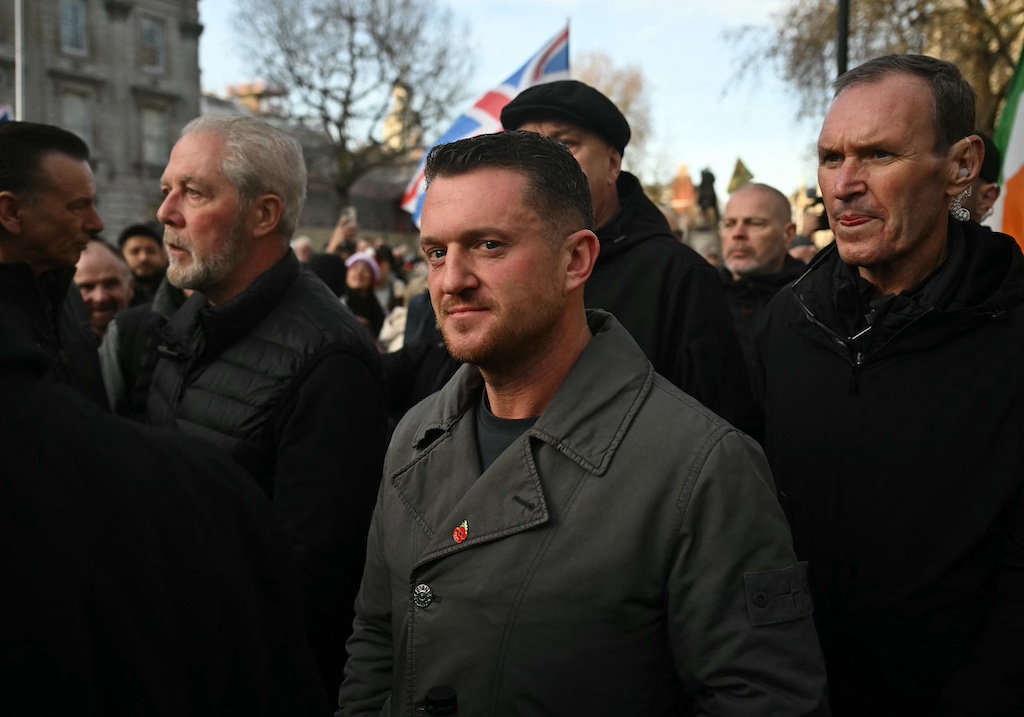
Tommy Robinson standing in a crowd on the street.

While Nigel Farage conquers the electoral arena, far-right influencer Tommy Robinson is building a movement in the streets. (Justin Tallis / AFP via Getty Images)


For years, the liberal center warned of a coming far-right threat. It posed as the line of defense against fascism. Yet now that threat is here, and the same political order is welcoming its arrival. The collapse of Britain’s old mainstream parties has opened space for such forces to move from online spaces to organized street power. That is what we will see again in London this Sunday, when the fascists around Tommy Robinson take to the streets to intimidate minorities.

Already in September 2025, Robinson’s “Unite the Kingdom” march drew around 110,000 people to central London, making it one of the largest far-right demonstrations in modern British history. Police said the crowd was too large for the approved Whitehall route, while around 5,000 anti-racist counterprotesters were kept apart nearby. Unsurprisingly, the day ended in violence. Robinson’s supporters clashed with police, attempted to break through lines, and left twenty-six officers injured, four of them seriously. At least two dozen people were arrested.

Since then, Robinson has been strengthened by the far right’s advance across Europe and by backers, such as Elon Musk, who want his machinery of intimidation kept alive. His movement represents the sharp edge of far-right terror in Britain: street power, moral panic, anti-Muslim hatred, and “remigration” fantasies that amount to a vision of ethnic cleansing. The neo-Nazi message sits in the language of Aryan civilization, echoing the white-supremacist politics of US groups such as the Silent Brotherhood (also known as the Order). The state’s inaction is shocking, as it allows Robinson’s movement to march under the protection of public order.

A Parade of Hate

Robinson, whose real name is Stephen Yaxley-Lennon, is a longtime anti-Islam activist and cofounder of the English Defence League. The far-right activist has built his political career on Islamophobia, ever in the public spotlight despite his many contempt-of-court cases and false claims.

The advertised cast for this weekend’s rally doesn’t just draw on the British far-right scene. In September, Musk appeared remotely at Robinson’s rally, and rumors have circulated that he may return this time (this has not been reliably confirmed).

One of the most extreme figures booked to appear is Valentina Gomez, a Colombian-American neo-Nazi influencer, also present in September, with a long and vile record of anti-Muslim performance politics. Her online material includes burning the Quran, staging mock executions of migrants on X, and promising to “kick out every Muslim from Texas.”

After Gomez announced her appearance, the Home Office banned her from entering the UK. In her response, she claimed the ban would not stop her from entering Britain “on a boat,” accompanied by current and former US soldiers. She called Home Secretary Shabana Mahmood a “dirty Pakistani Muslim” and vowed to spread her hateful message regardless. Other foreign invitees were later barred from entering the UK, prompting them to rage on X and ludicrously describe Britain as a communist regime.

The rest of the advertised lineup follows the same logic. Laurence Fox, Kellie-Jay Keen, and Gary Harvey have been promoted as part of Robinson’s domestic cast. Their role is to give the rally the culture-war cover. The movement tells its audience that Britain is being stolen from them, that migrants and Muslims are the enemy within, and that state power must be reclaimed in order to punish them. Other has-been celebrities joining the fold include Sharon Osbourne and dismal former Apprentice candidate Katie Hopkins.

Uniting Under God

Last September’s march already carried a Christian-nationalist charge unusual in British politics, but the new call to “unite under God” makes this message central. This is the language now binding far-right movements across Britain, Europe, and the United States. Religion is being turned into a weapon against multiculturalism. It gives racism a sacred touch and lets the far right present exclusion as moral duty.

That sacred element is exactly what makes Robinson’s march so dangerous. He is trying to wrap his organizers in a religious image, as though his movement carries divine authority. He knows this sells. The Trumpian template has already shown how religious spectacle can be fused with far-right messaging, from AI images casting Trump as Christ to claims of providential greatness and public clashes with the Pope. Robinson’s camp has absorbed the lesson quickly.

That makes the Church of England’s silence even more disturbing. After September’s march, church leaders condemned the violence. This time, with the same movement returning under an openly religious banner, the institutional response has been quiet. That failure must be treated as part of the crisis. The state is enabling the march, while the church is offering no serious public challenge to the far right’s theft of Christianity.

Nakba Day

With Israel’s crimes in Palestine still commanding public attention, last month thirty-nine MPs signed a parliamentary motion raising serious concern over the policing of this year’s Nakba commemoration. The Palestine Coalition holds an annual London march to mark the anniversary of the historic Zionist assault, and this year it falls on Saturday, May 16.

Yet London’s Metropolitan Police has refused the Palestine movement its preferred route, while clearing the capital’s streets for Robinson’s far-right rally. One movement is displaced in the name of public safety whereas the other is given central thoroughfares like Whitehall, Parliament Square, and Trafalgar Square. The state is choosing where to place the danger.

However, some have gone even further. Freshly resigned Victims Minister Alex Davies-Jones, for example, said that the government was prepared to approve bans where necessary. The normalization of hate and the vilification of the anti-genocide movement reveal a deep disconnect from public sentiment. This is happening as Israel continues its attacks on Lebanon despite formally agreeing to a cease-fire. Widespread antiwar sentiment itself is now being treated by state officials as something to be discredited.

Mainstreaming

Labour and the Conservatives have spent years normalizing the far right, borrowing its language and letting it roam free. In August 2024, I wrote in Jacobin that the far-right riots had to act as a wake-up call. Many others issued the same warning. Those warnings were ignored. There is nothing democratic about the far right’s “free speech” politics. In the name of “freedom,” they tried to burn down migrant hotels.

Since coming to power in summer 2024, Keir Starmer’s government has time and again doubled down on anti-migrant policies. It has turned a blind eye to the far right, while absorbing parts of its worldview into official policy. Home Secretary Mahmood has led that race, while other members of Starmer’s cabinet have followed suit. In their desperation, they have shown themselves willing to say almost anything to sound tough on migration and multiculturalism.

With a large, albeit weakly rooted, parliamentary majority, the old mainstream will remain in power for the foreseeable future. This also means it still has a choice. It can stop feeding this politics. It can abandon the anti-migrant obsession that has dragged Britain into moral panic. Once a party chases the far right, it loses control of where that chase ends.

The Wider Far Right

The consequences of chasing the far right’s tail were exposed in last week’s local elections. Nigel Farage’s Reform UK secured around 26 percent of the projected national vote, won more than 1,450 council seats, and took control of fourteen councils. The moral panic that now dominates British politics has handed Reform a clearer audience. Even so, Reform remains vulnerable. Its support appears to have slipped from the higher polling levels it reached last year, and its rise is taking place in the context of a deeply fragmented party system.

Farage has tried to keep formal distance from Robinson, and Reform has said Robinson is unwelcome in the party. Yet the boundary is extremely weak. Reform has embraced 1930s-style migration ideas with ease, pushing biopolitical narratives of national cleansing that sit close to the street politics Robinson mobilizes. Robinson has endorsed Reform candidates, including far-right academic-turned-pundit Matthew Goodwin in the Gorton and Denton by-election this February. Reform presents itself as the respectable electoral face of the revolt; Robinson supplies the street energy.

The question now is whether Britain’s democracy can openly confront this multilayered structure before it hardens further. With Starmer’s leadership of the Labour Party and British government now gravely wounded, any successor as prime minister will inherit the damage of his strategy: two years of chasing the far right, feeding its language, and watching it grow. Last week’s votes showed where that road leads. Saturday will show what it looks like on the streets.