What San Francisco Teachers Won on Their Strike

Over 6,000 public school educators in San Francisco went on strike last month for the first time in nearly 50 years. We spoke to three of them about what they won, including coverage of skyrocketing health care costs and easing special education workloads.
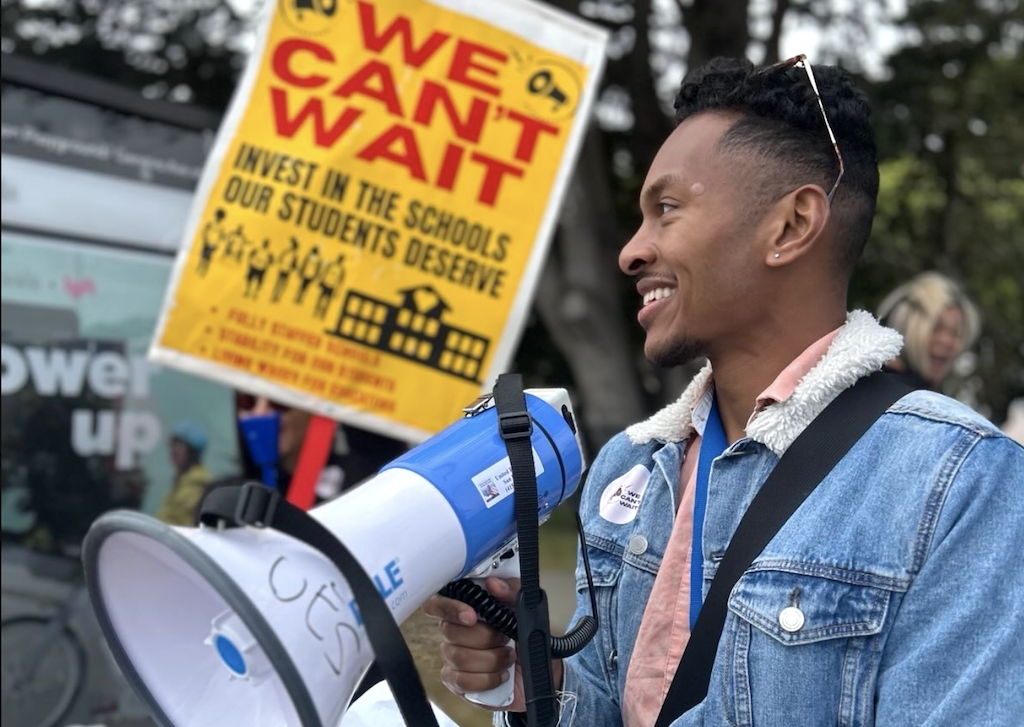
On February 9, over 6,000 K-12 teachers and paraprofessionals in the San Francisco Unified School District went on strike. (@UESF / X)

Interview by
Nick French

This winter has seen historic strikes hit the United States on both coasts. In New York City, 15,000 nurses across three of the city’s largest private sector hospital systems walked out on January 12 and stayed on the picket lines for about a month, making it the largest and longest nurses’ strike in the city’s history. Meanwhile, in California and Hawaii, 31,000 health care workers employed by Kaiser Permanente across the two states struck from January 26 to February 23 in what their union describes as the largest open-ended health care strike in US history.

But historic labor actions were not limited to the health care sector. In San Francisco, over 6,000 K-12 teachers and paraprofessionals in the San Francisco Unified School District (SFUSD) went on strike on February 9. The strike was the first for the district in almost fifty years; it ended with a tentative agreement between the district and the educators’ union, United Educators of San Francisco (UESF), on February 13.

UESF members voted to ratify the contract with a 92 percent “yes” vote at the end of the month. The union says the deal included major victories for workers on health care — getting the district to fully cover rapidly rising insurance costs — as well as pay increases, workload reductions for special education professionals, and the preservation and expansion of the school’s program to support unhoused students and their families. Jacobin’s Nick French recently sat down with three rank-and-file educator-leaders to talk about the strike and what they won.


Nick French

What are the main issues that led to the strike? And what was bargaining like such that educators decided to walk out?

Ryan Alias

This has been an eleven-month process. About 120 of us, as a bargaining team, have been putting together proposals that are in line with our members’ priorities. We started doing that almost a year ago, and then we were working to refine those.

Then we eventually started bargaining by presenting our proposals to the district. From there, we kept running into the district not listening to us and spending a lot of time striking through the things we presented to them. Throughout that process, we’ve been trying to communicate everything we possibly can to our members and families about what’s been happening at the table, and the inaction that we’ve been seeing from the district.

Akeylah Hernandez

Our priorities were really member-generated. At the very beginning of the process, we sent surveys to all of our members and we held interview sessions so we could get their stories. The surveys and those interviews gave us a qualitative and quantitative perspective on our members’ priorities.

That gave rise to our top five priorities. We had two very community-focused priorities. We wanted language in our contract that declares our schools sanctuary schools. And we wanted to ensure that the shelter programs we have currently to support our families continued and were enshrined in our contract.

Ryan Alias

Those are the programs for unhoused students and their families.

Akeylah Hernandez

It is pretty awesome that we have that; it came from our community and our educators working together. So we wanted to ensure it in our contract moving forward.

Our big priority, and one of our biggest wins, was getting health care paid for by the district, by our employer, particularly with a focus on our educator families. They were feeling the biggest impact of having to pay for dependents on their health care plans. For paraeducators like myself, if you had more than two dependents, it was an entire paycheck each month going to your health care.

We wanted equitable, living wages for educators. We have a lot of members with diverse salary ranges, so ensuring that we had equity around livable wages was a priority.

Finally, we were asking for support systems for special education educators to reduce the workload that impacts them. We wanted to create a system of relieving that workload so that educators could adequately support our special education students.

Nathalie Hrizi

Each contract struggle, in our view, has built on the last one. In the last contract negotiations, for 2023–25, the top issue was wages. We brought the floor for our hourly classified educators from $17 up to $30 an hour, and then they kept their stepwise pay increases. So some people experienced, in one contract struggle, an 80 percent raise.

We did the same thing with the pay for our certificated educators. And we loaded the bulk of the win onto the newest educators. So our newer educators are now making in the $70,000s when they start, instead of the upper $50,000s to lower $60,000s. By doing that, we felt we were addressing a critical issue for educators across the board.

But then, when we went back into the survey and interviews that Akeylah was talking about, what we were hearing was that for folks with one or two dependents, the raise had been almost nonexistent, because over the last three years, the increasing cost of health care had been eating up the raises. In January, my pay dropped because the health care costs had eaten up so much of the raise; the wage I got in January was actually lower than what I got in December.

So that became the issue in addition to special education, which is the only place where we had teacher vacancies this year.

Ryan Alias

Regarding the health care costs, my wife and I are both teachers in the district. It costs $1,500 every month for us and our two kids for health care. And health care costs just kept getting higher and higher.

We realized that this is one of the things that is keeping educators from living in the city and putting down roots. They have families and want to stay in the communities that depend on them, but they simply can’t afford to. And there are districts all over the Bay Area that provide free health care or incredibly subsidized health care.

That was something that was not only widely felt but also deeply felt by many of our members. And it became something that the city really adopted and cared about, and they backed us on the line for it.

Akeylah Hernandez

One of our biggest rallying cries throughout this contract negotiation was about bringing stability to our school district. Those vacancies that Nathalie mentioned earlier are a huge part of it.

On turnover, one of the stats that stuck out to me the most from our fact-finding report, which concluded that roughly 50 percent of our members had been hired in just the last five years. That includes me. That is not a stable school district when half of the people working in your classrooms supporting students are new, hired within the last five years. That doesn’t even capture the people who were hired within the last five years who have already left; it just captures the people who ended up staying.

Nathalie Hrizi

The special education proposal was the hardest to explain to community members. The educators who are in special education, and the students and families who are receiving special education services, understand the issues: how the turnover is affecting them and how the heavy reliance on outside contractors is affecting them. Students are getting speech services on Zoom with someone who’s in Hawaii, but they could be hiring a speech and language pathologist right here who could meet with them every week.

That was one of our tasks over the last year, to center that fight — not because everyone understood it or knew the ins and outs of it, but because it was so important to the stability of our schools. If we don’t get special education right, general education won’t be right. The students receiving special education services are in all our classes; the stability of that program affects the stability of the schools. So while it’s a little harder to grasp than health care, it was very important to us that we center this particular issue.

We ended up with the move toward what we call a “workload model” in our contract. In special education, educators have historically been assigned caseloads based on a number of students for whom they manage cases. Each case could require vastly different amounts of work for assessing, managing, and providing services.

The workload model moderates the caseload assignments by taking workload (assessment, services, and so on) into account. So students who require larger workloads are weighted more, which can reduce the overall caseload (the number of students whose cases are being managed by an educator). We also got additional time for special education educators to do their work.

That was huge — the district fought us tooth and nail on that. If you’re in special education, you are doing a set of paperwork and a set of assessments and a set of work that no educator in general education is doing. We have folks who have been in special education for twenty years who said, “I can’t do it anymore. I’m going to go into the general ed classroom, and I won’t do this thing that I’ve been specialized to do and that I have training and experience for.”

Nick French

You all have already spoken to how members were kept involved, especially in terms of formulating contract demands. Is there anything else you wanted to mention about the organizing that laid the groundwork for the strike, in terms of your coworkers but also the broader community? What did it look like to build community support?

Nathalie Hrizi

We were forced into striking. We never knew what was going to happen until the week before it happened. We would have been just as happy having settled with strong agreements in April, which the district could have done. This was a decision on the part of our bosses to put us in a situation where we had no choice but to do this.

At the same time, it was our view five years ago that to make the substantive changes we needed to make, we would have to be ready to strike. That doesn’t mean we wanted to or had to ― it means we had to be ready to. Because it’s not something you get ready for in a week.

So it has been a multiyear project of changing the way we interact with the membership of UESF at every single level. The central level is the site structures — the members at the school sites who are elected to take leadership in organizing their sites were key. We could not have been ready to do this without what we’d done over the last five years to engage those structures.

Part of that was the big bargaining team. There’s a difference between having fifteen people arguing about contract language versus 120 people who can go right back to their sites and say, “You should have seen what happened last night.” In the last contract fight, we built the biggest bargaining team we’d ever built in UESF, which was sixty-five people. When we went up to 120 people this time, I think people thought we were a little bit nuts. But that worked out really well for us.

That connection to the sites from the elected leadership was critically important for doing what we did in regard to the community piece over the last five years. We have tried to find ways to authentically engage with our communities and not just provide leadership but take leadership knowledge from them. On the fight around housing and the fight around immigrant rights, we are in partnership with organizations that are leading the fight from their experience, and that really gave us guidance around how to carry out this fight and what the ultimate goal is.

What we won on housing is not where we want to be. The stay-over program is a beautiful program, one of its kind — it offers unhoused students and their families a safe, warm place to sleep when school is not in session. But it’s a stopgap for a much larger issue. Our educators and our families need actual housing. If you look at our initial proposal, we had ways to get us to that housing, and we’re going to keep fighting for that. What we did get was protection of this existing program that does a lot, but it doesn’t do enough.

On the fourth day of the strike, at Embarcadero Plaza, this mom, Roxana, gave testimony, and it was incredible. The leadership came from her and the other moms, and it was a very collaborative relationship rather than a transactional one. That was the foundation for what happened in the strike: One, the community agreed with the demands. They were willing to give up time for their kids and be out there with us because they cared so much. Two, they had seen us already in the places we needed to be. We accompany immigrant families to the courthouse, so they know we’re there. We’re at the stay-over program. We created it — that was our social workers, not the district, who created that program, so they can see us in the fight with them.

Ryan Alias

As a bargaining team rep at my high school, Balboa, and working with communications, the thing that I kept in mind, and that I know many of us kept in mind, was the importance of patient preparation and transparency throughout the process. This is not something that we turn on a dime for.

As a union, we chose to make becoming strike-ready part of the process of how we organize. Part of that is being as transparent as we possibly can be about everything that is happening at the table, every single night we bargain — even if we are just passing a proposal to the district, and the district is just crossing everything out. Our communications team was trying to put together the clearest and most easily accessible version of events so that every member at every site could, with a couple clicks or by going to a quick meeting, hear exactly what happened that night.

When it comes to the community — for our members, going on strike is a scary thing. It is an act of trust. It was humbling for me as a parent and an educator to see the city and the family members support our union members. They were out in the streets in numbers that got bigger every single day we were out on strike. You can see some photos of Market Street being locked down with over 20,000 people. That includes people who don’t have kids or who don’t have students in SFUSD. But also, we had parents and children and everybody else out supporting us.

There was this district narrative that there was a loss of learning happening during the strike. But for my kids and for every SFUSD student out there, this was absolutely a week of education. We learned that the working class is powerful and that our voices are stronger when we lift them together. We learned that we may have different needs and be in different situations, but when we look at each other with the idea that an injury to you is an injury to me, we are strong and we can make real change in one of the wealthiest cities in the world.

So I want to push back on this idea that there was lost learning, because this was a week of education for our members, our families, and our students. And the district learned too. . . .

Akeylah Hernandez

I actually joined the bargaining team my first week of work in SFUSD. So I approached it keeping in mind that I’m very new and that I wanted to learn a lot. There are a lot of longtime teachers and educators at my site who have been in the district for decades. I came to them and I said, “I want to listen to you, and I want to bring what you know and what you are an expert on back into bargaining, and I will do that with everything in me.”

That was the way that I approached organizing at my site level. A lot of the time people would come to me with issues unrelated to what was going on with bargaining. I mean, it’s all related, but it wasn’t something I’m bringing back to the bargaining team to be like, “We need to really go hard on this proposal.” It was about something else regarding our working conditions or the way our school site operates. I found that the more I was holding this space for organizing around our contract, the more I was connecting with people in a deeper way and gaining their trust. The trust-building on our site level was fundamental to the way we won these victories.

Nick French

We’ve already spoken some about what the union won. Are there other victories you want to emphasize?

Nathalie Hrizi

There are multiple victories here. One of them was getting a 5 percent pay increase for certificated employees [salaried educators who hold a Department of Education license that is required for their role] and an 8.5 percent wage increase for classified employees [student-facing educational support professionals, who are paid hourly], along with an additional floating holiday, which is equal to about a 1 percent raise. That gives our classified workers some relief over the longer periods where they don’t have work. That, along with fully employer-covered health benefits; there will be some relief this year, and then starting in January 2027, it will be covered in perpetuity.

We achieved sanctuary-school language and the protection of the stay-over program for our unhoused families as well as a joint commitment to supporting unhoused families. We won the special education compliance period, which essentially gives more time for our special educators to invest in their work to meet the needs of students, as well as a workload model.

We had other wins too. We got a committee to look into paraeducator retirement — they have no retirement benefits right now. We got protections against artificial intelligence and contracting out. The district tried to gut our substitute proposal, and we protected them and got them a raise and cancellation pay.

The wins are great. But the bigger win, in my view, is the transformation we experienced in our city. Educator strikes are fundamentally political strikes. We don’t sit at the point of production; we don’t sit at the point of distribution, like when the Teamsters go on strike. That’s a totally different thing: you’re hitting the bosses right in their pockets.

One way of looking at it is that an educator strike could be disruptive to our community. We don’t think it was. But it’s also a political act. In taking this act on the basis of the right demands, we forced the political structure of the city, the leadership of the city, into a contradiction that they then had to overcome.

To me, that was a huge victory. This city feels different right now than it’s felt in twenty years. Everyone supported this strike. The first day, if you looked at who was honking for the pickets, it was union cars — it was your Toyotas and your trucks. By the fourth day, the BMWs and Mercedeses and Teslas were getting in on it too. The popularity of successful collective action was transformative for our city.

I would say it builds on what we’ve seen across the nation, like the Minneapolis walkout on January 30 — a confrontation with the billionaire agenda at the highest level — was recreated here. The mayor, a billionaire Levi Strauss heir who talks a good game about affordability, didn’t know what to do with us. We forced him to acknowledge the power of collective action. There are three union contracts coming up for the city itself, and the question of collective action in San Francisco is now on the table in a way it hasn’t been since, I would say, the ’70s, or even the general strike of 1934.

Ryan Alias

In my experience, it does not often feel like San Francisco is a city for working-class people. It feels like it is a city that uses labor. And then, eventually that labor needs to leave because they cannot afford it; it’s a revolving door.

This week was one of the most empowering things for working-class people that I’ve felt in my life. The contract wins, the line items are important — health care and the workload model and all those things. But they’re all folded into generalized stability for this district, which was our main focus: we want to stabilize the district for working-class people, for their families, for our students, so that they can feel like they are a part of this city, not just being used by this city.

It is something that I feel other unions can look at, seeing what was possible. We wanted health care — the district told us that was impossible for almost a year. And that is something that we get to hand off to future educators fifteen, twenty years down the line. This is a win for working-class people who we will never meet.

Nick French

Anything else?

Nathalie Hrizi

We have to acknowledge that we are part of the We Can’t Wait campaign, a coordinated effort of more than thirty locals up and down the state. The United Teachers of Richmond in California’s East Bay went out on strike for the first time in their history in December 2025. They won health care; they won protections for international teachers; they won special education. And we followed.

The local unions participating in We Can’t Wait have aligned our contract end dates; we are bargaining individually but coordinating a campaign to establish standards in key areas across California. We feel very proud to have done what we could to contribute to those standards, standards all students and educators should enjoy across the state. The other locals in the We Can’t Wait campaign are all on track to do that. San Diego educators won their agreement. They did not go on strike; they didn’t have to. But they won an agreement that they’re proud of. The other locals are all working in the same way.

The next battle is the state. The state government has to fully fund public education in the way that it needs to be funded, and so does the federal government. We’re not stopping here.

Share this article

Contributors

Ryan Alias is an English teacher at Balboa High School in the San Francisco Unified School District (SFUSD) and an SFUSD parent.

Akeylah Hernandez is a special education paraeducator at E. R. Taylor Elementary School in the San Francisco Unified School District (SFUSD) and an SFUSD alum.

Nathalie Hrizi is the United Educators of San Francisco vice president of substitutes and a San Francisco Unified School District (SFUSD) parent.

Nick French is an associate editor at Jacobin.

Filed Under