An Oscar Night of Sentimentality and Amnesia

At a time of profound unrest and the launch of an insane new war, Hollywood stuck to its “keep politics out” mandate.

Oscar winners Jessie Buckley and Michael B. Jordan at the 98th Academy Awards. (Gilbert Flores / Penske Media via Getty Images)

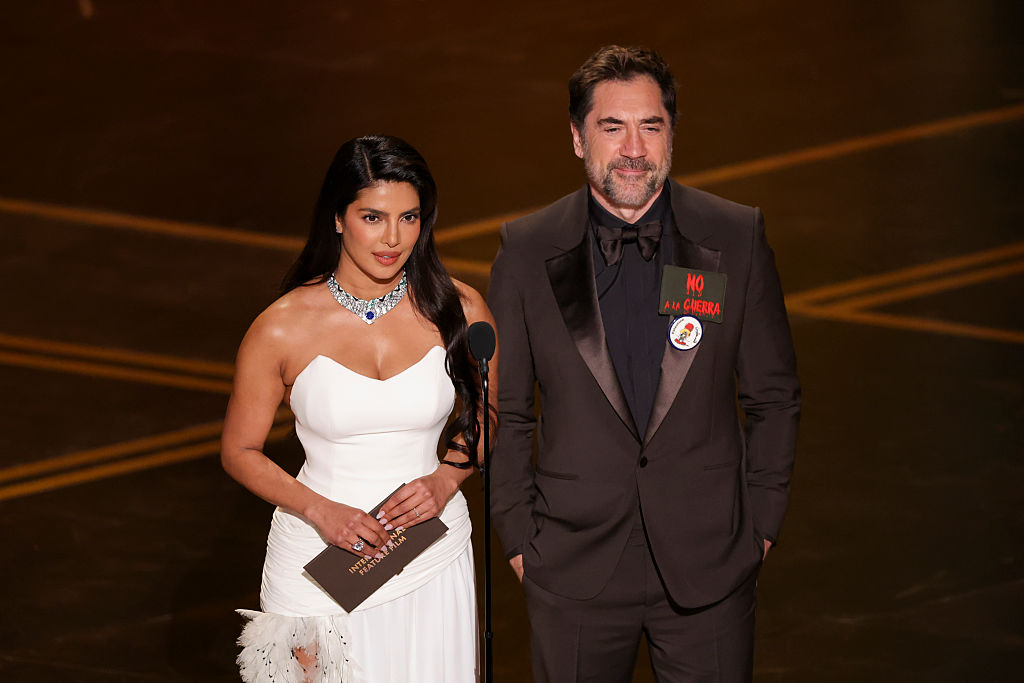
“No to war and free Palestine,” said Spanish actor and Oscar presenter Javier Bardem, who’s a mensch and a lefty stalwart. He got a big cheer from the audience at the 98th Academy Awards ceremony last night, probably because it was a relief to hear the most direct political statement of the evening.

And quite a mid evening it was. Mostly predictable Oscar wins, including the pleasing ones — Paul Thomas Anderson for Best Director; One Battle After Another for Best Picture; Jessie Buckley for Best Actress; Michael B. Jordan for Best Actor — and the disheartening ones, such as Sean Penn winning Best Supporting Actor over both Delroy Lindo and Benicio del Toro, and then the bastard wasn’t even there to collect. And don’t even get me started on Park Chan-wook’s No Other Choice not even being nominated for Best International Film, when it was a far greater cinematic achievement than the winner of the award, Norway’s Sentimental Value, and almost everything else getting honored this year.

There were some amusing gags from returning host Conan O’Brien, who started strong wearing Amy Madigan’s monstrous hair and makeup from the horror movie Weapons. “I look like Bette Davis with lupus!” he shrilled, getting in an astute comical nod to a major figure of Hollywood history before racing out chased by gleefully murderous children and finding himself edited into other Oscar nominated films, such as solemn Scandinavian exchanges with Stellan Skarsgård in Sentimental Value (“I learned Norwegian for this!”). Though, as usual, some jokes died in pained silence, especially the bum-drum bit referring to Timothée Chalamet’s spanking in Marty Supreme.

The carefully done “In Memorium” sequence was more effective than usual, especially Billy Crystal’s extensive tribute to the late Rob Reiner. Though there were several technical mishaps in the telecast, including apparently drunken camerawork throughout and problems with sound that made inaudible the first half of Barbra Streisand’s tribute to the late Robert Redford and their one costarring effort together, The Way We Were (1973).

It seemed a little odd to see such a fervent tribute to this glossy weeper of a film, which is notorious for having been eviscerated of its left-wing political stance in the editing process, under orders from timorous Columbia Pictures executives. Redford was supposed to be playing a successful Hollywood screenwriter who knuckles under to the House Un-American Activities Committee (HUAC) in the 1950s in order to avoid being blacklisted, betraying his colleagues to save his own career, which is what ultimately ends his marriage to Streisand’s character. She played an impassioned leftist political organizer who becomes a liability to him in McCarthy Era Hollywood, but good luck getting that out of watching The Way We Were.

Streisand wrote extensively and indignantly about it in her vast and detailed 2023 autobiography My Name is Barbra. Yet there she was, praising Redford for objecting to the way the character he was being asked to play “had no backbone.” Damn straight the character had no backbone — that was supposed to be the point of the film. But it’s the Academy Awards, so there was Streisand waxing maudlin about it and singing the lugubrious crescendo from the title song, which won the Academy Award for Best Original Song in 1974. Not a dry eye in the house, I’m sure.

That’s Hollywood for you — the sentimentality as well as the amnesia. And in keeping with such traditions, it was a mild-mannered evening, everyone behaving decorously at a time when decorum just seems. . . strange. If ever there was a time for people to lose their sense of propriety and rant about the madness we’re living in daily in the United States, this was the year. There were occasional appropriately heated remarks, but far too few. The winner of the Best Short Film Oscar for Mr Nobody Against Putin, for example, offered a warning that seemed appropriate for the occasion, specifying that the film is “about how you lose your country — through countless acts of complicity.”

Though it was also the Oscar telecast with the most aggressive tendency to play people off-stage, as in the nasty moment when one of the KPop Demon Hunters celebrants, about to speak after their Best Song win, was not only immediately drowned out by the orchestra, he was plunged into darkness while the camera soared backward and up to the rafters to make sure the viewing audience couldn’t see the KPop team’s reactions to such a pointless bit of cruelty.

But there were far more mordant bits on what’s happening to Hollywood in terms of threatening “new media,” which actually isn’t so new anymore. A bit about a corporation that “makes films very tall and skinny” in order to fit on cell phones, for example, seems like an ancient reference to the viewing habits of younger generations. YouTube is taking over the rights to broadcast the Academy Awards starting in 2027, which inspired a bit on the ads likely to interrupt the Oscars next year, featuring Jane Lynch hyping a product by bellowing, “This is the flashlight that killed bin Laden!”

A black-and-white skit featuring O’Brien as the lovelorn Rick in Casablanca, trading basic plot information with piano player Sam (played by Sterling K. Brown), so that young people who supposedly have no attention span could follow the film, had choice lines like, “She definitely contributed to my overall cynicism, this being World War II and all.”

In short, it was a typical Oscar night of recent years in most ways, everybody making nice and dressed in careful designer duds and murmuring occasional words of protest like Paul Thomas Anderson’s sad, muted remark when he won Best Picture for One Battle After Another: “I wrote this movie for my kids, for the housekeeping mess we left them with.”

The housekeeping mess!

No matter how jaded you are about the Academy Awards, and I thought I’d passed jaded a long time ago, this seems like a time when “typical” just doesn’t — or at any rate, shouldn’t — cut it. I think it was during the elaborate tribute to Bridesmaids, in honor of its fifteenth anniversary year (fifteen whole years since that fairly amusing comedy with women in it!) that I began to feel that, even for the Oscars, this represented a commitment to fatuousness that bordered on the sinister.