How Will the Future Judge Our Own Gilded Age?
At the end of the Gilded Age, Edwin Markham’s poem “The Man with the Hoe” became an ideological litmus test, polarizing the American public between an allegiance to either workers or the oligarchy in an age of massive inequality surpassed only by our own.
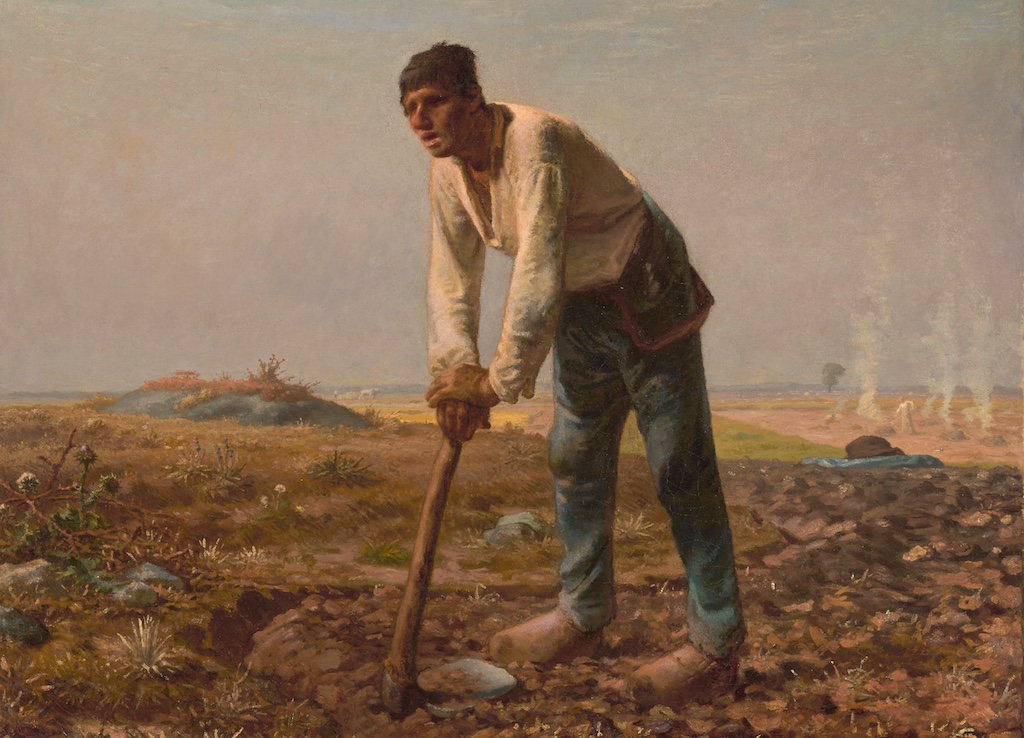
The Man with a Hoe by Jean-François Millet, 1860–62. (Heritage Art / Heritage Images via Getty Images)
Bowed by the weight of centuries he leans
Upon his hoe and gazes on the ground,
The emptiness of ages in his face,
And on his back the burden of the world.
So begins Edwin Markham’s lionized poem “The Man with the Hoe.” At the tail end of the Gilded Age and the dawn of the Progressive Era, Markham’s incisive critique of the gaping wealth inequality that came to define this period in American history was lauded as “the battle-cry of the next thousand years” and “the supreme poem of the century.” The poem contributed to a vigorous national dialogue — immortalized in the opinion and letter sections of newspapers across the country — on labor’s role in society and the potential for a socialist future.
Much like debates across social media today, however, not all the commentary was celebratory. Tensions between classes had reached such a zenith that they also provoked responses like this: “As a tiller of the soil, I resent personally every word of the ungrateful writer who smites in the face of the man who feeds him.”
The poem was inspired by a Jean-François Millet painting, L’homme à la houe (The Man with a Hoe), from which it takes its name. Its opening stanza describes the farmer’s stooped posture and vacant gaze as he takes a moment’s respite over a half-emptied clearing. The painting’s intimate and unembellished portrait of a man brutalized by life as a rural laborer — a life Millet knew firsthand, having worked on his father’s farm in Normandy — clashed with the artistic sensibilities of the era.
The bucolic works it debuted alongside at the Paris Salon in 1863 instead idealized rural life with manicured portrayals of its subjects. Adolphe Pierre Leleux’s A Breton Wedding and Jules Breton’s The Turkey Tender depicted rural workers as saintlike figures carrying out God’s will, a will that assumed the eternality of their place in society.
Decades after the French Revolution, the painting provoked revulsion, contempt, and fear among the elite of France, some of whom claimed that the stooped figure resembled the notorious serial killer Martin Dumollard, who targeted female domestic workers and was executed by guillotine in 1862 following a very public trial. One critic accused Millet of seeking out notoriety through “being interested in the ugly, heroizing the ugly, and making the ugly loved.” For the working class, however, The Man with a Hoe became a symbol of labor’s struggle.
It wasn’t until nearly four decades later that the painting’s subject — “a thing that grieves not and that never hopes, stolid and stunned, a brother to the ox” — was canonized in the United States through Markham’s poem. The growing availability of mass-produced art prints, owing to advancements in print technology like lithography, made paintings like Millet’s, and in turn its themes, increasingly accessible for working people. “The painting really becomes, through the poem, an ideological litmus test, depending on where you stood on capital versus labor,” Scott Allan, painting curator of the Getty Museum and editor of Reckoning with Millet’s “Man with a Hoe,” 1863–1900, told Jacobin.
The Inequality of Markham’s America
Like Millet’s France, Markham’s America — much like ours — was defined by increasingly combustible class conflict. Rapid industrialization, the rise of monopolies, and urbanization created previously unprecedented fortunes for a small elite class, while many working people lived in poverty. By 1890, the wealthiest 1 percent of Americans controlled 51 percent of the nation’s wealth, and the bottom 44 percent held just 1.1 percent. John D. Rockefeller’s wealth alone represented roughly 1.5 percent of the entire GDP of the United States — approximately $447 billion in today’s dollars.
The same forces that made Rockefeller and the robber barons billions pushed Markham’s “Hoe Man” into the maw of poverty. Annual wages for rural farmworkers during the Gilded Age would have fallen somewhere around $300 to $500, or roughly $9,000 to $15,000 in today’s dollars. Sharecroppers or tenant farmers would have fared all the worse, trapped in cycles of debt to landowners. New technologies of the era, like the steel plow or mechanical reaper, would have been financially inaccessible to Markham’s subject. Without equipment, long days spent clearing fields with only rudimentary tools were the norm. Exploitative rail rates for transporting produce would have added to his burden, all while being forced into competition with wealthier farmers who could afford the advantages of the industrial revolution.
An industrial worker might have fared better than the average farmworker, but chances are he would still be living below the poverty line. Depending on the region, annual earnings would have been approximately $9,000 to $19,000 today. He, too, would have found himself working long hours under hazardous conditions for little recompense.
Though apologists for the robber barons and ownership class took issue with Markham’s phrase “slave of the wheel of labor,” it seems an apt descriptor of the situation. Organized labor in Markham’s day responded to social inequities and the increasing ubiquity of wage labor with unions, strikes, and boycotts. (Not unrelated, voter participation, particularly among immigrants, was also high, to the concern of elites.) Between 1881 and 1900, there were nearly 23,000 strikes involving close to 4.7 million workers. In 1899, the year of the poem’s publication, almost 432,000 workers were involved in labor disputes (strikes and lockouts) nationwide.
These strikes often turned violent, as in the Great Railroad Strike of 1877 and the Pullman Strike of 1894. And they weren’t the only bloody conflicts. The Haymarket massacre of 1886 began as a demonstration in support of the eight-hour workday; the Thibodaux Massacre of 1887 followed a strike led by black sugarcane workers; the Homestead massacre of 1892 was caused by Pinkerton agents hired to break a strike at Carnegie Steel; and the Lattimer Massacre of 1897 occurred after sheriff’s deputies fired on striking immigrant coal miners.
When Markham’s poem was published in the San Francisco Examiner on January 15, 1899, national reception was swift — and intensely polarizing.
The Forgotten Debate on Labor, Left Politics, and Markham’s “Hoe Man”
Papers across the country quickly reprinted “The Man with the Hoe,” often alongside reproductions of Millet’s painting. Ads parodied the poem (like one for Minnesota Valley Canning Company canned corn depicting their Jolly Green Giant tending his crop while dressed as the “Hoe Man”); school children staged tableau vivants, or static scenes, while dressed and posed as the farmworker in Millet’s painting (and yes, those were stories worthy of print); special sermons focused not on scripture but Markham’s poem (one Rev. R. A. Holland of St Louis gave a particularly memorable series of sermons in which he accused Markham of being not “the poetic champion of the laboring man, the prophet of the masses,” but rather “an anti-Christ, who would lead the man with the hoe, who typifies labor, through communism and ruin and destruction”); and, crucially, letters to the editor flooded newspapers, which published pieces dissecting every angle of the poem’s cultural and ideological impact. Before long, “Man with the Hoe” and “Hoe Man” became synonymous with “worker” and “working people.”
The San Francisco Examiner, recently gifted to William Randolph Hearst by his father, Senator George Hearst, ran wild with all things Markham and “The Man with the Hoe.” A deluge of opinion letters lent themselves to the sensationalist style of yellow journalism. For months, the “Letters from the People” column featured almost exclusively criticism and celebration of the poem.
“Edwin Markham is yielding more influence than Henry George, and the first we know I will have only more taxes to pay,” read one 1899 letter in the San Francisco Examiner. “There must be a great truth in Mr. Markham’s lines else they would not so strongly appeal to our feeling and move us as they do,” read another. “It is not a great poem; if it lives at all, it will be as an example of the curiously perverted views of human life prevailing in this era of ignorance,” read still another. “The poem should act as stimulus to the development of a social conscience, a sense that there are others; to the realization of the worth of the original man.” And, “It is a remarkable production in many respects, but in nothing so much as its absolute untruthfulness.”
In the print-based media era, these letters became a critical forum for public debate, essentially serving the same space that X does now. “No instrument can be so useful as the great daily newspaper which is open to receive and publish the views of those who think upon the subject,” wrote one reader. “No doubt in such discussion many erroneous theories may be advanced, but these can do no harm. Error must eventually go down before truth. Let the discussion then go on, for never could the subject be of greater or more vital interest.”
And go on it did! While some arguments were clear antecedents to the modern-day culture war, endowed with all the spirit of the sh-tposters who would follow, many more were representative of sincere debates on labor, socialism, and left politics as well as technology, religion, and human nature.
It Has Stirred Them Up!
“Let us start with a statement of the problem to be solved: Why is it that with the productive power of man so greatly increased by machinery, invention and science, poverty and want exist among those willing to work and capable of producing more than enough to satisfy their wants if they could find the opportunity?” asked one Cameron H. King. He went on to list, from “a reliable authority,” the number of individuals in the United States making above $10 million per year in 1898, before concluding, “Wherever there is private ownership of land and capital, wherever the competitive system of production and distribution exists, we find two classes, the very rich and the very poor.”
Like today, not everyone agreed that there was a problem to be solved. In one Sunday feature, “It Has Stirred Them Up: Letters on ‘The Man with the Hoe,’” a self-described “Hoe Man,” Thomas Nunan, apologizes to the owner class on behalf of those suggesting that the Hoe Man’s poverty might have something to do with them:
Bounteous nature has given to every man 200,000 acres of good, rich land. Some of it is in the moon, some of it on other planets, but the circumstances that we cannot get at it is not the fault of the rulers, landlords, and masters. Why should I blame the millionaire when he merely follows his instinct, and aids nature in her great and new evolutionary work — the production of millionaires instead of men? Let him stand on my neck.
Apparently, some of us have always liked punishment.
With unfortunate irony, Nunan admits, between laments of his own ruination by a dry season while “the holder of 200,000 acres” prospers, that “we don’t know much about Plato out here on the farm, as we were all forced by deliberately invited poverty to leave school rather early”; that the $200 interest on his mortgage “oppresses” him; and that he “had the chance to be what the millionaire farmer is” and his son “has an even chance with the millionaire’s son.” Nunan ends his letter by imploring readers to “not be in a hurry, for the process is necessarily slow” as “nature is patiently, yet surely, evolving us all from men into millionaires.” If only, Mr Nunan!
Other writers were rooted in a similar ideology. In The Rocky Mountain Husbandman (yes, really) — sandwiched between a piece titled “About Carpets,” which is exactly what it says it is, and generous, $25 bounties for the return of “estrayed” or “taken up” horses — Robert E. Jenkins writes a poem in Markham’s style defining the real “man with the hoe.”
This man with the hoe moves well in his place
With a good manly stride and smile on his face,
With strong, brawny arms his implement wields
Nor leans on his hoe to gaze ‘round o’er the fields.
Jenkins goes on to imagine the Hoe Man’s “comely young wife” with whom he has “six manly sons.” “The farmer’s boy leads,” he says. “Hard work made him strong” because “worth only to live is the strenuous life.” The last few stanzas offer an admonishment to those who would consider financial status when taking stock of one’s lot in life.
Man of the toilers whoever you be,
Your labor is patent of true dignity.
On the inherent “dignity of labor,” the predecessor to meritocracy, one letter states: “‘The dignity of labor’ is a modern catch-phrase coined to meet the emergency raised by the power of the ballot in the hands of the laborer. This is easily proved by the fact that those who prate most loudly of the nobility of toil are those who most persistently shun its honors.”
Apropos of nothing, railroad tycoon Collis Potter Huntington also registered a response — under the fantastic pseudonym “Responsibility.” Huntington derides the “younger sons of titled people” who “have been taught that common labor is beneath them” as “the real brothers to the ox,” who “have lost that true independence of soul that comes to him who dares to labor with his hands.”
In fact, Huntington was so disquieted by Markham’s provocation that he put out a call in the Sun for three poems, to be awarded cash prizes, that could answer “The Man with the Hoe” with a treatise on capital’s love for labor.
The paper received about a thousand poems, “only a small percentage . . . entitled to the careful consideration given to them all.” While we can’t say whether the poems resulting from Huntington’s cynical contest were as “lacking in poetic quality” as the Sun said, I can offer one memorable verse from the third-prize poem:
Work — let the anvils clang!
Work — let us sew the seam!
Let us bind the girth of the mighty earth
With the glory of our theme!
Meanwhile, Reverend Holland asked in the St Louis Dispatch, “Is the march of civilization to be halted because there are laggards at the rear of the column who cannot keep up?” He goes on to ask who will be at the helm when “whirlwinds of rebellion shake the world . . . after the silence of centuries,” as Markham suggests in his final stanza. “Not this idiot with the loosened jaw and slanting brow; not this fool who scars the face of the earth with his hoe,” writes Holland. “Idiots do not work revolutions.”
The Spirit of Twitter in the Victorian Era
More than letters written to be read once and forgotten, these called for a response in turn. In the March 11, 1899, edition, Jerome A. Anderson inspired quite a few readers to pen their thoughts when he wrote that Markham’s poem “is built upon entirely wrong conceptions of human life — of the relations between man and man, and between man and divinity. It appeals to class distinctions; it engenders and perpetuates human hatred and revengeful feelings.” One A. M. Goodnough likewise ruffled readers’ feathers with his commentary: “When Mr. Markham would show how low in the scale of morals and intelligence humanity can sink, he goes for his illustration, not to the saloon . . . but to the honest tiller of soil, forsooth! He makes an unseemly, unprovoked, and indecent assault upon the first, noblest, God-given calling of man — tiller of the earth.”
Dozens of responses to Anderson and Goodnough appear in subsequent editions, some like convoluted threads of a Twitter argument. “To the Editor of ‘The Examiner’ — Sir: Will you allow space for a friendly comment on Oliver Everett’s criticism of Jerome A. Anderson and A.M. Goodnough?” opened one. In “Another Word for the Man,” C. E. Hawkes rebuts, “J.A. Anderson’s position is the same as has been held by ‘the church’ for centuries, which has done more to embrute ‘the man with the hoe’ than any other one force of latter-day civilization.” He goes on to say that Anderson’s belief that the “downtrodden, the meek and lowly” will be rewarded in the afterlife is a tool to “quiet the rebellious spirit of the exploited masses with glittering promises of bliss in that fair land beyond the skies.”
And of Goodnough, he says, “I am sure if he handles his hoe as awkwardly as he does his brains he would make a poor hand at farming.”
Goodnough responded once more to say, “The work-people of the world have real troubles, trials, and oppressions enough” without needing to borrow imaginary “horrible shapes of evil, ‘dumb terrors’ and frightful hobgoblins, from the storehouse” of the “fevered brain” of a poet, adding, “I have no taste for the theories of the anarchist, however well sugar-coated, or for any form of socialism which leans toward anarchy, however eloquently its claims may be presented.” He concludes that Markham has a “bad case of ‘wheels in the head’” (the phrase comes from the nineteenth-century German philosopher Max Stirner, a criticism of those fruitlessly consumed with ideology and dogmatic beliefs).
One of Markham’s most vocal critics was his close friend and fellow poet Ambrose Bierce, who once derisively referred to Markham as “Poet of the People.”
Shortly after the poem’s publication, in a private letter to Markham, Bierce asks, “Must you cry and kick because the sun isn’t cooking your mud pie fast enough? Is it nothing that we all were once reptiles?” By the next correspondence, Bierce took an increasingly agitated tone. “I . . . believe you are preaching . . . a doctrine of hate which has successfully appealed to the worst side of human nature. . . . I hope you will no longer dwell in the tents of the demagogue.” Markham replied within days, saying “I wish to arouse but one hatred — the hatred of injustice.”
Bierce’s rebuke would spill out onto the public pages of the San Francisco Examiner, where he wrote, in June 1899, “The charming poet has become a demagogue, a ‘labor leader’ spreading that gospel of hate known as ‘industrial brother-hood.’” Taking quite the jab at his friend, he declares, “If any two words stand for ‘class hatred’ for blind, brutal, reasonless animosity, all the more mischievous because lodged in the heart and brain of a great poet, those words are ‘Edwin Markham.’” Their friendship was over after that one.
The “Poet of the People” Responds
On February 22, 1900, a little over a year after the publication of “The Man with the Hoe,” Markham himself responded to the fervent debate his poem ignited in the pages of the Independent. “Edwin Markham: The Man with the Hoe Stands with the Oppression of Labor,” read the headline.
“Some thousands of my countrymen have been good enough to point out in public prints during the past year certain ‘misrepresentations of labor’ in my ‘Man with the Hoe,’ and after having read for 12 months what these critics say I meant to say in the poem it seems to me that I may be allowed to express my own opinion on this and some kindred matters.”
Markham tells the story of his first encounter with Millet’s The Man with a Hoe:
I soon realized that Millet put before us no chance toiler, no mere man of the fields. No; this stunned and stolid peasant is the type of industrial oppression in all lands and in all labors. He might be a man with a needle in a New York sweatshop, a man with a pick in a West Virginia coal mine, a man with a hod in a London alley, a man with a spade on the banks of the Zuyder Zee. The human is the symbol of betrayed humanity, the toiler ground down through ages of oppression, through ages of social injustice. He is the man pushed back and shrunken up by the special privileges conferred upon the few.
He goes on to express a sentiment that still resonates deeply 125 years later.
The human is the effigy of a man, a being with no outlet to his life, no uplift to his soul — a being with no time to rest, no time to think, no time to pray, no time for the mighty hopes that make us men. His battle has not been confined to his own life; it extends backward in grim and shadowy outline through his long train of ancestry. He was seen of old among the brickmakers of Egypt, among the millions who lifted wearily the walls of Ilium, who carved the pillars of Karaak and paved the Appian Way. He is seen to-day among the stooped, silent toilers who build London and beautify her tombs and palaces. Do I need to say that the hoe poem is not a protest against labor? No; it is my soul’s word against the degradation of labor, the oppression of man by man.
“The Battle-Cry of the Next Thousand Years”
Since 1980, wealth inequality has risen to heights not seen since Markham’s America. As of 2026, the elite 1 percent controls nearly a third of the nation’s wealth, while the top 10 percent hold approximately 67 percent. The bottom half barely holds 2.5 percent. Twenty-first-century robber baron Elon Musk has surpassed Rockefeller with a net worth of approximately $850 billion — representing near 3 percent of total US GDP, double that of Rockefeller.
For all the changes in industry and the economy, the concentration of wealth in the hands of a few, while the many struggle, has remained unchanged. Labor historian Steve Fraser has aptly declared our own period the Second Gilded Age. However, contemporary workers’ response has not been the mass labor organizing seen in Markham’s time. Rather, growing wealth inequality has coincided with labor’s waning, and its legacy of collective power is under open attack.
In the final stanza of his poem, Markham asks how future generations — how we — will look upon the enduring brutalization of working people by and in service of capital.
O masters, lords and rulers in all lands,
How will the Future reckon with this Man?
How answer his brute question in that hour
When whirlwinds of rebellion shake the world?
How will it be with kingdoms and with kings —
With those who shaped him to the thing he is —
When this dumb Terror shall reply to God
After the silence of the centuries?
The final word of “The Man with the Hoe” has yet to be written. Will we remain the “stooped, silent toilers” buckled in for centuries of silence? Or is this the Future that will give Markham his answer?