Big Tech Oversees Itself at Homeland Security

Kristi Noem, just fired from her job as secretary of DHS amid allegations of self-dealing, staffed the department’s AI division with leadership taken directly from a tech company under contract with DHS to develop its biometric surveillance system.
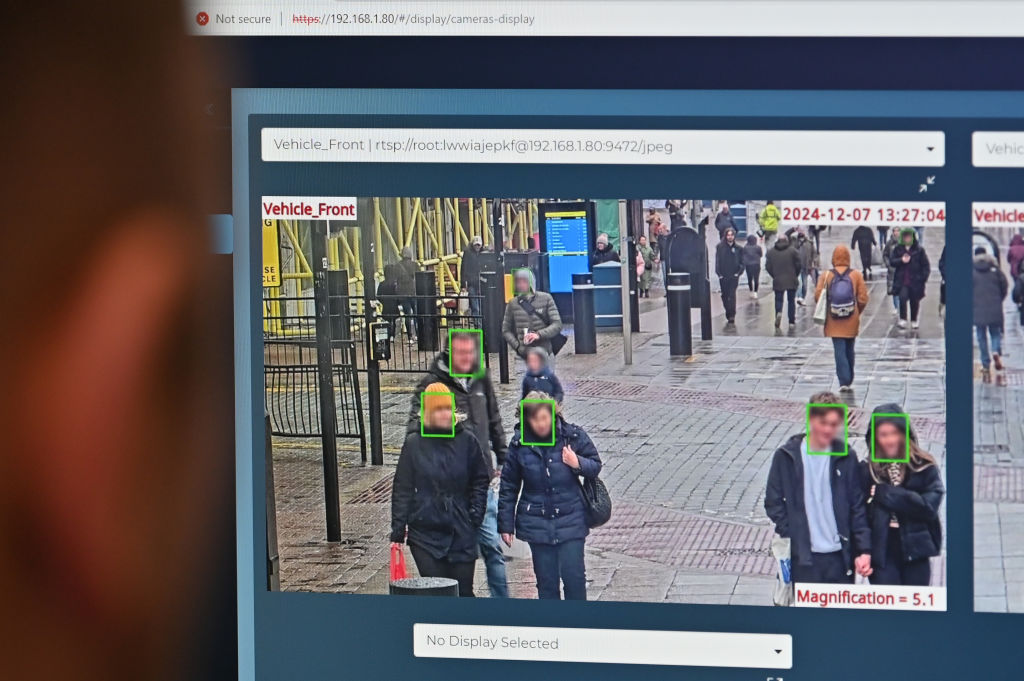
The Department of Homeland Security is building a massive AI-driven biometric surveillance apparatus, headed by a former employee of major contractor Anduril. Yet again, cartoonish Trumpian corruption is proving highly lucrative for the tech industry. (John Keeble / Getty Images)

The official charged with overseeing the Department of Homeland Security’s artificial intelligence operations and massive surveillance dragnet came to the job from Anduril Industries, a powerful military AI contractor that could benefit from the reconnaissance build-out his office is overseeing, according to an ethics disclosure reviewed by the Lever.

The official joined the Department of Homeland Security while the agency was led by Kristi Noem, who was just fired amid allegations of self-dealing.

The Department of Homeland Security appointed Antoine McCord in March 2025 as the agency’s chief information officer and chief artificial intelligence officer. McCord also leads the Office of Biometric Identity Management, a Homeland Security operation that oversees hundreds of millions of biometric records like fingerprints and face scans of immigrants and citizens alike.

The disclosure revealing McCord’s work for the company was made public on Thursday by ProPublica, part of a trove of thousands of ethics documents from the Trump administration obtained and published by the news organization. McCord’s work at Anduril has not previously been reported.

The biometrics office has been a focus of the Trump administration as it attempts to build out a biometric surveillance dragnet under Customs and Border Protection, an arm of the Department of Homeland Security. The most recent plans for the program would require border agents to scan the faces of all immigrants and visitors entering or leaving the United States.

Anduril is already swimming in taxpayer funding; within six months of McCord leaving the company, it received a $363 million expansion of the vast network of surveillance towers and sensors along the southern border that it operates. The company is considered a likely beneficiary of Homeland Security’s expanded biometrics program, given its border surveillance work.

While Anduril’s border-security tech has traditionally not involved biometrics, the company has been toying with the idea for years. Most recently, the company has been developing “immersive combat wearables,” like its AI-powered battle helmet EagleEye, equipped with biometric sensors. Anduril is also actively hiring tech workers with experience in “biometric authentication systems.”

The company also offers AI and data analytics for the defense industry — offerings directly under McCord’s purview as AI officer and information officer.

When McCord was appointed, the Department of Homeland Security was tight-lipped about his background. In his biography, the agency noted only that he had “contributed to the private sector,” in addition to his intelligence work for the US Marine Corps.

In fact, McCord worked for nearly three years at Anduril, joining the firm in August 2022 and departing days before his March 2025 appointment. He described his role at the company as “insider threat and counterintelligence” on his ethics disclosure. When he left the company, he held between $250,000 and $500,000 in Anduril stock and was receiving an annual salary of $499,793.

McCord still holds stock in the company, according to his disclosure.

McCord did not return a request for comment from the Lever, nor did the Department of Homeland Security.

Jeff Hauser, executive director of the Revolving Door Project, an organization that tracks conflicts of interest in the federal government, wrote in an email to the Lever that the exclusion of Anduril from McCord’s public résumé is concerning.

“Ordinarily, being tied to a prominent firm is presumably something someone would brag on,” Hauser said. “Unless they had something to hide.”

Anduril is a weapons manufacturer and surveillance technology giant.  The company has worked closely with the Pentagon, for which it has won quarter-billion-dollar deals providing drones and missiles to the US military. Its founder, Palmer Luckey, is a Donald Trump ally and longtime donor, which once tarnished his reputation in Silicon Valley.

The company also has significant business with the Department of Homeland Security. Over the last six years, Anduril has been deploying its autonomous surveillance towers along the southern border for Customs and Border Protection, work that has proved a major moneymaker, bringing at least $450 million in revenue for the company since 2020. The towers now cover 30 percent of the southern border, the company has claimed.

Anduril was cofounded by alums of Palantir, another tech giant deeply enmeshed in the Department of Homeland Security’s surveillance work. In December, Palantir and Anduril announced an AI and data analytics partnership in an attempt to offer their services collaboratively to the Department of Defense and other federal agencies.

The partnership is an effort “to ensure that the US government leads the world in artificial intelligence,” the companies announced.

In McCord’s role as chief AI officer at the Department of Homeland Security, he is tasked with promoting “AI innovation and responsible use within the department,” a mission that appears to directly align with the federal contracts Anduril is hoping to secure.

In 2024, an equivalent office at the Department of Defense, the Chief Digital and AI Office, awarded Anduril a three-year $100 million contract for its data processing and AI technology, a platform called Lattice.