For Migrant Workers in Spain, Gender-Based Violence Is Rife

Domestic work in Spain is often a low-paid job done by migrant women. A new study shows that half of them are subject to gender-based violence, harassed by their employers.
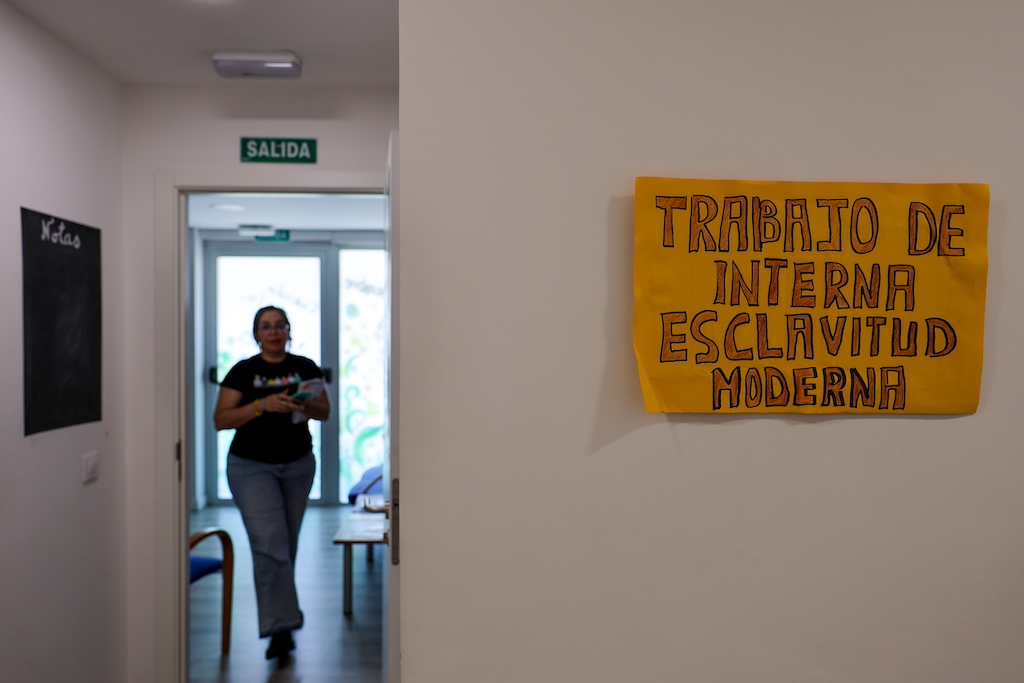
Data and testimonies collected reveal a hidden trauma of gender-based violence behind closed doors, where victims remain silent, afraid for their future. (Courtesy of Leah Pattem)

Aged eighteen, just three months after giving birth to her second child, Dalisay emigrated to Spain. Leaving her daughters in the care of her sister in the Philippines, she started a job as a live-in domestic worker in Madrid, sending money home each month. Not long after moving into her employer’s family address, the husband began an unusual routine. “He would wait until his wife was away on a business trip and then walk around the house naked,” she recalls, scrunching a tissue in her hand. Dalisay felt uncomfortable about her employer’s behavior but hadn’t yet recognized it as gender-based violence. “I was scared and I knew I had to get out of that situation,” she says, dabbing her tears. “If I hadn’t, I think something much worse could have happened.”

Teresa, sixty-four, a qualified English teacher from the Philippines, has been employed as a domestic worker in Madrid for three decades. In one job, she was repeatedly exposed to her employer’s genitals, in his home. “The first time it happened, I was very frightened,” she recalls. “I dropped my basket of laundry and ran away, I left the house. I didn’t know what to do. It was a very scary time.” But when asked if she considers this as gender-based violence, she shakes her head — initially not believing it was.

Teresa and Dalisay didn’t consent to seeing this. Yet both wrestled with these ex-employers’ right to be naked in their own homes, where public-private boundaries are blurred. What they experienced could be defined less as nudity than exhibitionism: a compulsion to behave sexually or expose one’s genitals in public. If this happened in their own homes, this was also someone else’s workplace.

Over the past nine months, including through fifty in-person interviews, 106 female migrant domestic workers across Spain have shared experiences of gender-based violence in the workplace. Half of the women surveyed reported such acts, ranging from verbal abuse to rape — yet none of them filed a police report. Data and testimonies collected during this investigation reveal a hidden trauma of gender-based violence behind closed doors, where victims remain silent, afraid for their — and their family’s — future.

Sixteen domestic workers cited fears of losing their jobs as the reason they didn’t go to the police. Four mentioned fear of the police themselves. Three cited fear of deportation, while others expressed a combination of concern about shame or stigma in the reporting process, worry that no one would believe them, and feeling that what happened to them was simply not important enough to report. Others cited lack of knowledge of how to make a report.

Tip of the Iceberg

The migrant women interviewed and surveyed live across Spain, in Madrid, Barcelona, Valencia, Galicia, Malaga, and other regions. They come from eighteen different countries — predominantly in Latin America and the Philippines — and their ages range from twenty to seventy-seven, with an average of forty-nine. Approximately four in ten were undocumented at the time. Half report being subjected to workplace gender-based violence within the last decade. It could be the tip of the iceberg.

Survey responses reveal a wide variation in how gender-based violence was perceived and recognized. Twenty-four women who reported physically violent assaults, such as rape or attempted rape, generally identified as victims or survivors. Yet participants who hadn’t experienced such overt violence often initially responded “no.”

In around half of the 106 cases, the survey was conducted as an in-person interview, allowing for the opportunity to draw closer attention to the examples of gender-based violence listed in the questionnaire (verbal gender-based insults, humiliation, coercive or controlling behavior, financial control, isolation, intimidation, or being forced to witness sexual acts). In interviews, responses were more frequently “yes,” indicating that with greater resources to interview more women, results could indicate a much deeper systemic problem.

One participant recounted an incident while she was ironing her employer’s clothes in the living room. She said he entered the room, switched the TV to pornography and told her she could stay if she wished. Another live-in worker described how her employers refused to give her a set of house keys, leaving her unable to leave the home at night while the family slept. She framed this as a minor inconvenience, as she was unable, for instance, to take out the bins at night. Yet this restriction could amount to a form of false imprisonment.

Another participant, Anna, recounted that her current employer commenting on her freshly painted nails. “She told me she must be paying me too much because she thinks I’m able to afford a professional manicure,” says Anna. “I corrected her, and told her I’d painted my nails myself a few days ago.” After hours spent scrubbing floors and bleaching bathrooms, Anna’s dark red nail polish is visibly chipped and peeling. “People think we’re supposed to look like victims,” she says, “I just want to look nice.”

While working for another employer, Anna also experienced what she believes is false imprisonment. She needed sick leave for essential surgery but said her former employer was reluctant to give her time off. “He wouldn’t let me leave the house unless I signed an agreement stating that I had ended the employment voluntarily, which could have meant I wasn’t entitled to benefits,” she says. Recognizing that her employer was escalating the situation and holding her in his home until she signed, Anna began secretly recording their conversation on her phone, which I was able to listen to. This recording later allowed her to negotiate with her employer directly and resolve the dispute. Like Anna, domestic workers are increasingly aware of their rights. But many still feel unempowered to act.

Highly Educated, Underpaid, and Overworked

Domestic work is called low-skilled labor — work that requires little to no specialized training to perform. However, of the domestic workers surveyed, 42 percent have a university degree and 85 percent finished school. Four out of five earn less than €15,000 a year — below minimum wage for full-time work. Two-thirds lived in their employers’ homes, and three-quarters worked five or more days a week.

Taken together, this data reveals a workforce that is highly educated, overworked and poorly paid, often undocumented, and often living in the employer’s home. Many testimonies also highlight workers’ responsibilities to support children back home. Three-quarters of survey participants had one or more children, like Daniela, who arrived in Madrid from El Salvador around ten years ago.

Daniela trained as a lawyer in her country but lived in a gang-controlled area where extortion payments were so high that she realized she could earn more by moving to Spain and sending money home. While working toward legal status and the hope of eventually bringing her children to join her, she took a job as a live-in domestic worker. She says her employer soon began harassing her.

“It started with comments, and then he began walking around the house naked,” Daniela says. “I grew worried that one day he might try and rape me, so I started wearing a second pair of trousers under my uniform. I thought that, if he ever tried to take them off, it would take longer and, during that time, maybe I could fight back.”

One afternoon, Daniela says that she was cleaning her employer’s kitchen when he approached her from behind, naked. “He grabbed my hair and dragged me up the stairs. I was screaming and fighting back — I swear I was fighting — but he hit me so hard and told me that if I didn’t stop screaming, he would hit me harder,” she says. “When he saw that I was wearing a pair of jeans under my uniform, he laughed and then said, ‘Do you think that’s going to stop me? I know you’re enjoying this.’”

Daniela says that her employer tore her clothes and violently raped her. Afterward, while she was in the bathroom, she says she remembers him going back down to the living room to smoke a cigarette. “He showed no remorse,” she says. “It’s like we are just bodies that are commercialized.”

Daniela never reported the alleged rape to the police, for fear of repercussions that might risk her obtaining the permanent residence that she wanted for her family. “You put everybody else above yourself,” she explains. “This is why we are the perfect victim for that kind of person. They know that we have to send money back home for our kids and for our families and that we don’t have a network here to support us, or the same opportunities to get the same justice as another woman, just because we don’t have an ID number.”

Instead of going to the police, Daniela tried to cope on her own, even cutting her hair short after it was used to drag her upstairs. She confided in friends — as did half of the women surveyed — and eventually told her son, now twenty-five, what had happened, after finally being able to bring him to Madrid on a family visa. “I paid for this with my dignity, with my own life,” she says. Yet Daniela worries that her son carries vicarious survivor’s guilt, aware of the sacrifices she made for her family. “He said he wants to find the man and kill him, but I told him that won’t solve anything.”

Legal Reforms Failing to Protect the Most Vulnerable

Domestic workers are among Spain’s lowest earners, working the longest hours. Women account for 95.5 percent of them, 43.5 percent of them foreign-born, according to 2023 data from Spain’s National Statistics Institute. It is a sector that has long been fighting for better working conditions and, in 2022, the ratification of ILO Convention 189 on Domestic Workers significantly strengthened rights and protections. Registered domestic workers are now legally entitled to conditions in line with other sectors, including fair pay, limits on working hours, guaranteed rest periods, and protection against abuse and exploitation.

The convention has driven major legal reforms, including employers’ compliance with health-and-safety measures. A September 2024 decree requires private employers who hire domestic workers to carry out an online assessment through a platform called Prevención 10, recognizing their home as a formal workplace. Under this framework, private households with domestic staff should comply with the same health-and-safety standards as other workplaces, and may face substantial fines if they don’t.

Prevención 10 also makes clear to the employer that one of their “top priorities” is to “actively and visibly commit to preventing and addressing violence and harassment in the workplace.” However, the completed assessment does not need to be formally submitted to the government — rather, it must only be retained, in case of a workplace inspection. This assessment notably overlooks employers who have hired undocumented workers, meaning that potentially hundreds of thousands of women working in private homes remain unprotected.

This January, Spain unveiled a decree to regularize around 500,000 undocumented migrants and asylum seekers. The measure is aimed at people living in Spain without official status. To qualify, applicants must have no criminal record and must have lived in the country for at least five months — or filed for international protection — before December 31, 2025.

Edith Espínola has been a key spokesperson for domestic workers during the five-year signature-collection campaign spearheaded by the Regularización Ya! movement. This “people’s legislative initiative” brought the regularization law to the Spanish Parliament, although the government — a coalition between Pedro Sánchez’s Socialists (PSOE) and left-wing alliance Sumar — ultimately approved the regularization by royal decree.

Espínola believes that “any law aimed at improving working conditions should be celebrated.” However, “what is written in law often does not match what a working woman experiences on a daily basis,” she explains. “Global employment (how people are employed across national borders) continues to be a system of abuse and exploitation.” Indeed, over half of survey participants who do have a legal right to work still reported gender-based violence in the workplace.

Espínola is also the director of the Empowerment Center for Domestic and Care Workers (CETHYC), which offers training to help women recognize exploitative practices and understand their legal definitions. She is critical of the long-accepted culture of domestic workers living with their employer, where she believes the risk of abuse can increase: “Inside someone’s home, domestic work becomes invisible, and the laws do not really protect these women.”

Among the live-in domestic workers surveyed, 51 percent reported experiencing gender-based violence, compared to 44 percent among those who live independently. With reference to Prevención 10, Espínola says, “Instead of acting as preventative laws, they are merely reactive, and that is why it is so difficult to truly protect our colleagues.”

Exposed to Risk

The Philippines is one of the world’s biggest remittance-receiving countries, with over two million overseas workers sending $40 billion back home in 2024, according to the World Bank. More than half of these workers are women, 68.4 percent of them employed in low-skilled occupations such as cleaning, cooking, and delivery services, according to the Philippine Statistics Authority. According to the Ministry of Labor and Social Economy, Spain officially employs just over 350,000 domestic workers — Europe’s biggest number — especially in Madrid (96,000) and Barcelona (52,000), although the true number could be much higher, also considering undocumented workers.

Of the forty undocumented workers interviewed and surveyed, many reported finding work through informal networks, relying on already hired friends or family to connect them with employers’ contacts also seeking domestic staff. In these cases, employment references are usually unnecessary, with work arrangements based on mutual trust. This trust, however, is embedded in networks of domestic workers who often remain silent when problems arise, to avoid jeopardizing the jobs of colleagues, who are often relatives.

Of the eighteen Filipina respondents, only two — Dalisay and Teresa — disclosed experiencing gender-based violence. In contrast, of the eighty-eight Latin American respondents, forty-four reported gender-based violence in the workplace over the past ten years. Their experiences ranged from verbal insults and emotional abuse to harassment, stalking, threats to physical safety, exhibitionism, unwanted touching, and rape.

Language as a Barrier to Justice

Variations in the reporting of gender-based violence by nationality may, in part, be explained by linguistic differences. Many of the Filipina interviewees did not speak good Spanish and were not aware of domestic worker support centers. Their working lives, which often exceed the forty-hour weekly maximum, involve speaking little Spanish, leaving them with few opportunities to practice the language or integrate into wider society and discover support networks.

The majority of Latin American domestic workers in Spain, however, are native Spanish speakers. Those interviewed tended to be aware of Spanish political developments, including women’s rights, migrant rights, and workers’ rights. In recent years, the Spanish government and local authorities have made significant efforts to highlight gender-based violence. Noteably, the “La Manada” (wolf pack) case in 2016 — involving the gang rape of an eighteen-year-old woman in Pamplona — sparked major reforms in the judicial process for gender-based violence and drew clearer boundaries around consent.

Spain is also one of rather few countries with an official, dedicated database specifically tracking femicides (gender-based killings of women). News channels cover femicides extensively, framing them as serious crimes and bringing the issue of femicide into mainstream consciousness. Such violence is also brought to the streets across Spain on International Women’s Day (March 8) and the International Day for the Elimination of Violence Against Women (November 25). Nonprofit domestic workers’ organizations such as SEDOAC (Active Domestic Service) and Territorio Doméstico frequently join these protests and others.

But beyond day-to-day awareness, the community engagement of domestic workers also depends heavily on grassroots organizations such as CETHYC. Through workshops, members learn not only about laws and their practical application but also about practical strategies to protect themselves — such as gathering evidence by saving messages, keeping a diary, or recording conversations, as Anna did — and how to request a labor inspection if they believe their employer is violating the law. While CETHYC seriously helps empower domestic workers, it operates exclusively in Spanish. As a result, non-Spanish speakers are unable to access the same opportunities.

“I wish I hadn’t been so afraid”

The stories of Dalisay, Teresa, Anna, and Daniela, as well as over a hundred others, highlight the many and diverse vulnerabilities of a huge yet invisible female migrant workforce. Despite several recent legal reforms, domestic workers — especially those who are undocumented and living where they work — remain at high risk of gender-based violence, with limited avenues to report abuse safely. Language barriers, isolation, and fear of losing employment continue to silence domestic workers, leaving their abuse hidden behind closed doors.

This investigation underscores the urgent need not only for stronger legal protections for Spain’s domestic workers, but also for accessible support networks and culturally sensitive outreach that targets all domestic workers, regardless of nationality or status — or of the secluded nature of their workplace. Only when the everyday realities for domestic workers are transformed will they truly be able to work without fear — for their safety, their future, and that of their loved ones.

Daniela was diagnosed with a brain tumor and lost her hair. She has lost the strength in her legs and walks with the help of a stick, but her hair is growing back and she now runs a small arts-and-crafts business with her sister in Madrid. She enjoys regularly meeting up with her son for lunch, slow walks, and family celebrations. “I have fought so many battles,” she says. “We can do anything we set our minds to, and we can fight against anything.”

Yet Daniela carries one regret: not having pursued a rape complaint against a former employer, despite the huge risks she faced back then. “I wish I hadn’t been so afraid to report it. If anyone else is in this situation, they should do it because they are a person, a human being, and we deserve to enjoy each and every right we have.”

The names of domestic workers Dalisay, Teresa, Anna, and Daniela have been changed in this article to protect their identities.

This reporting was supported by IJ4EU.

Spain: If you have experienced any form of domestic violence at work and would like support, call 016 for advice on gender-based violence (this line is free and untraceable) for all regions of Spain. Call 900814815 for legal advice from College of Lawyers in all regions of Spain.

Share this article

Contributors

Leah Pattem is an award-winning journalist and photographer in Spain, and the founder of the popular local blog Madrid No Frills.

Filed Under