The Legacy of the International Socialists, 50 Years Later
Like many left-wing groups in the 1970s, the International Socialists hoped to build the class struggle by making a “turn to industry.” The IS’s efforts generated an important legacy in the form of Labor Notes and Teamsters for a Democratic Union.
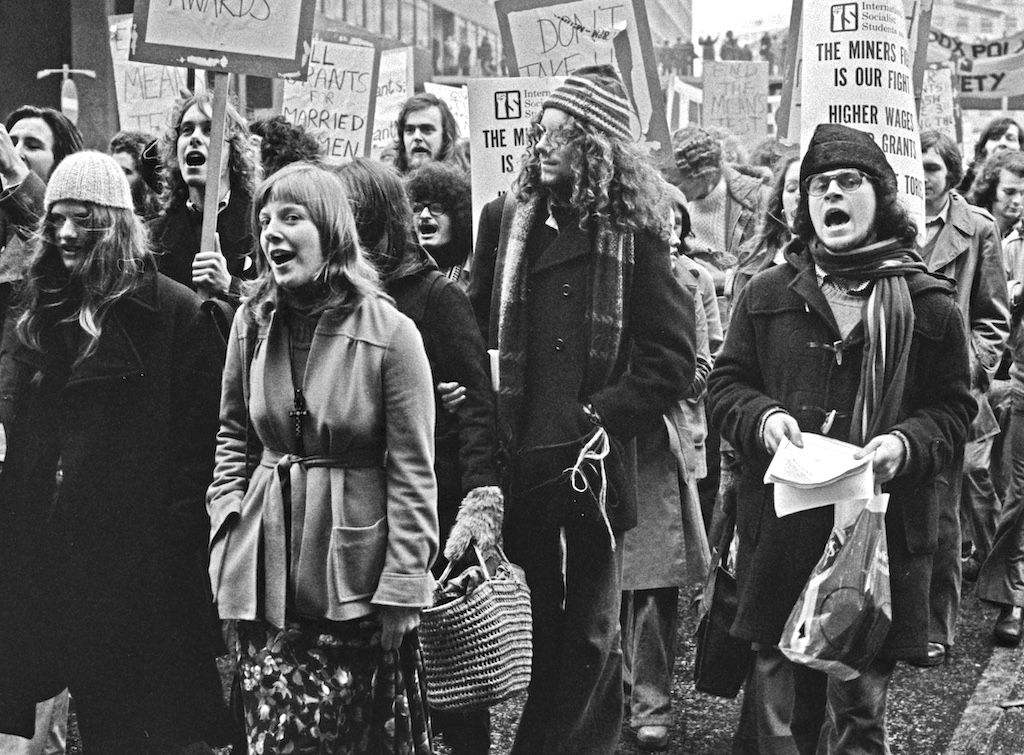
From the Free Speech Movement to the Factory Floor offers a useful perspective on how an earlier generation of leftists in the IS approached the labor movement. (Evening Standard / Hulton Archive / Getty Images)
Some young radicals are still pondering how they should relate, personally and collectively, to the labor movement. Should they try to become agents of workplace change while serving on the staff of local, regional, or national unions? Or should they organize “on the shop floor” — in nonunion shops or as unionized teachers, nurses, or social workers? And then seek elected rather than appointed union leadership roles?
A few years ago, delegates to a national convention of Democratic Socialists of America (DSA) narrowly passed a resolution favoring the rank-and-file route. Some DSA members have joined the Rank & File Project, which supports this approach “to fighting for a better world from the bottom up.”
Fifty years prior, ’60s leftists pondered the same options before launching their own reform efforts, both within the labor bureaucracy and as challengers to it. Some had the foresight to transition from campus and community organizing to union activism in health care, education, and social work where college degrees were helpful and job security good.
Other former student radicals — under the (not-always-helpful) guidance of various left-wing sects — opted to become blue-collar workers in trucking and telecom, Midwest auto plants and steel mills, and West Virginia coal mines in the 1970s. But in the decade that followed, deregulation, deindustrialization, and global capitalist restructuring produced enormous job losses and industrial contraction.
Radicals who made a “turn toward industry” often lost union footholds they had struggled for years to gain. Many ended up back on the academic track, retooling as teachers, lawyers, or pro-labor college professors. Others became community organizers, public sector union activists, labor educators or staffers, and in some cases even entered the business world.
Among the recent volumes recounting this personal and generational journey are Mike Stout’s book about working in a Pittsburgh-area steel mill, Jon Melrod’s recollections of his “fighting days” in Wisconsin manufacturing plants, Dave Ranney’s account of “life and death on the factory floor” in Chicago, and the late Frank Emspak’s memoir about being a third-generation General Electric worker in the Northeast.
Alumni of one left group active during the same period — the Progressive Labor Party — compiled a more gender diverse collection focused on their “adventures building a worker-student alliance” in the late 1960s and thereafter.
In similar fashion, From the Free Speech Movement to the Factory Floor: A Collective History of the International Socialists, edited by Andrew Stone Higgins, tells the story of the International Socialists (IS) via oral history interviews with and chapters written by former members of the group. It offers another useful perspective on how an earlier generation of leftists approached the labor movement.
Socialism From Below
The IS was founded in 1969 by veterans of the Free Speech Movement (FSM) at Berkeley and other hotbeds of ’60s activism. The FSM alums featured in the book include the late Mike Parker, an East Bay DSA member and IS founder whose chapter “The Student Movement and Beyond” contains good advice for campus radicals today. Like organizational rivals on the Left less interested in promoting “socialism from below,” the IS made a decade-long attempt to “bridge the gap between a left disproportionately formed on college campuses and the working class, which, of course, remains a central concern for all American socialists.”
In Higgins’s collection, contributors such as Candace Cohn, Gay Semel, and Wendy Thompson provide vivid first-person accounts of their experience leaving student life or white-collar jobs to become embedded in industry. Each of them helped fight the discriminatory treatment of women and African American workers that was widespread in the blue-collar world they entered in the 1970s.
Cohn became politically active as a member of Students for a Democratic Society (SDS) at the University of Michigan. After graduation, she moved to Pittsburgh and helped create a local advocacy group for Mon Valley workers exposed to hazardous health and safety conditions. She then became “one of the first women hired into basic steel since World War II” at US Steel’s Clairton Coke Works, “the world’s largest coking operation and its filthiest and deadliest.”
In the mill, “sexual harassment was non-stop, both from foremen and from older white co-workers.” Nevertheless, Cohn built relationships with black workers and other female steelworkers, started a shop floor paper, Steelworkers Stand Up, and helped rally fellow rank-and-filers on behalf of Ed Sadlowski and his “Steelworkers Fight Back” slate in a 1977 international union election.
Retooling in Law School
Sadlowski was a “left social democrat,” who was heavily red-baited during his exciting, but ultimately unsuccessful, challenge to labor-management partnering in the steel industry. “In the employer’s offensive that followed,” Cohn writes, “tens of thousands of steelworkers were thrown onto the street, mills shuttered, and steel valley voices silenced.” She was able to retrain as a labor and civil rights lawyer.
Like Cohn, Semel went to law school after her tour of duty in the IS as its national secretary and editor of Workers Power, an “agitational newspaper” featuring a popular column called “Labor Notes.” Before that, she worked as a telephone operator in New York City. In that well-timed intervention, she got herself expelled from the Bell System company union then representing her coworkers, which the Communications Workers of America (CWA) was trying to oust. As a lawyer, she spent most of later career working for CWA, the union she also tried to support back in 1971, when she wouldn’t cross its picket lines during a nine-month strike by 38,000 New York Telephone Company (NYTel) technicians.
Unlike Cohn and Semel, Thompson actually made it to the finish line of a good union pension in the auto industry after being radicalized during her junior year in college abroad (in France, circa May 1968). Thompson worked for General Motors at a Chevy gear and axle plant, with a predominantly black workforce. Surviving layoffs and repeated management attempts to fire her, Thompson battled sexism on the shop floor, contract concessions, and the long-dominant influence of the Administration Caucus in the United Auto Workers (UAW).
During her thirty-three years at the plant, only one critic of the Administration Caucus was ever elected to the UAW international executive board. But the 2022 membership vote to ditch convention voting for top officers — and switch to direct election by the rank and file — enabled a slate backed by Unite All Workers for Democracy (UAWD) to win what Thompson calls an “unprecedented victory — and a great culmination of my many years of activity” on the shop floor.
Working-Class Recruits?
The recollections of individual IS members support Higgins’s conclusion that their “pre-party formation” of five hundred failed to create an organizational culture “more fully welcoming to diverse working-class recruits.” The latter numbered only about one-fifth of the IS’s membership at its peak. Higgins claims that was because
while refreshingly democratic and seriously committed to political education of new members, the IS culture of deep reading, broad discussion, fierce debates, and long, numerous meetings was a hard sell to prospective members [with] pressing familial obligations, and a limited amount of free time.
And then there was the internal feuding that disrupted the group’s initially well-coordinated labor work. In 1976–77, the IS split three ways. Several hundred loyalists stayed put; fifty formed a group called Workers Power, and one hundred created the International Socialist Organization (ISO), which grew bigger over the years but eventually imploded in 2019. In the mid-1980s, as part of a more constructive “regroupment” process, Workers Power members reunited with remaining ISers to form Solidarity, a looser network of socialists that publishes the journal Against the Current.
According to former Teamsters for a Democratic Union (TDU) supporter Dan La Botz, now a New York City DSA member and coeditor of New Politics, “One of the principal reasons for the IS split was differences over the labor work,” which some members argued was “making the group more conservative.”
As feminist historian Barbara Winslow recalls, the grounds for her expulsion from the IS, in the late 1970s, was arguing “for a larger engagement in all possible areas of working-class women’s struggles — blue-, white-, and pink-collar movements as well as other women’s liberation activities.” She and her then husband, former IS national industrial organizer Cal Winslow, became targets of a subsequent purge when they were expelled from the ISO, despite being among its founding members. Winslow then resumed his long and productive career as a labor educator, historian, and author of books like Radical Seattle: The General Strike of 1919.
A Durable Legacy
Contributors to Higgins’s collection like UC Santa Barbara professor Nelson Lichtenstein, Against the Current coeditor David Finkel, and others cite TDU and Labor Notes as the main legacies of the IS. The latter is a uniquely durable labor education, rank-and-file organizing, and alternative media project launched forty-seven years ago, during an era when most socialist or communist groups favored highly competitive self-promotion. Those groups’ publications often prioritized new “cadre” recruitment over building a broad-based, multitendency rank-and-file movement. In contrast, as Thompson recalls:
the IS clearly rejected the model that many organizations had of maintaining their labor front groups tightly under their control. Originally staffed by IS members, Labor Notes became a project where workers would feel they were in a comfortable milieu but also a pond where socialists could swim.
This may have “violated all the norms of so-called Leninism,” Finkel notes. But in the end, a more ecumenical approach was critical to developing a multigenerational network of rank-and-file militants that now meets every two years with five thousand or more in attendance, as opposed to just six hundred in the early 1980s (which was considered good turnout back then).
This very readable volume has much solid advice for socialists trying to revitalize existing unions or create alternatives to them today. One key lesson is that building a big labor or political tent is better, for the Left, than becoming a small one. If you prefer the latter result, then endless meetings, too much organizational “discipline,” and fractious debates over the finer points of Marxist theory — followed by destructive purges — will get you there pretty quick. On the other hand, if you want to be an ecumenical individual or organizational long-distance runner on the labor left, you could do worse than to look at some of the role models featured in From the Free Speech Movement to the Factory Floor.