Corporations Are Using Carbon Credits to Exploit Refugees
The UN is putting refugees to work in poorly paid green jobs to generate carbon credits for billion-dollar firms. It’s one of the most cynical instances of a corporate greenwashing agenda that has done little to address climate change.
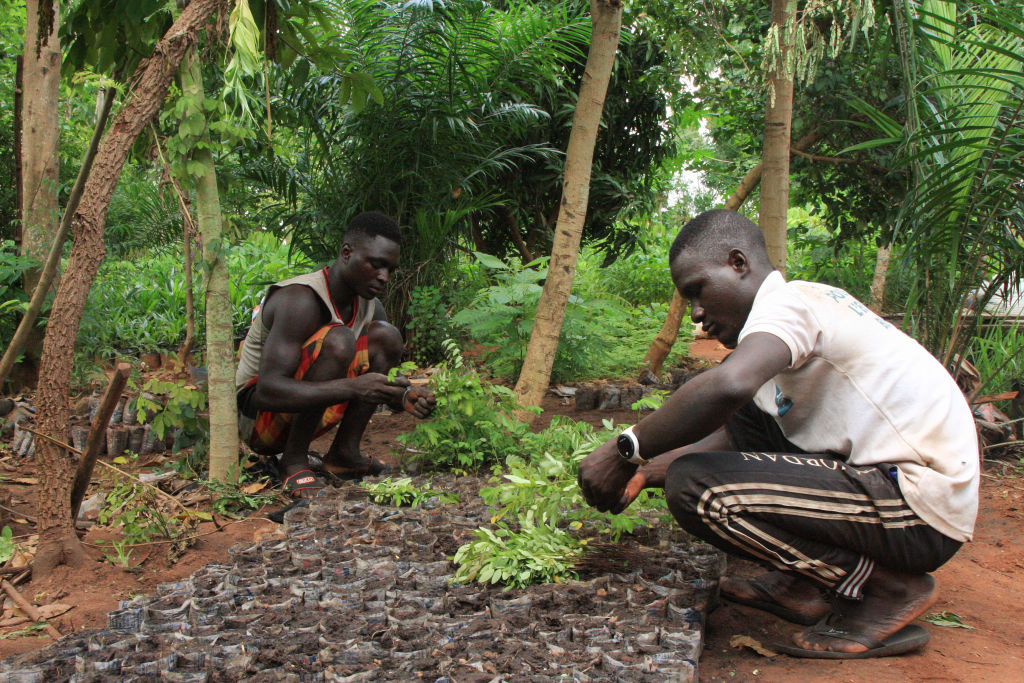
The vast majority of the value generated from reforestation work won’t go to the refugees but to the companies buying the credits enabling them to continue polluting the atmosphere. (Matteo Fraschini Koffi / AFP via Getty Images)
At the start of 2026, the White House declared that it was withdrawing from a raft of international organizations, covering areas of supposed global cooperation from education to aid to climate change. As with much that comes from the current administration, this announcement was deceptive: not only had the United States already disengaged and withdrawn funding from many of these bodies, but it has also long been actively undermining their operation.
Perhaps the starkest example concerned the United States’ international aid budget. In 2025, massive cuts led to the UN World Food Program cutting upward of 30 percent of its staff, while the international body responsible for refugees, the United Nations High Commissioner for Refugees (UNHCR), declared it would downsize, cutting positions and reducing expenditure. In this new world, Donald Trump warned that the UN and its agencies must “adapt, shrink or die.”
The Deepening Climate Crisis of the UNHCR
This is not a new crisis for the UN and its refugee agency. It is, however, a dramatic escalation.
In 2024, the number of forcibly displaced people reached a record high of 122.6 million, 32 million of whom are refugees under the UNHCR’s mandate. While the numbers of those forced from their homes has often fluctuated, there have been more dramatic increases since 2010 and, especially, since 2020, driven increasingly by environmental disasters.
Around a fifth of refugees end up in camps, where they are often stuck for a decade or more. But while refugee numbers have exploded, funding to support them has not. The UNHCR has rarely had sufficient funding. Now it is in a deep financial crisis. While its target for funding in 2025 was US$10.6 billion, it had only managed to raise $3.5 billion. This shortfall will put millions at risk of harm.
The REP Fund
Climate change is one of the central drivers of displacement, both directly through environmental crises and indirectly as conflicts over resources — from water to critical minerals used for “green” technologies — force people from their villages and towns.
In response to both crises — funding shortfalls and climate impacts — the UN is choosing to adapt. But it’s doing so by exploiting refugees to enable corporations to keep trashing the atmosphere, all to fund refugee camp infrastructure.
In 2021, the UNHCR launched the Refugee Environmental Protection (REP) Fund. The idea is that refugees’ labor, both waged and unwaged, is used to create carbon credits, which are then sold to fund the refugee camps.
As with similar social and environmental funds and bonds, the fund starts by attracting initial donors who enable the initial investment in credit-generating programs around refugee camps. The positive carbon impacts of these programs are then verified and registered as carbon credits that are sold on voluntary carbon markets; the income generated replenishes the fund, allowing camps to become more financially sustainable and enabling additional programs in other camps.
A carbon credit is a tradable certificate representing the removal of one ton of carbon dioxide from the atmosphere. It essentially acts as a permit that allows a person or organization to “offset” its own pollution by paying for environmental improvements elsewhere. A voluntary carbon credit (VCC) is one bought by a company or person who is not legally required to purchase them, similar to when you purchase an airline ticket and you’re invited to pay more in order to “offset” the environmental impact of your flight.
Following feasibility assessments, the UNHCR has selected three pilot sites for the fund in Uganda and Rwanda. Fund managers are planning further feasibility studies in Brazil, Bangladesh, Kenya, Mozambique, Cameroon, and Chad.
Two labor processes will be mobilized in order to generate carbon credits across these three sites. The first is the planting and maintaining of trees (reforestation). Starting with 20,000 hectares around the three pilot sites, the fund’s eventual target is tens of millions of new trees in the vicinity of refugee camps. The employment provided for refugees is an additional benefit of the scheme.
However, reforestation work is poorly paid. There is no standard pay rate for reforestation work in Uganda and Rwanda, but the pay for a similar project in Uganda was around US$1.30 per day. Most accounts suggest pay rates of $2 to 5 per day for formal work contracts; actual pay can be much lower.
While reforestation work is poorly paid, the other credit-generating activity isn’t paid at all. A sizable proportion of the labor generating carbon credits will come from the use of so-called clean cooking stoves, that is, stoves that use liquified petroleum gas (LPG) or solar energy. (Their use of LPG is one reason why gas-exporting countries such as the United States support clean-cooking initiatives, even when they otherwise oppose climate measures.) This work is done “for free”; it is unwaged reproductive labor — in this case, everyday housework — done primarily by women. For the purpose of generating carbon credits, this unwaged work is assessed in the same way as reforestation work.
Counting Carbon Credits
Trees sequester carbon dioxide, but carbon credits are made by people. Apart from the highly remunerated financial engineers and intermediaries, the REP Fund will put refugees to work to generate these credits. Refugees’ work will be low-waged in the case of reforestation and unwaged in the case of credits “generated” by the use of clean-cooking stoves.
We can compare this to the money the fund expects to raise. The fund will produce Gold Standard–certified carbon credits, which are typically valued at $20 to 27 per ton of CO2e (carbon dioxide equivalent, at 2025 prices). If we take the midrange for carbon sequestration of eight tons of CO2e per hectare per year, the value per year for the planned 20,000 hectares of the REP Fund program is $3.2 million, generating $64 million over a presumed twenty-year period.
The vast majority of the value generated won’t go to the refugees, however, but to the companies buying the credits enabling them to continue polluting the atmosphere, to the intermediatory actors who manage the transactions, and finally to the UNHCR itself, where the sale underwrites the continued operations of UN camps.
Won’t Someone Think of the Climate?
But will the exploitation of vulnerable refugees trapped in camps for decades at least contribute to stopping climate change? The short answer is no.
There are significant and by now well-known problems with VCCs. Markets are self-regulated and there is no common set of criteria and methodologies concerning their generation — both factors undermine the credibility of any claims to carbon reductions. What’s more, key actors across the production and reporting chain, including host governments, are incentivized to overstate the impacts of projects. Worse, the science behind carbon credits in general is questionable.
To assess what carbon has been “saved” by a project, an assessor needs to make a series of counterfactual estimates. What would have happened if the reforestation or clean-cooking project had not gone ahead? This is difficult to do accurately, if not impossible. Not only because of the need for counterfactual evidence but because climate change and land use themselves impact local carbon sequestration rates.
In addition, reforestation projects have high failure rates, with many projects suffering close to 45 percent mortality rates in the first five years. Some poorly managed projects can have mortality rates as high as 90 percent. Die-off isn’t the only factor to consider. Reforestation projects can also have destructive impacts on soil (releasing more carbon) and biodiversity and can provoke water shortages. Climate change is also increasing the frequency of wildfires, creating additional risks of carbon emissions from reforestation projects.
This combination of problems with VCCs, and accreditation in general, make even the most legitimate carbon credit schemes dubious at best. It’s for this reason that they are generally decried as false climate solutions that enable companies to continue to create carbon emissions without any countervailing carbon reductions. Indeed, much research has established that large numbers of VCCs are in fact worthless.
Maladapting to Climate Change
All this means the UNHCR’s REP Fund risks making the situation worse. It is less an adaptation and more a maladaptation to climate change.
In effect, the project takes those displaced in no small part by the climate crisis and puts them to work for a pittance to benefit those companies responsible for the climate crisis. Worse, these displaced people labor to make the camps that confine them sustainable.
While not quite the same as installing bird-friendly electric fences around prisons, this nevertheless is on the spectrum of “greening” the technologies of confinement that many of the world’s “surplus” populations finds themselves trapped within.
Similar to the social and environmental consequences of many aspects of the emerging green economy, the REP Fund risks contributing to worsening climate impacts while exploiting refugee labor for the benefit of those most responsible for climate-changing emissions.
It’s hard to see this as anything but the worst outcome in response to the existing situation, one that greenwashes the abandonment of the world’s climate displaced.