How Not to Talk About Climate Change
The New York Times Magazine claims in a blockbuster new article that democracy and human nature are to blame for the climate crisis. They're wrong.
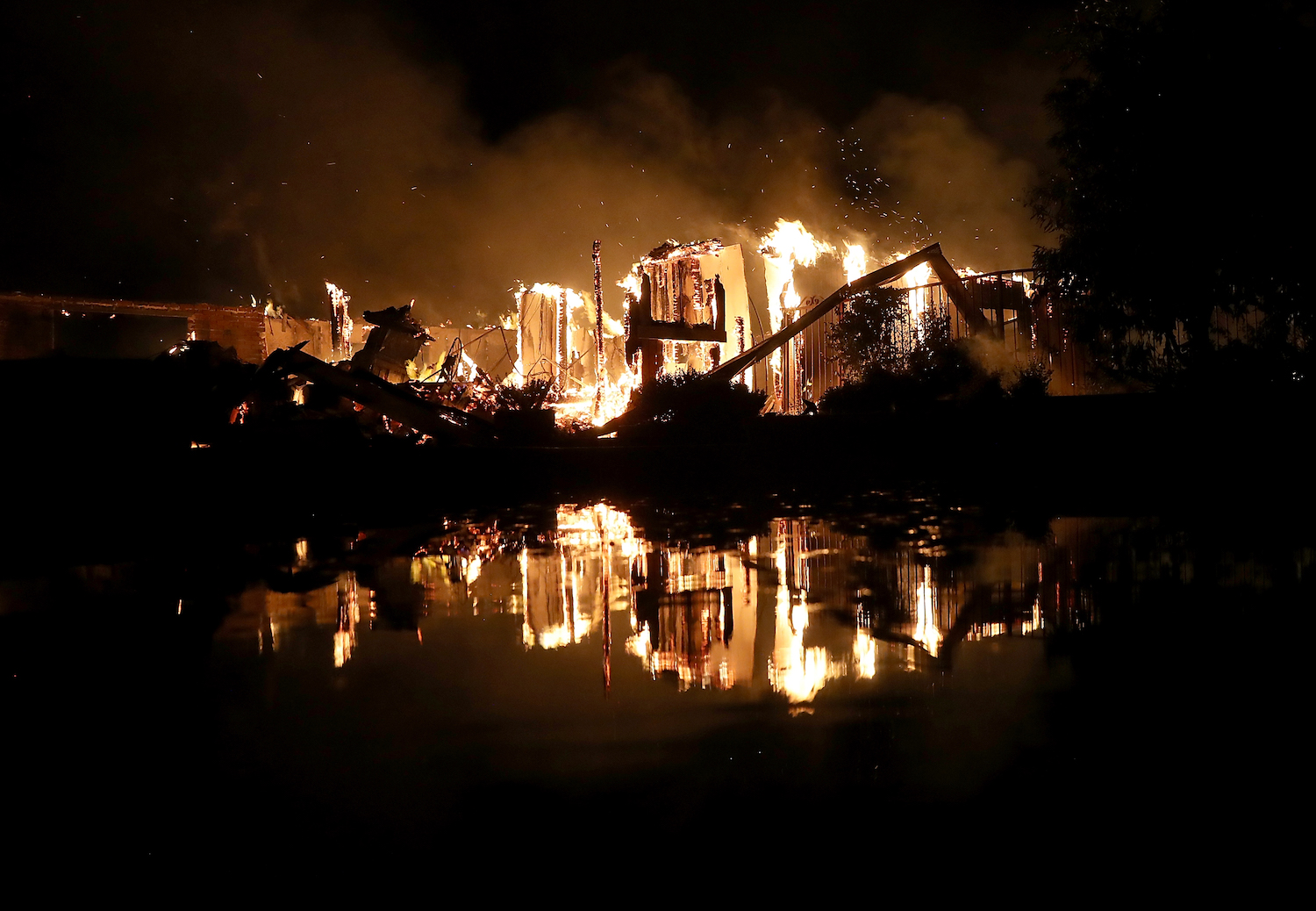
A home burns during the Carr Fire on July 27 in Redding, CA. Justin Sullivan / Getty
Once upon a time, we almost solved climate change, but then human nature got in the way. This is the thesis of novelist Nathaniel Rich’s new article on climate change, comprising an entire issue of the New York Times Magazine, entitled “Losing Earth: The Decade We Almost Stopped Climate Change.”
The decade in question is the 1980s, when, in Rich’s telling, a “handful of people” — a small group of scientists and policymakers, based entirely in the United States — nobly tried to save the rest of us from the doom now approaching. The story follows the environmental lobbyist Rafe Pomerance and the climate scientist James Hansen as they try to raise the alarm about the greenhouse effect, with help from some surprising allies — the occasional Republican senator and concerned representatives of oil companies. The climax comes in 1989 when the United States, under the “environmental president” George H. W. Bush, torpedoes a promising effort to reach an international agreement to reduce carbon emissions.
From this narrow look at a brief period of American history, Rich draws the conclusion that we are all — “we” as in humanity, “we” as in the human species — to blame for the catastrophe that we failed to prevent. Interspersed with pictures of our beautiful, wounded planet, the thesis is laid out in stark pull quotes — “All the facts were known, and nothing stood in our way. Nothing, that is, except ourselves.”