Trump Has a Thin Cultural Vision of the Future
On art and culture, Donald Trump and the movement behind him are offering a highly circumscribed vision of the future in comparison to far-right movements of the past.
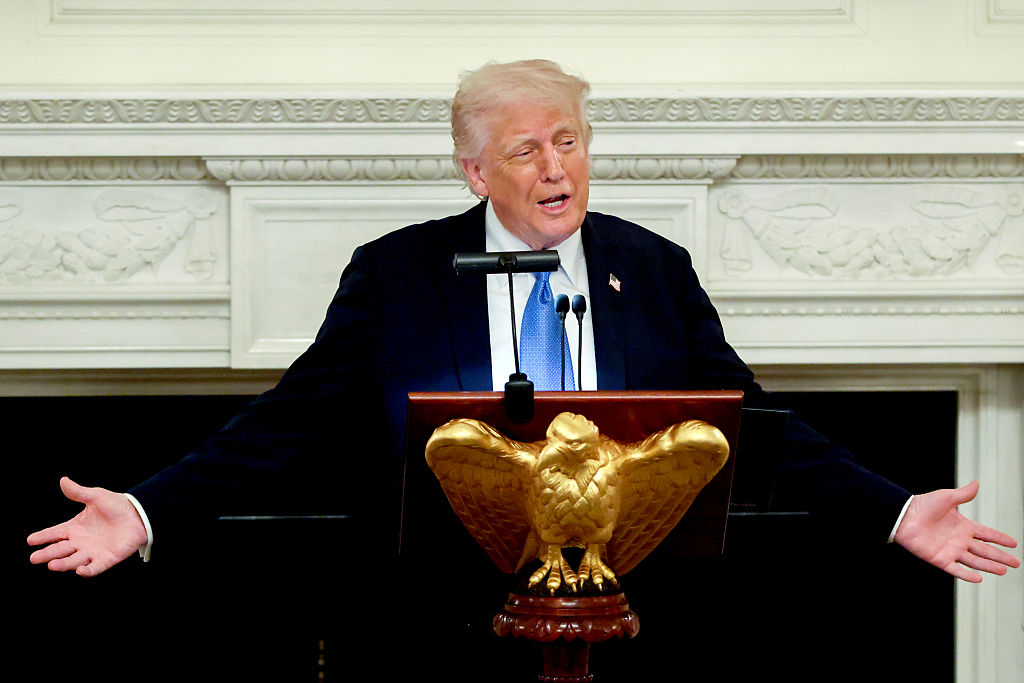
Donald Trump speaking during a Kennedy Center Board dinner in the State Dining Room of the White House in Washington, DC, on May 19, 2025. (Samuel Corum / Bloomberg via Getty Images)
On November 16, 1989, protesters lined the sidewalk outside of Artists Space in New York City to protest the rescinding of federal funds for an exhibition dedicated to the AIDS crisis. The National Endowment for the Arts (NEA) had withdrawn a $10,000 grant because, as then NEA director John E. Frohnmayer claimed, “a large portion of the content [was] political rather than artistic in nature.”
The cut came on the heels of NEA-supported exhibitions featuring works by the artists Andres Serrano and Robert Mapplethorpe. These exhibitions sparked debates in Congress, with far-right Senator Jesse Helms and Representative William Dannemeyer pushing through tighter controls over what kinds of art could receive federal funding.
The AIDS activist group ACT UP and the artist David Wojnarowicz were quick to call out Frohnmayer’s dissimulations and homophobia at the NEA. Wojnarowicz linked the right-wing backlash to earlier waves of repression, writing, “We as a society have been in this political climate before. It is cyclical and similar bigots and extremists have reared their conservative/fascist heads before in order to conduct witch-hunts.” Like today, the invocation of fascism was not uncommon. A sign at the Artists Space protest read, “Fascism begins with censorship.”