The GOP’s School Voucher Program Is Anti-Populism
The GOP is smuggling a $5 billion school voucher program into the budget reconciliation bill. It’s a major giveaway to wealthy school-privatization boosters — and a slap in the face for many of Donald Trump’s own voters.
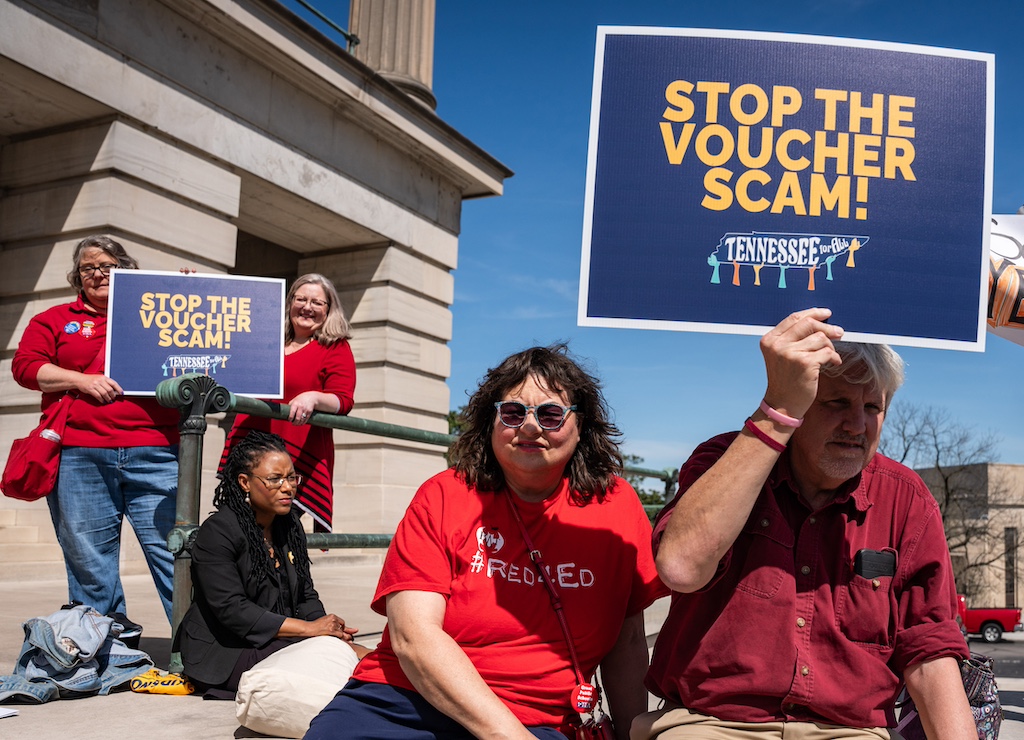
A protest outside the Tennessee state Capitol building against Governor Bill Lee’s school voucher program on March 12, 2024, in Nashville, Tennessee. (Seth Herald / Getty Images)
When it comes to poking holes in the GOP’s claims to now be a populist party of the working class, the effort to shred Medicaid in order to pay for tax cuts for the wealthy is exhibit A. But I’d make the case that a $5 billion voucher program, smuggled into the text of the budget reconciliation bill this week, may be an even more glaring example of faux populism in action. That’s because the maneuver not only circumvents the will of Donald Trump’s own voters but enriches the very wealthy and decimates public budgets in the process.
A quick recap: The Educational Choice for Children Act (ECCA) of 2025 has now officially made it into the “big, beautiful bill,” the House GOP tax plan that offsets tax cuts with deep cuts to health care for low-income Americans. (Gluttons for punishment should skip to page fifty-seven of the bill where the text of ECCA begins.) The New York Times’ Dana Goldstein covers the basics here:
The program is structured as a $5 billion tax credit, allowing donors to reduce their tax bill by $1 for every $1 they give to nonprofits that grant scholarships — up to 10 percent of the donor’s income. The option to donate is expected to be popular with wealthy taxpayers. The resulting scholarships could be worth $5,000 per child, reaching one million students. Any family who earns less than 300 percent of their area’s median income — which equals over $300,000 in some parts of the country — could use the funds, meaning a vast majority of families would be eligible.