In France, the Collective Denial of Islamophobia Is Deadly
A stabbing at a southern French mosque last Friday sparked terror and protest among France’s Muslims. Yet many top politicians refuse to speak of “Islamophobia,” instead leaning into far-right narratives of the Islamic danger to France.
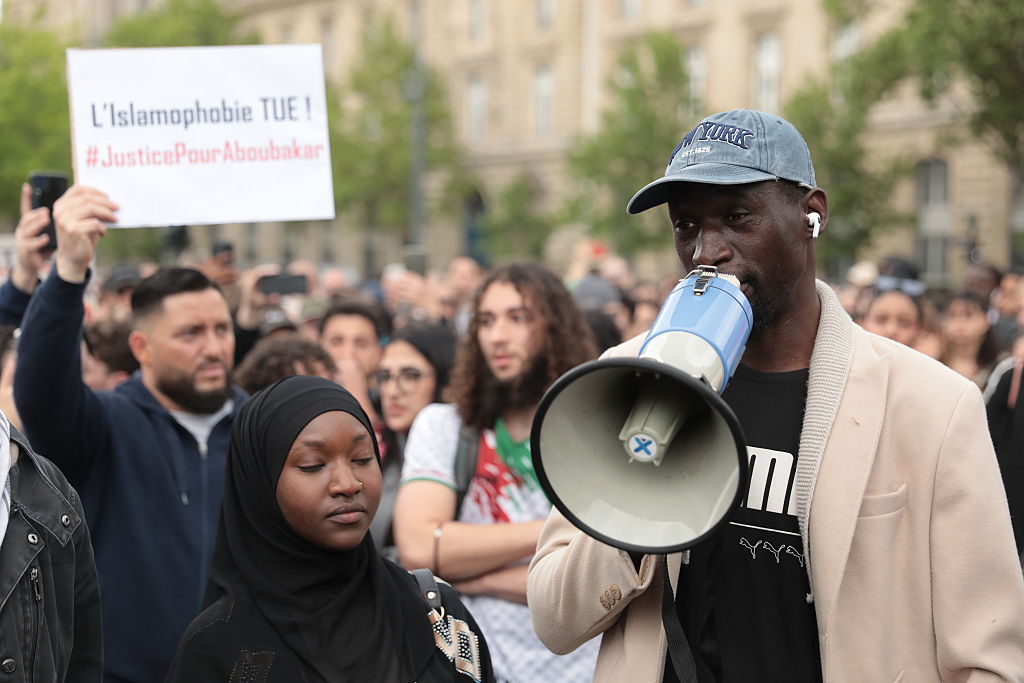
Aboubakar Cissé’s brother joins demonstrators to denounce Islamophobia and honor his memory in Paris, France, on April 27, 2025. (Mohamad Salaheldin Abdelg Alsayed / Anadolu via Getty Images)
Last Friday, April 25, Aboubakar Cissé was stabbed to death inside a mosque in the southern French town of La Grande-Combe, where the twenty-two-year-old Malian man had lived for three years. Two videos recovered by police investigators — one from the mosque’s CCTV and the other filmed by the attacker from his own smartphone and posted to social media before it was removed — revealed a scene of horrific violence. Cissé was impaled with upward of forty stabs to his body.
According to the summaries of the videos reported in the press, the attacker — a French man also in his early twenties — took to imitating an Islamic prayer before lunging toward his victim with a kitchen knife. Over Cissé’s body, the assailant twice shouted, “your shitty Allah,” before fleeing the scene. Late on Sunday night the presumed suspect surrendered himself to Italian police in the Tuscan town of Pistoia after a nearly three-day-long manhunt. He has since been handed over to French authorities. Pending a murder trial, and the probable criminal implication of individuals involved in his several-day escapade, the arrest and a confession of the suspect brings the case of Cissé’s killing to a quick close.
Given the taboo surrounding anti-Muslim violence in France, the killing seems primed to join a growing, yet relatively anonymous list of Islamophobic crimes that have targeted the country’s Muslim community in recent years. Coming on the heels of the Christchurch attack in New Zealand, in October 2019, a man in his eighties tried to burn down a mosque in southwestern France before shooting and injuring two practitioners. In late August 2024, a neofascist militant killed forty-three-year-old Djamel Bendjaballah near Dunkirk in a hit-and-run car attack, an incident that drew nowhere near the same level of public uproar as Cissé’s murder. The charges filed against the suspect in that case — a member of the Brigade française patriote, a far-right gang — did not include aggravation on racial grounds.