Michael Burawoy’s Marxism for Realists
What distinguished Michael Burawoy from other socialists was that he did not sidestep or ignore conservative criticisms of Marxism. Rather, he took them head-on and developed a sociology that could make sense of actually existing capitalism and socialism.
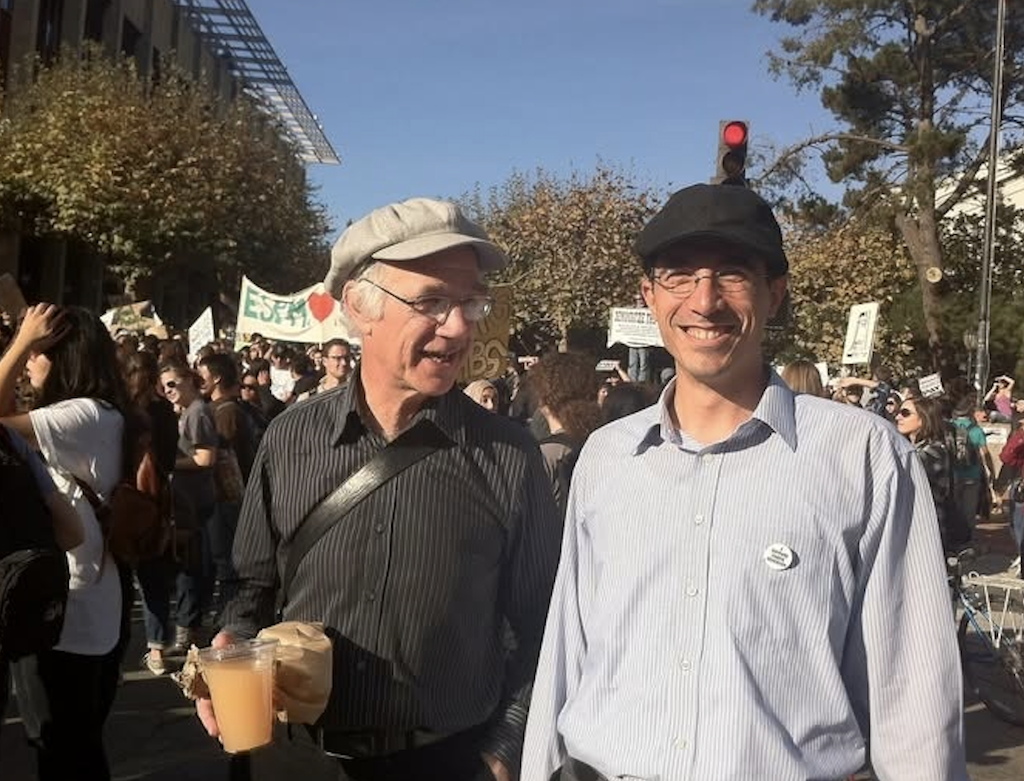
Michael Burawoy (L) and Cihan Tuğal at a protest for public education and against austerity at University of California Berkeley, 2011. (Courtesy of Barry Eidlin)
The work of sociologist Michael Burawoy, who was killed in a traffic accident on February 3, combined in equal measure optimism and realism. Born the child of émigrés from the Soviet Union, he began his career in the mines of post-independence Zambia. While liberals and most Marxists dismissed “actually existing socialism” and paid little attention to labor outside the advanced capitalist world, Burawoy looked to the working class of the East and the formerly colonized world to understand the prospects of the Left in the twentieth century. Ultimately, both Africa and the Soviet bloc left him disillusioned, but this was a disenchantment borne of clear-eyed reflection on material reality. He was too committed to field work and research to arrive at views any other way.
Not Laboring Under Illusions
In Zambia, he worked in the Personnel Research Unit of the Copper Industry Service Bureau as an office employee crafting job evaluation schemes, a position from which he sought to act as both a participant and observer of the labor process. Out of this study emerged The Colour of Class on the Copper Mines: From African Advancement to Zambianization, in which Burawoy pointed out that the color bar only shifted, but did not disappear after independence. Whenever blacks were promoted, their white supervisors would be promoted further upward, resulting in administrative overload.
Following Karl Marx and Frantz Fanon, Burawoy explained this postindependence persistence of racial hierarchy based on class interests. The postindependence reproduction of what we today call “racial capitalism” incited Burawoy to dig deeper into the hard-to-discern forces that render inequalities resilient.