The German Election in Ten Graphs
On Sunday, Germany voted in a federal election that saw massive growth in support for the far-right AfD, resurgence of the socialist Die Linke party, and more losses of working-class votes for the Social Democrats. These ten graphs explain what happened.
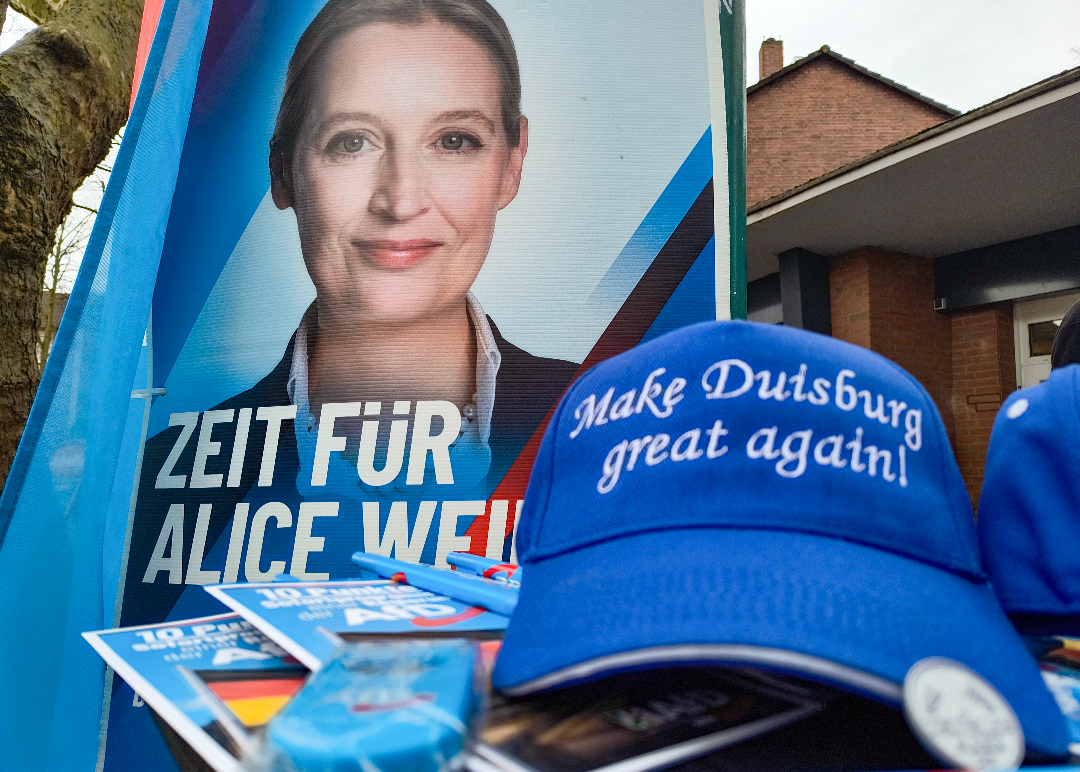
The far-right Alternative for Germany party doubled its score from the 2021 parliamentary elections. (Louis Van Boxel-Woolf / AFP via Getty Images)
The German federal election produced a parliament representing five main parties, plus one seat for regionalists in Schleswig-Holstein. Two parties previously in the Bundestag, namely the neoliberals of the Free Democrats (FDP) and the left-conservative Sahra Wagenknecht Alliance (BSW), failed to secure representation, missing the 5 percent threshold.
The biggest single bloc is Friedrich Merz’s Christian Democrats (here shown in black, as Union), a conservative force. They have repeatedly governed in the past with the center-left Social Democrats, in an arrangement called a GroKo (grand coalition), and are expected to do so again now. But this coalition is less grand than it used to be. While the first such arrangement in 1966 held 447 of 496 seats, and in 2005 under Angela Merkel 448 out of 614, these parties now together have a thin majority of 328 out of 630. This would be the first grand coalition built on the two historic “mass parties” but backed by less than half of voters (29 percent for Christian Democrats, 15 percent for Social Democrats).
A coalition including the Greens as well as these two parties remains possible. While the Christian Democrats and far-right Alternative for Germany have a notional majority when added together, this coalition is ruled out for now. Constitutional change would require a two-thirds majority, which could prove decisive if the government seeks to end the current constitutionally mandated limits on borrowing, for instance for military spending. Such a measure would rely not only on Christian Democrats, Social Democrats, and Greens, but also at least one other party.