Republicans’ and Democrats’ Biggest Corporate Sponsors
Both political parties in the US receive exorbitant amounts of donations from corporations and the very rich. A close look at the money trail shows which sections of capital favor Republicans and Democrats, respectively.
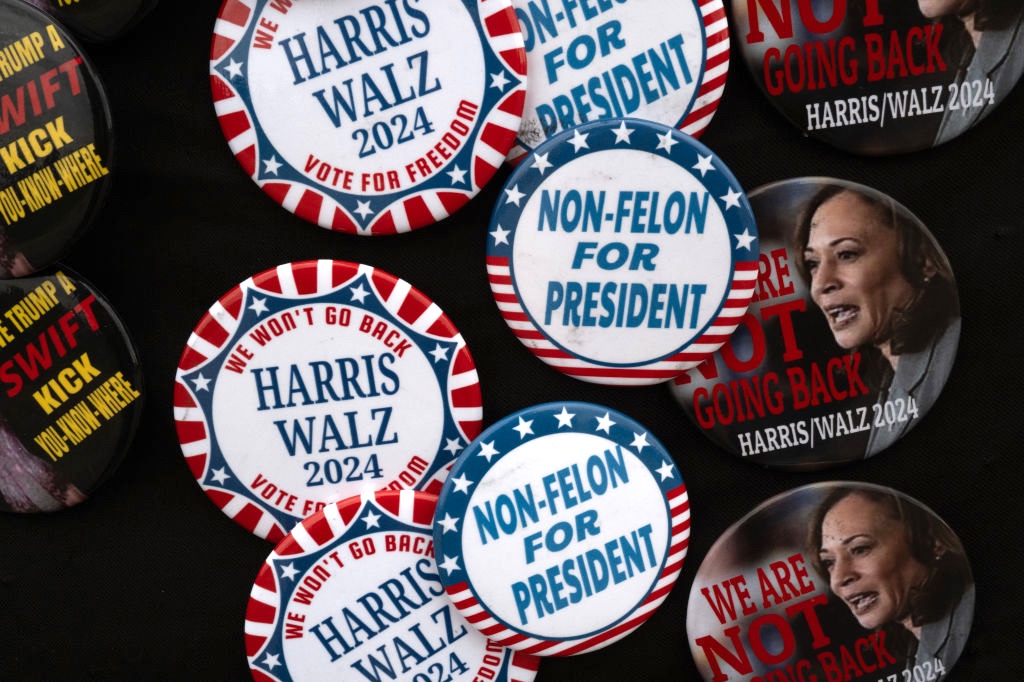
Buttons for Democratic presidential nominee Vice President Kamala Harris in Flint, Michigan, before a rally on October 4, 2024. (Scott Olson / Getty Images)
From one point of view, the aphorism “you get what you pay for” does not apply when it comes to US electoral democracy. Enormous amounts of money are spent on elections in this country, but few would say their exorbitant cost is a mark of quality. The total cost of federal elections has increased with each election cycle, but the 2020 election marked a quantum leap in the level of political spending. There was a staggering $14.4 billion in total spending on federal elections, including both presidential and congressional campaigns, in 2020. This was more than double the total amount from 2016, which was itself the most expensive election cycle ever to that point.
But if you’re a billionaire instead of an average voter or small-money donor, the old saying still means something. Earlier this summer, news outlets reported that tech billionaire Elon Musk, whose estimated net worth is over $250 billion, planned to donate $45 million per month to a new pro–Donald Trump outfit called America PAC (both Musk and Trump denied these reports). As of mid-July, the group had already raised upward of $8 billion, largely from titans of the tech world. Its main backer is Joe Lonsdale, who cofounded the software and data firm Palantir with Peter Thiel.
As for Thiel — who funds much of MAGA-world’s political and intellectual apparatus — he must be rather happy with the returns on his political investments. In 2015, he recruited a fresh-faced Yale Law School graduate and soon-to-be best-selling author named J. D. Vance to his Silicon Valley investment firm Mithril Capital. After Hillbilly Elegy went big, Vance moved back to his native Ohio to start laying the groundwork for his political career. Fifteen million dollars of Thiel’s money followed Vance back to the Buckeye State, where it boosted his successful 2022 campaign for a US Senate seat. Less than two years later, Trump tapped Vance as his 2024 running mate, capping this Potemkin populist’s lightning ascent to the heights of Republican Party politics. At just thirty-nine years old, Vance would be the third youngest vice president in US history if he and Trump win this fall’s election.