AMLO’s War on Neoliberal Corruption
Since the 1990s, the Mexican right has portrayed privatization and deregulation as democratic causes. AMLO’s redistributive program cuts through this framing, casting neoliberalism as a form of corruption that disempowers ordinary Mexicans.
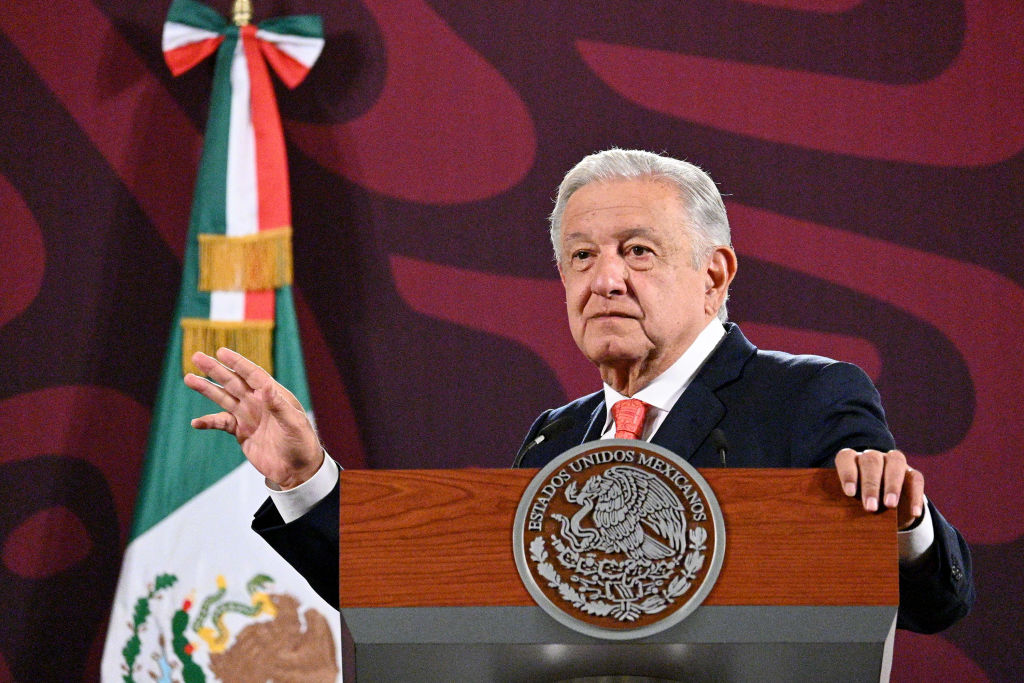
Mexican president Andrés Manuel López Obrador speaks during his daily morning briefing on August 29, 2024, in Mexico City, Mexico. (Juan Abundis / ObturadorMX / Getty Images)
A recent Gallup poll tallied the approval rating of Andrés Manuel López Obrador (AMLO) of the Morena party, now six years into his presidential administration in Mexico, at 80 percent. In October, he will hand off power to Claudia Sheinbaum, his longtime political protégé. Sheinbaum achieved a landslide victory in the presidential elections on June 2, garnering close to 60 percent of the vote, more than 30 percentage points ahead of the runner-up. The main opposition parties — the Institutional Revolutionary Party (PRI), the National Action Party (PAN), and the already diminished Party of the Democratic Revolution (PRD) — which ran together as a coalition this time, lost significant ground compared to 2018, securing about 27 percent of the vote, around 10 percentage points less than their combined total in the previous general election. In this recent contest, Morena, formed just over a decade ago, secured a two-thirds supermajority in the Chamber of Deputies and fell just two representatives short of achieving the same in the Senate. How should we understand the success of the electoral left in contemporary Mexico?
This article offers an outline of the model of reform pushed by AMLO, what he calls the country’s “fourth transformation of public life.” AMLO, who handily triumphed in the previous elections, frames Morena’s mission as spearheading this cuarta transformación. Linking Morena’s program to the momentous events of the war of independence in the 1810s, the liberal state reforms of the 1850s, and the early twentieth-century Mexican Revolution, AMLO envisioned the 2018 victory less as a change in government than as a transformative regime change. To what extent, then, is Morena’s electoral success the emergence of an entirely new social pact?
In what follows, I present an account of AMLO’s rise and his years of government as well as the historical trajectory of the Mexican left during the neoliberal era. The aim is to develop conceptual clarity that can help us make sense of the magnitude of Morena’s rise. I make three broad points. The first is that the distinctive feature, comparatively and historically, of AMLO’s project is his progressive reframing of anti-corruption politics. I trace the electoral left in the context of the period of the “transition to democracy” that began in the late 1990s, when the PRI, which governed for most of the twentieth century, lost its grip on power for the first time. The argument here is that the Right was able to capitalize on this transition so that the struggle against the PRI came to be equated with a general anti-statism, lending neoliberalism a prodemocratic, antiestablishment edge. It took a quarter century for the electoral left to cut through with a redistributive program that cast neoliberalism itself as corruption. Second, I argue that this platform was premised on a diagnosis of corruption as a specific neoliberal political economy — not a series of isolated scandals or moral failings but a particular logic of capital accumulation. Third, I reason that AMLO’s tenure is better understood as post-neoliberal rather than anti-neoliberal, a reshaping of the relationship between state and market in a society already deeply transformed by decades of neoliberalism. Post-neoliberalism here aspires to relegitimize the state as a social actor and to reignite class politics. It aims, in other words, to revamp a developmentalist state — and to do so assuming that certain key features of neoliberal discourse and practice, such as global free trade, foreign investment–led growth, and macroeconomic orthodoxy, are irreversible. Furthermore, its emerging attributes are constrained by the structural limits imposed by decades of neoliberalism: a dilapidated state apparatus and a disarticulated working class.