The Pussy Riot Trial Was a Warning for US Universities
The 2012 trial of Russian punk band Pussy Riot was a scandalous case of censorship dressed up as preventing offense. Claims that US campus protests over Gaza represent “faith-based harassment” are doing the same thing.
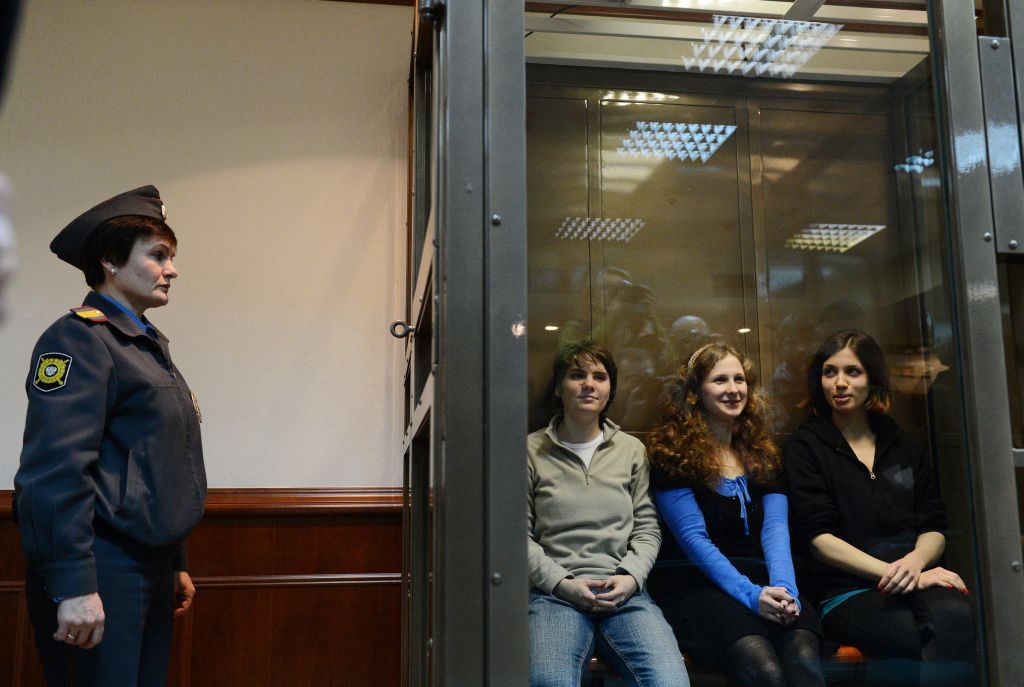
A police officer guards members of the punk band Pussy Riot sitting in a glass-walled cage in a court in Moscow, on October 10, 2012. (Natalia Kolesnikova / AFP via Getty Images)
Three women sit before their country’s highest deliberative body, on trial for incitement of hatred against a religious group. Their statements, which rigorously distinguish political speech from criminal harassment, earn widespread condemnation from liberal and conservative commentators alike. In the eyes of the federal government and the court of public opinion, these women have crossed an unspoken boundary on acceptable political discourse. Calls for their public punishment abound.
One would be forgiven for confusing this scenario with the 2012 trial of Russian punk band Pussy Riot. In fact, I’m referring to the recent Congressional hearings on antisemitism at college campuses, which began on December 5, 2023, in Washington, DC. University of Pennsylvania president Elizabeth Magill and Harvard University president Claudine Gay resigned after backlash to their testimony, while the leaders of the Massachusetts Institute of Technology and Columbia University also faced immense pressure to step down. While the state-sanctioned cases against Pussy Riot and the Ivy League presidents differ vastly in context, content, and consequences, they rely upon the same tactic: invoking accusations of religious intolerance, faith-based harassment, and faith-based animus as a reason to censor political speech. The repercussions of the Pussy Riot trial in Russia should give all Americans pause as they consider the appropriate tools, and actors, to combat hate speech.
Fighting Words
While the prosecution of Pussy Riot struck many Western observers as a cynical show trial, the charges against them reflect a rather conventional interpretation of free-speech limitations in the Russian context. On February 21, 2012, Nadezhda Tolokonnikova, Maria Alyokhina, and Yekaterina Samutsevich disrupted services in Moscow’s Cathedral of Christ the Savior to sing the following lyrics from their song “Punk Prayer:”