There’s Still Tomorrow Shows Women’s Fight for Freedom
Paola Cortellesi’s film There’s Still Tomorrow offers a striking portrayal of working-class women fighting gendered violence in late 1940s Italy.
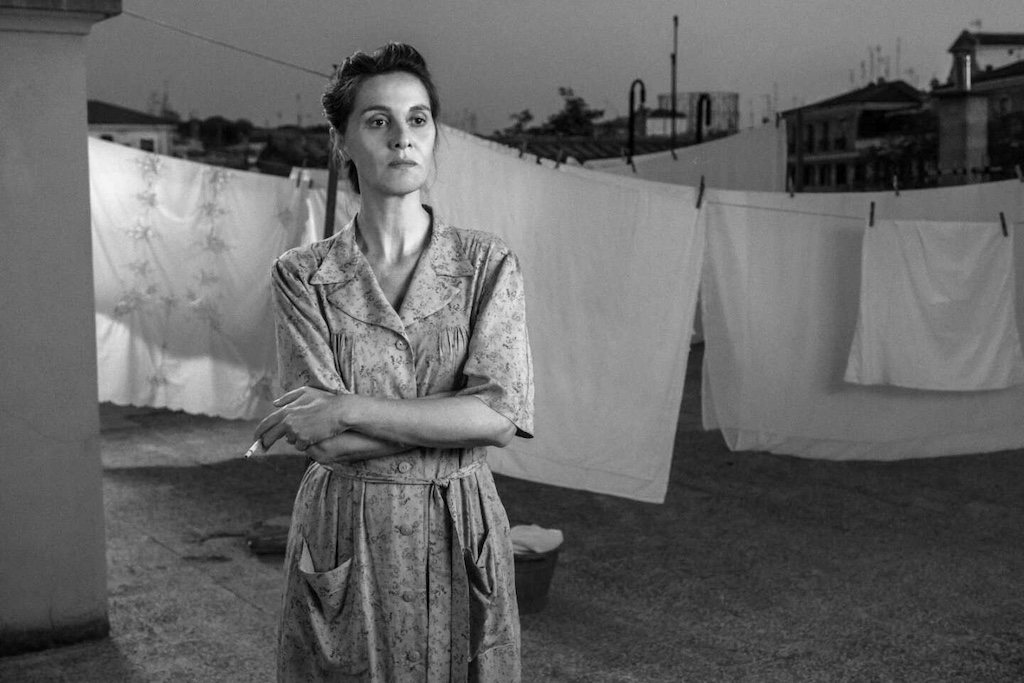
Still from There’s Still Tomorrow. (Universal Pictures)
Delia dances, a disjointed puppet in the hands of her husband, Ivano. He spins her around, throws her into the air, catches her, pulls her by the hair, turns her over onto one of his arms, pitches her back against the wall, slaps her, picks her up again, and strangles her. Two bodies in motion repel, approach, and jostle with each other to the stripped-down rhythm of “Nessuno” [Nobody], a song by Italian singer Mina, famous in the 1960s. Only a bass line, that of the man, sets the tone for the scene. The voice — the woman’s — seems to be mimicking outright madness: “No one, I swear, no one, not even fate, can separate us, because this love will shine with eternity, eternity, eternity.”
It’s an unbearable scene, without screams or bloodshed. It’s a sublimation of the cruelty that Delia endures and has to abstract herself from on a daily basis. We see, in bodily rhythm, a mother’s life pulsating against the beatings inflicted on her by her husband. It does so “in a circular time, where bruises and wounds appear and disappear, repeat, overlap, heal and bleed again, where violence is not a single fact but a Leitmotiv.”
There’s Still Tomorrow by Paola Cortellesi — she is director, female lead, and cowriter of the screenplay — has the effect of a brutal slap in the face, the same one that hits Delia, the heroine she plays, in the first minute of the movie. Filmed in black and white, this cinematic gem plunges us into postwar Italy, a Rome still occupied by Allied troops, but at an indefinite date until the final scene (spoiler alert). The action takes place in the working-class neighborhoods of the capital, where we follow the life of Delia, mother of three children, two young boys and a teenage daughter named Marcella. Cortellesi shows us with great sensitivity the living and working conditions imposed on women. Delia takes on a series of jobs (umbrella repairer, laundress, seamstress, domestic help) for which she is underpaid “because she’s a woman,” while taking care of the family household, her violent husband (played by an astonishing Valerio Mastandrea), and his father with wandering hands, whom she washes and feeds.