The Best Way to Secure LGBTQ Rights: Unions
Labor’s ability to improve queer workers’ lives stems from its power to raise standards for all workers.
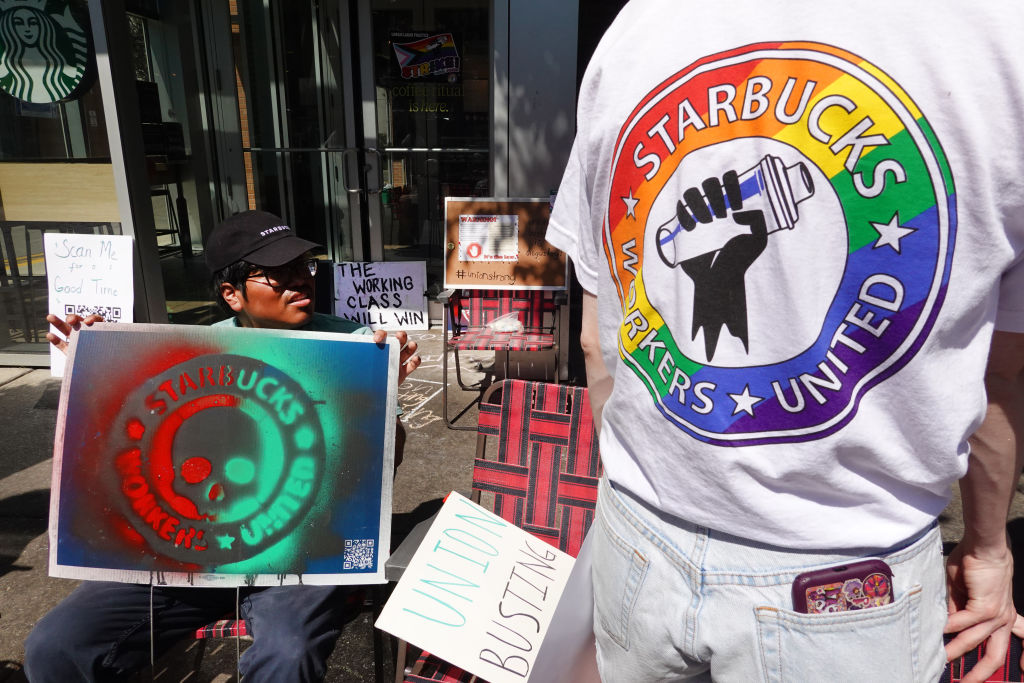
People picket in front of a Starbucks store in the Greektown neighborhood on June 24, 2023 in Chicago, Illinois. The event, organized by the Starbucks union, was one of many pickets held nationwide after the coffee giant and the union clashed over claims that the company was not allowing Pride month decorations in Starbucks coffee shops. (Scott Olson / Getty Images)
In the early months of 2020, queer Starbucks baristas brewed a plan to challenge their low wages and workplace discrimination. I first learned about the campaign while attending a national LGBTQ advocacy meeting where a group of these workers previewed their organizing agenda. Sitting in a dim hotel conference room, I listened to the baristas share their experiences, which mixed episodes of humiliation and financial hardship — a trans worker’s “dead name” (pretransition name) that reappeared on each week’s work calendar; a work calendar that never listed one worker’s name (dead or chosen) enough times to keep their name on an apartment lease. Many of the workers shared their disillusionment with a company that had portrayed itself as corporate America’s trans rights vanguardist. In fact, Starbucks had just released its “#whatsyourname” advertising campaign, which featured trans and gender-diverse customers asking to have their chosen names scribbled onto coffee cups. Challenging the company’s rosy narrative, UNITE HERE issued press releases in February 2020 documenting Starbucks baristas’ complaints of discrimination, low wages, and too few hours.
LGBTQ advocacy and leadership appear central to a new generation of labor militants. Take for example the Starbucks workers who have voted to unionize over 350 cafes. Reflecting on these efforts, the American Federation of Labor and Congress of Industrial Organization’s (AFL-CIO) Pride at Work executive director Jerame Davis remarked that the union drive was “one of the queerest union campaigns I’ve ever seen.” In June of that year, over three thousand Starbucks Workers United members struck against the company’s decision to prohibit in-store Pride decorations, a policy that some perceived as capitulating to rising anti-LGBTQ sentiment. Beyond Starbucks, Pride at Work has received an influx of requests from labor leaders seeking advice on queer-inclusive contract provisions. Among international unions, the United Auto Workers (UAW) recently created an LGBTQ caucus, and the American Federation of Teachers (AFT) have agitated for trans teachers’ and students’ rights.
Now is an appropriate time to assess why queer advocacy seems commonsense to many of today’s unionized workers. One answer is that unions promoting LGBTQ issues can deliver — through negotiations — often more readily than civil rights law or supposedly progressive corporations can. However, inspiring as an unabashedly queer working-class politics might be — that is, an approach to labor struggle that centers specific LGBTQ reforms such as antidiscrimination contract provisions and trans-inclusive health care plans — organized labor’s ability to improve queer workers’ lives stems ultimately from its power to raise standards for all workers. This is in no small part because the basic union contract gains that positively impact LGBTQ workers are essentially the same ones that address the health, income, and housing needs of all workers.