What LGBTQ Workers Need
The Supreme Court should rule in favor of LGBTQ workers. But whether it does or doesn’t, those workers need unions and stronger labor laws to fight discrimination.
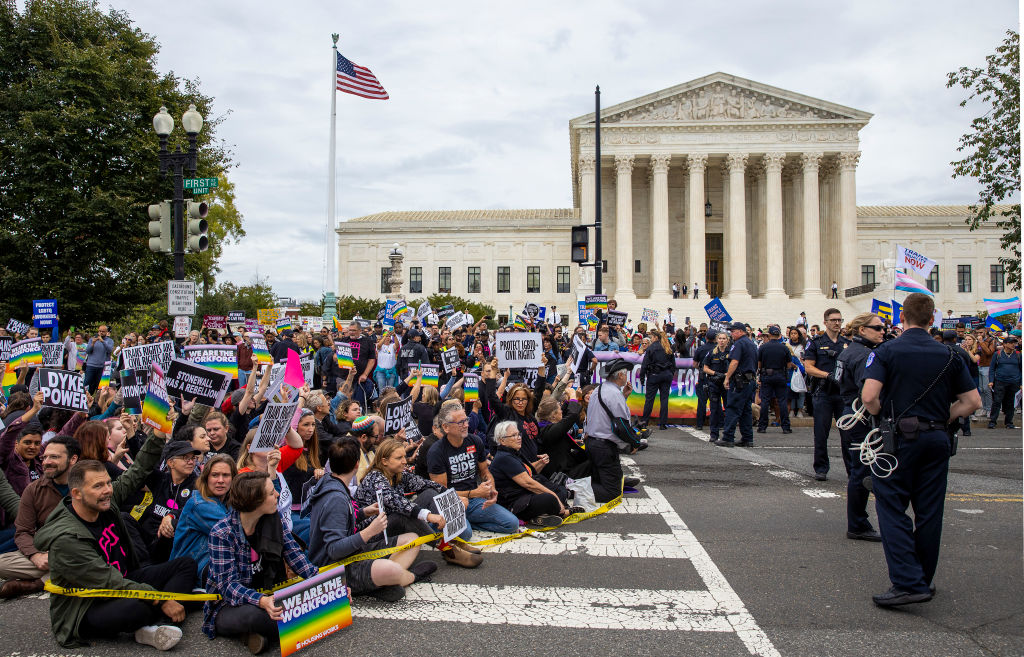
Protesters block the street in front of the Supreme Court as it hears arguments on gender identity and workplace discrimination on October 8, 2019 in Washington, DC.Tasos Katopodis / Getty
The Supreme Court is hearing argument to rule on whether Title VII of the Civil Rights Act of 1964, which prohibits employers from discriminating against workers on the basis of sex, ought to extend to sexual orientation and gender identity as well.
The swing vote looks to be Neil Gorsuch, nominated to the court by Donald Trump. Gorsuch’s comments illustrate that he’s receptive to the plaintiffs’ arguments: when a person is discriminated against because of their sexual orientation or gender identity, “Isn’t sex also in play here, and isn’t that enough?” he asked.
Quite right. The basis of discrimination against, for example, a lesbian worker is precisely that she is a woman who dates women. Sex is at the heart of the objection; the idea that women ought to date men instead is the entire rationale. If it’s already unconstitutional for an employer to discriminate against a worker because she doesn’t conform to the behavior expected of her based on her sex — for example, that she dress a certain way — then the law ought to extend to other instances of sex-related nonconformity as well.