We Can Have Cop City, or We Can Have Democracy
Atlanta’s Democratic leadership is trying to build a massive police urban-warfare training facility before the public can stop it. The outcome will set a precedent for the political future, with implications well beyond the city itself.
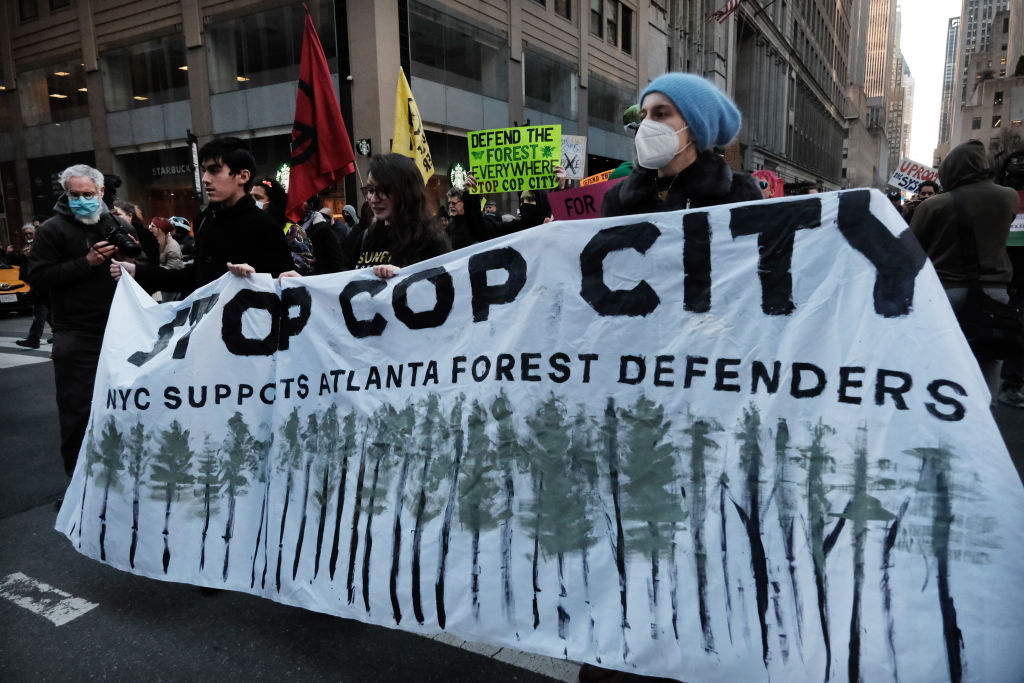
Activists participate in a protest against Cop City on March 9, 2023, in New York City. (Spencer Platt / Getty Images)
Atlanta residents are awaiting a court decision on whether they will be allowed to vote on the construction of a massive new police training facility, dubbed “Cop City.” The $110 million Atlanta Public Safety Training Center would draw police trainees from across the country and contain an entire mock city, a model strikingly similar to the Israeli military’s “mini-Gaza” used to train Israeli troops for urban combat.
Atlanta’s Cop City was proposed after the 2020 George Floyd uprising, the mass protest movement sparked by the murder of George Floyd by then officer Derek Chauvin in Minneapolis, MN, and other instances of racist police violence. As with earlier waves of Black Lives Matter protests, 2020 led to some policing reforms — many imposed by voters through ballot initiatives — but in general, police institutions responded to the movement by preparing for war. Just over a year after George Floyd took his last breath, the Atlanta city council voted to green-light Cop City.
From the moment it was announced, many Atlanta residents have fought bitterly to stop Cop City, while the city government is doing its best to build it anyway. The effort to ram Cop City past public opposition is dovetailing with antidemocratic measures and increasingly draconian anti-protest laws across the country, in a bipartisan spiral toward authoritarianism that we ignore at our peril.