Narendra Modi’s Election Setback Has Opened Up a New Horizon
The political formulas that worked so well before for Narendra Modi proved less effective this year and he lost his single-party majority. Modi will remain in office, but his opponents will be more confident that they can challenge his Hindutva agenda.
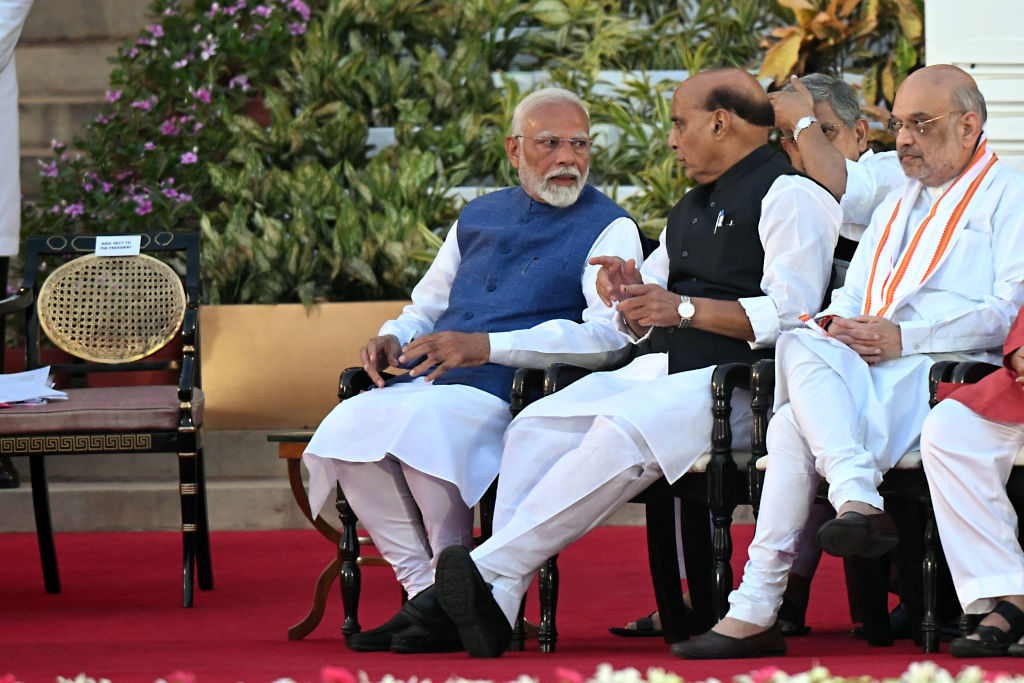
Indian prime minister Narendra Modi, left, speaks with Rajnath Singh, senior leader of the Bharatiya Janata Party, during a swearing-in ceremony at the Rashtrapati Bhawan in New Delhi, India, on June 9, 2024. (Prakash Singh / Bloomberg via Getty Images)
Narendra Modi has won a third successive term as India’s prime minister in a much closer general election than expected. The ruling coalition, the National Democratic Alliance (NDA), which is dominated by Modi’s Bharatiya Janata Party (BJP), won 293 of the 543 seats in the lower chamber of the Indian parliament, the Lok Sabha. The opposition bloc, the Indian National Development Inclusive Alliance (INDIA), led by the Indian National Congress (INC), got 234 seats.
Many pundits and a major portion of the media had believed that Modi’s unbridled march would result in an easy victory, but the results showed otherwise. Modi’s ambitious slogan “Ab ki baar, 400 paar” (“this time, 400 plus”) failed terribly, with the BJP losing its single-party majority and obtaining only 240 seats in the Lok Sabha, down from 303 in 2019.
If there is one figure that reflects the personal aspect of Modi’s tumble, it is the reduced victory margin of 152,513 votes — down from 471,000 in 2019 — by which he won his own seat in Varanasi. It is not only the margin that has decreased. The prime minister received roughly sixty-two thousand fewer votes this time, despite the fact that the total number of votes cast in the constituency increased by about seventy thousand, with his vote share dropping from 63.6 percent to 54.2 percent.