Spain’s Socialist Party Has Survived but Is Still in Danger
- David Broder
Spain’s Socialist Party is Europe’s strongest center-left force, easily winning last Sunday’s Catalan elections. But it’s gaining at the expense of its own coalition partners, whose weakness risks bringing Pedro Sánchez’s broad-left government to its knees.
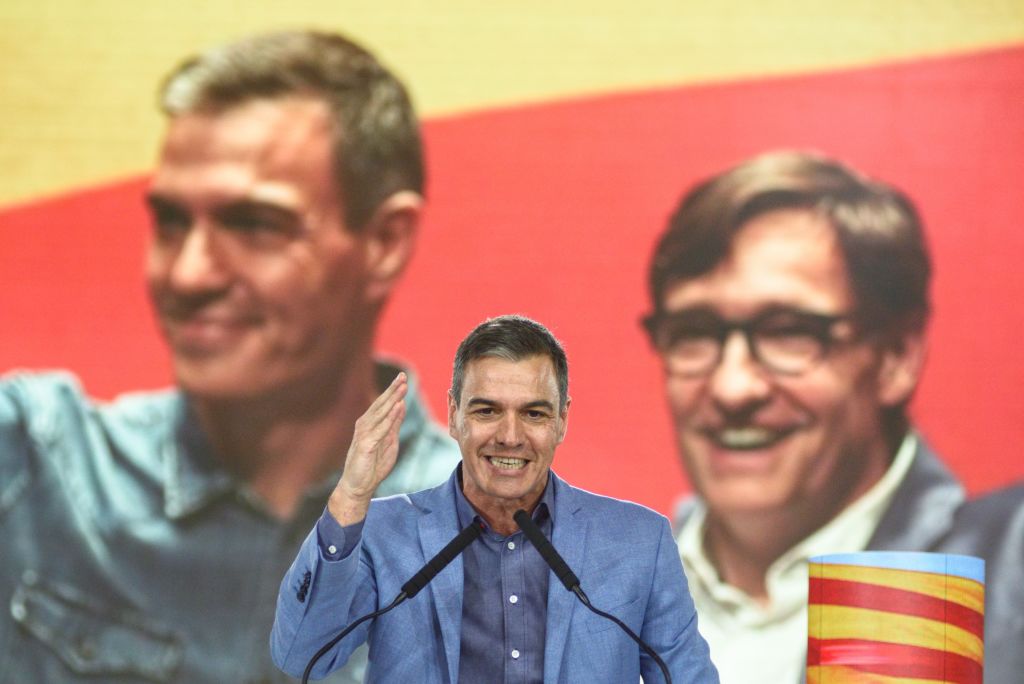
Spanish prime minister Pedro Sánchez speaks at the Palau de Congressos de Catalunya, on 18 May, 2024, in Barcelona, Catalonia, Spain. (Alberto Paredes / Europa Press via Getty Images)
The Left, broadly defined, is in clear decline across Europe — while the Right, especially the far right, is thriving like it hasn’t done since 1945. Ahead of June’s European elections, the trend is unmistakable: social democrats, greens, and other left-wing parties are set to lose around forty seats in the new parliament. After the fall of the Partido Socialista prime minister António Costa in Portugal, Spain is today the only European Union (EU) country with a meaningfully left-wing government. While other governments may appear “progressive” on paper, such as Slovenia’s, many are either grand coalitions (like Denmark’s) or lean more toward the center than the left (like Germany’s). Events in Spain, then, are more decisive than might be imagined.
So, what’s going on in Spain? Madrid was surely a crucial target for the European right, especially after the Partido Popular and Vox won the local elections in May 2023. German Christian Democrat Manfred Weber, who is president of the EU-wide European People’s Party (EPP), and Italian prime minister Giorgia Meloni strategized for Spain to follow the same path as Italy, Finland, and Sweden by forming a coalition between the mainstream right and the far right. However, the snap general elections last July 23 saw a different outcome due to a strong mobilization of the broad-left electorate, allowing the coalition government to continue.
Still, Pedro Sánchez, the Partido Socialista Obrero Español (PSOE) leader who has been prime minister since June 2018, managed to stay in office by forming a diverse coalition that includes not only the left-wing alliance Sumar but also various regionalist and nationalist parties, including Catalan and Basque pro-independence forces. This minority government relies on the support of almost every parliamentary faction except the conservative Partido Popular and far-right Vox. Yet even this risked being upset this spring by an extended electoral cycle that began with Galicia’s regional contest in February, continued with the Basque elections in April and the Catalan elections in May, and will end with the European elections on June 9.