The Palestinian Resistance Isn’t a Monolith
As Palestinians reckon with the genocide being inflicted on them and their prospects for national liberation, it does them a disservice to flatten their political diversity and complex ongoing debates.
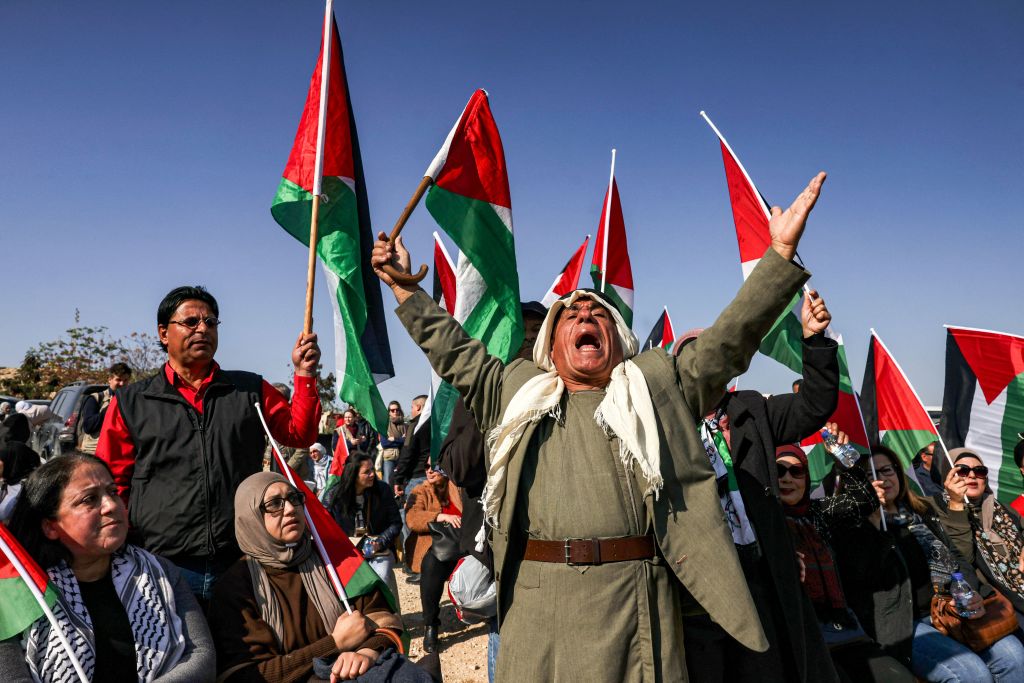
Palestinians demonstrate in the village of Khan al-Ahmar in the occupied West Bank on January 23, 2023. (Hazem Bader / AFP via Getty Images)
Since October 7, any critical evaluation of Hamas’s military operation — its method, rationality, and targets, or its role in ending the Israeli occupation — has been hard to voice within the Left. This is so not only because an occupying power is ultimately responsible for the destructive status quo, but also because criticizing the tactics of a group acting in the name of the oppressed is seen as undermining their rightful cause.
This situation is compounded by numerous intellectuals on the Left who have voiced unconditional support — if not celebration — for Hamas’s attack. A recent post on the Verso Books blog places a socially regressive religious movement like Hamas into the universal emancipatory tradition of the Left, stating that “the paragliders who flew into Israel on October 7 continue the revolutionary association of liberation and flight.”
Andreas Malm has suggested that the Al-Aqsa Flood operation achieved more than the First Intifada because Palestinians managed to replace stones with military arms — ignoring that the intifada was the largest self-organized anti-colonial mass movement in Palestinian history, and that it compelled Israel to make unprecedented political concessions. Indeed, to argue that Hamas has managed to achieve more is to totally ignore that its military attack has triggered a huge genocide against the Palestinian people.