Effective Altruists Are Stoking Tensions With China
The Biden administration has had an open-door policy for effective altruist think tanks in the White House — who have in turn used their influence to push a hawkish anti-China agenda by casting the development of AI as the new arms race.
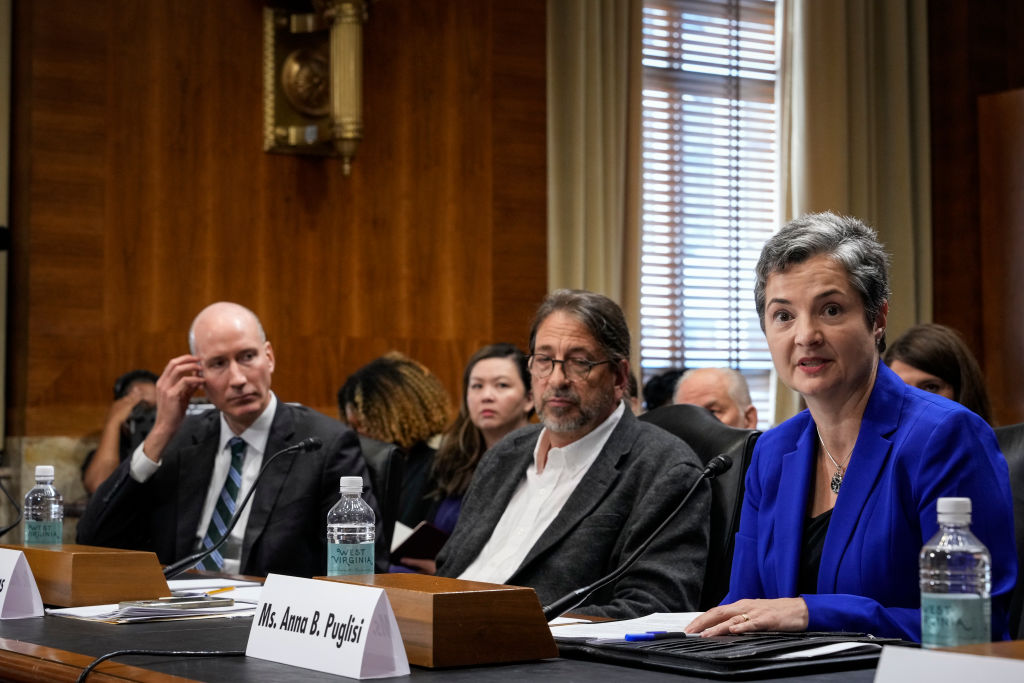
Anna Puglisi (R), senior fellow at Georgetown University’s Center for Security and Emerging Technology, testifies during a Senate Energy Committee hearing focusing on the administration’s role in ensuring US competitiveness in AI technologies on September 7, 2023, in Washington, DC. (Drew Angerer / Getty Images)
Effective altruism (EA) has, in just a few years, morphed from a niche academic fad to a thoroughly mainstream worldview. After years flying under the radar, the long financial reach and ideological penetration of effective altruist organizations and individuals in Washington have finally begun to attract media attention. Effective altruists attempt to number-crunch solutions to societal ills by devising ingenious ways, frequently reliant on the latest artificial intelligence (AI) technology, that states and wealthy individuals can maximize the benefits of policy interventions or charity contributions, often with a special focus on very long-term outcomes.
In the United States, most criticism of the movement’s political influence has focused its attention domestically. The argument that AI, when it is used to speculate about the future or make decisions about the present, often bakes in sexist or racist assumptions is well known. While this is of course an important issue, bigger picture concerns, such as the actual influence of EA-dominated approaches to technology-powered decision-making in Washington, have largely fallen out of view. Nowhere has the dangers of EA been more serious, however, than in the school’s escalation of economic hostility toward China.
An Open Door to the White House
As I wrote in Jacobin last May, President Joe Biden’s historic October 2022 semiconductor export bans gave every indication of being carefully directed by the Center for Security and Emerging Technology (CSET), an EA-aligned, Open Philanthropy–funded think tank based at Georgetown University. Senior White House figures ideally situated to dictate the contents of the controls had, in their capacity as CSET members and alumni, spoken and written extensively about their desire to use export regulation to hamper China’s relative progress on AI.