China’s Climate Pledge Is Historic in Scale, but Wobbling
Chinese president Xi Jinping’s focus on green investments overseas under the Belt and Road Initiative is ambitious and environmentally necessary. But tighter enforcement of its climate pledge is necessary to curb coal on a global scale.
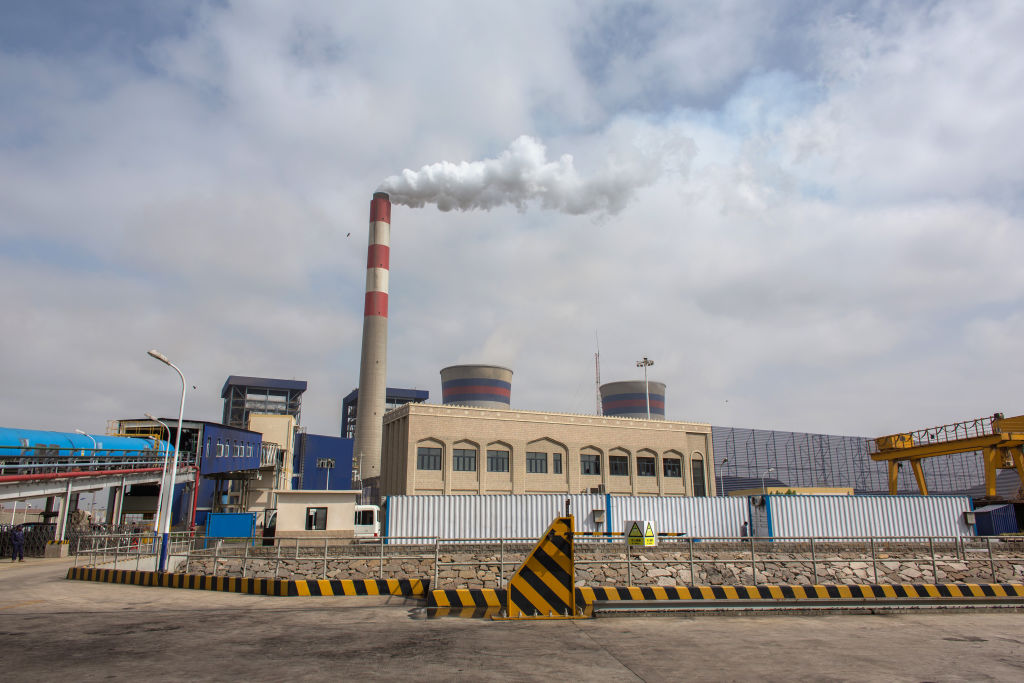
Emissions rise from a chimney at the Port Qasim coal power plant operated by Port Qasim Electric Power Co., a joint venture between Power Construction Corp. of China and QInvest LLC, in Port Qasim, Sindh Province, Pakistan, on September 19, 2018. (Asim Hafeez / Bloomberg via Getty Images)
Activists struggling to reverse a surge in new coal plants around the world have yet another fight on their hands: one of the world’s most ambitious anticoal pledges is looking fragile.
Back in 2021, China’s president, Xi Jinping, announced that the nation’s titanic, $70 billion-a-year investment program known as the Belt and Road Initiative (BRI) would throw its weight behind green energy and ban investments in coal projects overseas.
The BRI is the boldest foreign investment commitment by any single country by a long shot. In scale, it dwarfs US president Joe Biden’s Partnership for Global Infrastructure Investment — a counter to the BRI that aims to commit $200 billion over the next five years. And while the US version lacks detail apart from a handful of flagship proposals, Chinese policymakers can point to a multiyear track record of green investments.
Yet like many sweeping declarations of good climate intentions, Xi Jinping’s pledge may have been too good to be true.
Already, loopholes and gray areas have allowed several major coal projects to go ahead with Chinese backing. As nations around the world leap to shore up energy security by any means necessary in the wake of an energy crisis following Russia’s invasion of Ukraine, more coal projects may be on the horizon, raising the prospect of ever more emissions from the dirtiest fossil fuel. Fueled by little guidance from Beijing, China’s overseas coal pipeline has become a major risk.
“It’s concerning in terms of what’s going to happen in the future,” said Nandikesh Sivalingam, director of the Center for Research on Energy and Clean Air (CREA).
Belt and Road
For developing nations looking to fund major infrastructure, the BRI, funded by a web of Chinese banks and institutions that lends across 148 nations, is pretty much the only game in town. In the decade since the initiative was launched in 2013, more than $1 trillion worth of financing and investments have poured mostly into the Global South, according to data from the Green Finance and Development Center at Fudan University in Shanghai.
When Xi promised the UN General Assembly in 2021 that China wouldn’t build any new coal-fired power projects overseas as part of this large-scale initiative, it was cheered by climate campaigners. Moreover, Xi added that China would ramp up spending on green fuels, ushering in what was meant to be a grand new “green” BRI. In 2022 China went further, upping the nation’s green investments by half. Then, late last year, China announced an additional $100 billion in financing and a new green project pipeline that will help identify potential opportunities.
Yet behind the headlines, the picture is less clear. Key among the major problems: China’s coal ban only applied to new projects.
Data from CREA, published in October of last year, shows that of the 103 coal plants in twenty-eight countries in various stages of planning and permitting at the time of the pledge, just thirty-six were outright canceled. In eleven cases, the report noted, plants that had been previously shelved or canceled were quietly revived, although at least one of those projects, Bosnia and Herzegovina’s Tuzla 7 plant, appears to have been scrapped yet again.
In a major blow to the dreams of green-power campaigners, several of the projects slipping through the loopholes are enormous.
Take Pakistan’s Gwandar coal plant, situated in a port city in the southwestern part of Pakistan and part of a crucial economic corridor that Beijing has sought to develop for nearly a decade. The plant was first approved in 2016, then delayed, and then officially abandoned when Pakistan’s Ministry of Energy announced that the plant would be replaced by an ambitious solar project instead.
The solar project was, at the time, in keeping with Pakistan’s 2020 vow not to build more new coal-fired power plants — a vow that was quickly reversed in 2023 when the country, facing an energy crisis, said it would quadruple its coal-fired capacity. Gwandar’s plant, a sprawling three hundred–megawatt project, is just one part of that push.
Gray Area
Another major loophole campaigners point to is the lack of clarity around whether China’s pledges also apply to captive plants, or plants attached to industrial facilities that are only used to power those same facilities.
Such captive plants have exploded in popularity in Indonesia, often with Chinese backing. According to a report by CREA and the Global Energy Monitor, coal capacity additions have outpaced renewables as Indonesia stumbles in its bid to contain emissions. Of the eleven dormant, Chinese-backed projects identified by CREA that have now been renewed, five of them are captive Indonesian plants.
Meanwhile, CREA’s October report noted that two entirely new captive projects (which were not disclosed prior to Xi’s announcement in front of the UN) have emerged. Both projects are in Indonesia, and represent combined lifetime emissions of over two hundred million tons of carbon dioxide.
CREA’s Sivalingam added that part of the problem is a lack of clarity from the Chinese government on which plants will be canceled under the terms of the 2021 pledge and which will go ahead.
“The ambiguity around captives is a challenging issue,” he said. “There’s a lot of scope to increase transparency around captive deployment, and of course making them green in the long run.”
Major Blow
China’s half-hearted enforcement of the pledge has dealt a major blow to efforts to curb coal, particularly as nations around the world seek to shore up domestic energy capacity after the Ukraine conflict left governments scrambling.
Data from the Global Energy Monitor’s coal tracker showed new coal-fired power capacity increasing by forty-seven gigawatts in 2022 after steadily dropping off since 2019. In the first half of 2023, the world had already added an extra twenty-six gigawatts in coal power. Two-thirds of the world’s coal plants currently under construction, meanwhile, are in China, with India and Indonesia following close behind.
Yet, for all the setbacks, CREA’s Sivalingam says that he remains optimistic about the future of the BRI. On the whole, there are reasons to celebrate.
For one, Xi Jinping’s focus on green investments overseas has produced results. In an appraisal, the Green Finance and Development Center concluded that the first half of 2023 was the greenest in any six-month period in the history of the BRI. Over those months, 41 percent of China’s investment and financing went to solar and wind projects and 14 percent to hydropower, an engagement to the tune of about $4.8 billion. At the same time, the BRI pared down investments in the oil and gas sector to a historic low.
That’s become increasingly more important as efforts to help vulnerable nations falter. The UN Green Climate Fund has warned that after the United States repeatedly failed to deliver funds, it may need to limit operations. Former president Donald Trump has also promised to scrap even the paltry $3 billion promised to the fund by the Biden administration if Trump returns to the White House in 2024.
Meanwhile, the plants China decided to cancel have helped. CREA figures show that between all the scrapped coal projects, the world was spared a combined 4.1 billion tons of coal emissions. If China canceled all planned coal capacity, it would result in an emission avoidance of 227 million tons of carbon dioxide every year, a crucial if insufficient step for campaigners.
“Right now, it’s about ambition, how much countries want to invest, how ambitious they want to get to accelerate the progress toward transition,” Sivalingam said. “The transition is inevitable. Now, how fast can it happen?”