The Paris Commune Struck Fear Into the Hearts of the British Elite
In 1871, elite British writers were horrified by the threat to the bourgeois social order that the Paris Commune represented. But their working-class counterparts expressed profound sympathy for the Communards and their revolutionary aspirations.
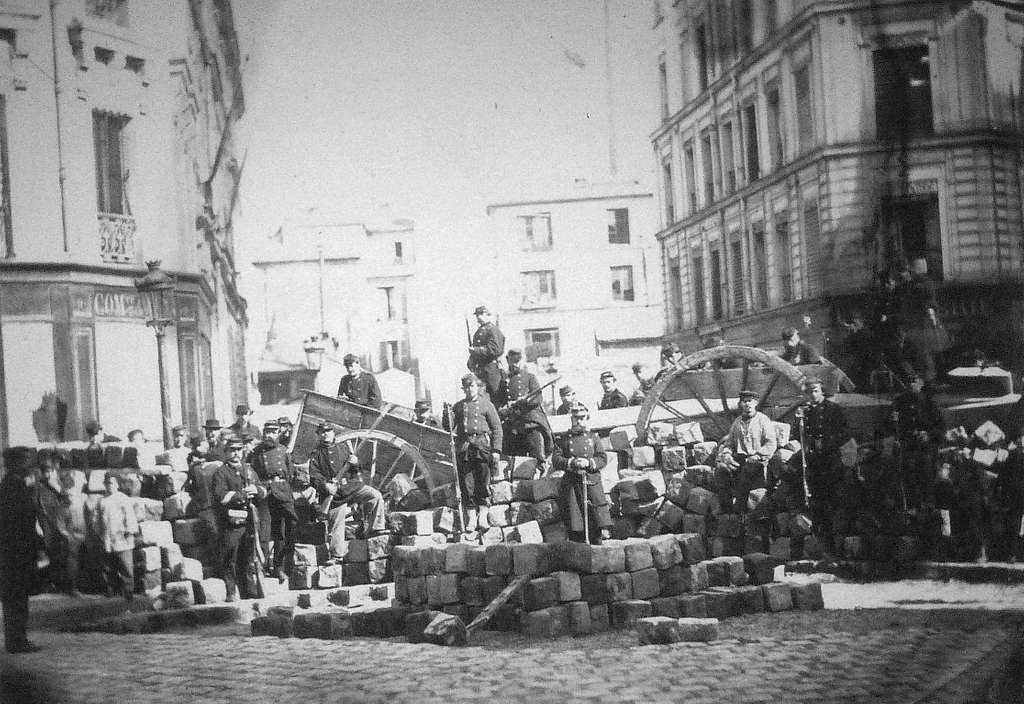
A barricade during the Paris Commune of 1871. (Musée Carnavalet / Wikimedia Commons)
Those historical moments when civil order is suspended, when the political edifice trembles and flinches, are almost always instructive in hindsight. The causes, events, and ramifications are pored over by journalists, and lawmakers shore up the edifice with specific legislation, often as repressive as they can get away with in the contemporary political culture. Just occasionally lessons are learned, and social, cultural, and political attitudes shift to address, at least in part, the original grievances. However, when the threat to the social fabric offers a coherent alternative political model, when civil disobedience is organized and militarized, these historical moments resonate at a much greater order of magnitude. And when the capital city of a nation is occupied by a revolutionary government, the effects transcend borders and resonate internationally.
Owen Holland’s admirable volume Literature and Revolution unpacks one example of this resonance: the British literary response to the Paris Commune of 1871. Britain’s shock at the events in a neighboring nation, just twenty-one miles across the water, may have been tempered by comparable precedents, but the French Revolution had occurred almost a century previous, and 1848’s Europe-wide revolutionary conflagration was politically various in nature. It is a historical commonplace that the former influenced British literary Romanticism, and that the latter triggered the suppression of British Chartism and the dissolution of its attendant working-class radical writing culture. But the British literary response to the Commune has not been comprehensively studied until now.
Early in Holland’s book, he quotes from Chris R. Vanden Bossche’s 1991 volume, Carlyle and the Search for Authority, in relation to the nineteenth-century commentator’s The French Revolution: A History (1837). He neglects, however, to refer to Vanden Bossche’s 2014 book, Reform Acts: Chartism, Social Agency, and the Victorian Novel 1832–1867, which can be seen as a more historically expansive domestic treatment of the effects of political change on mainstream fiction, and which nevertheless covers some of the same methodological ground as Holland’s work. This is not to suggest a Bloomian anxiety of influence but rather to note that the reading of “canonical” or “middling” Victorian literature through specific political events is a welcome trend from which rich seams can be mined, and Holland’s work is very much part of this turn.