North Carolina’s Legislature Wants to Destroy Public Schools
North Carolina’s voucher plan diverts vast amounts of public money to private schools, many of which provide substandard education and engage in open discrimination. Weakening public schools in the process, the scheme violates the universal right to education.
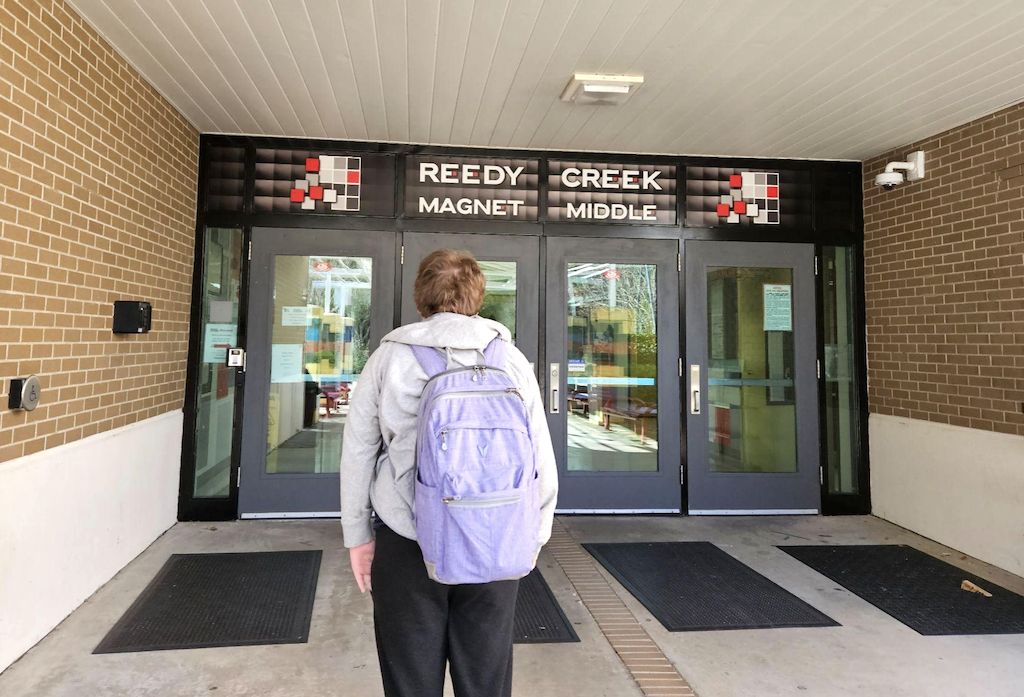
Thirteen-year-old Emerson enters Reedy Creek Middle School in Wake County, North Carolina. Emerson says that if he took a voucher, his needs would not be met. (Courtesy of Susan Book)
Susan Book says that, in theory, she “should be the poster child for private school choice” because of the “hell” her family went through at her son Emerson’s Wake County, North Carolina, public schools. Between kindergarten and fifth grade, Emerson, who has autism, experienced inappropriate and harsh discipline, segregation from nondisabled students, and extended removal from school through a program called Home/Hospital.
During this ordeal, Book began researching a statewide voucher program that allows parents of disabled students to apply for state funding for private education and therapies — provided they unenroll in public school. But the Wake County schools set up for autism all had gargantuan wait lists. And, Book was shocked to discover, many of the other private schools designated for special education didn’t even have a trained special education teacher on staff.
North Carolina has another, larger voucher plan — the Opportunity Scholarship — that has been publicly subsidizing private schools since 2014. But many of the nondisability-specific schools simply refuse to enroll children with disabilities, while others add upcharges for special learning needs. One of the modifications Emerson depends on is a one-on-one aid to help him access the curriculum. In public school, this service is free and guaranteed through his legally binding Individualized Education Program (IEP). But in the Wake County private schools that would theoretically accept someone like him, Book told Jacobin, a one-on-one was $15 an hour, on top of pricey tuition that already exceeded what either voucher program would cover.