Edgelord GPT
Elon Musk doesn’t care about free speech. He wants everyone — including his new “anti-woke” chatbot — to think like him.
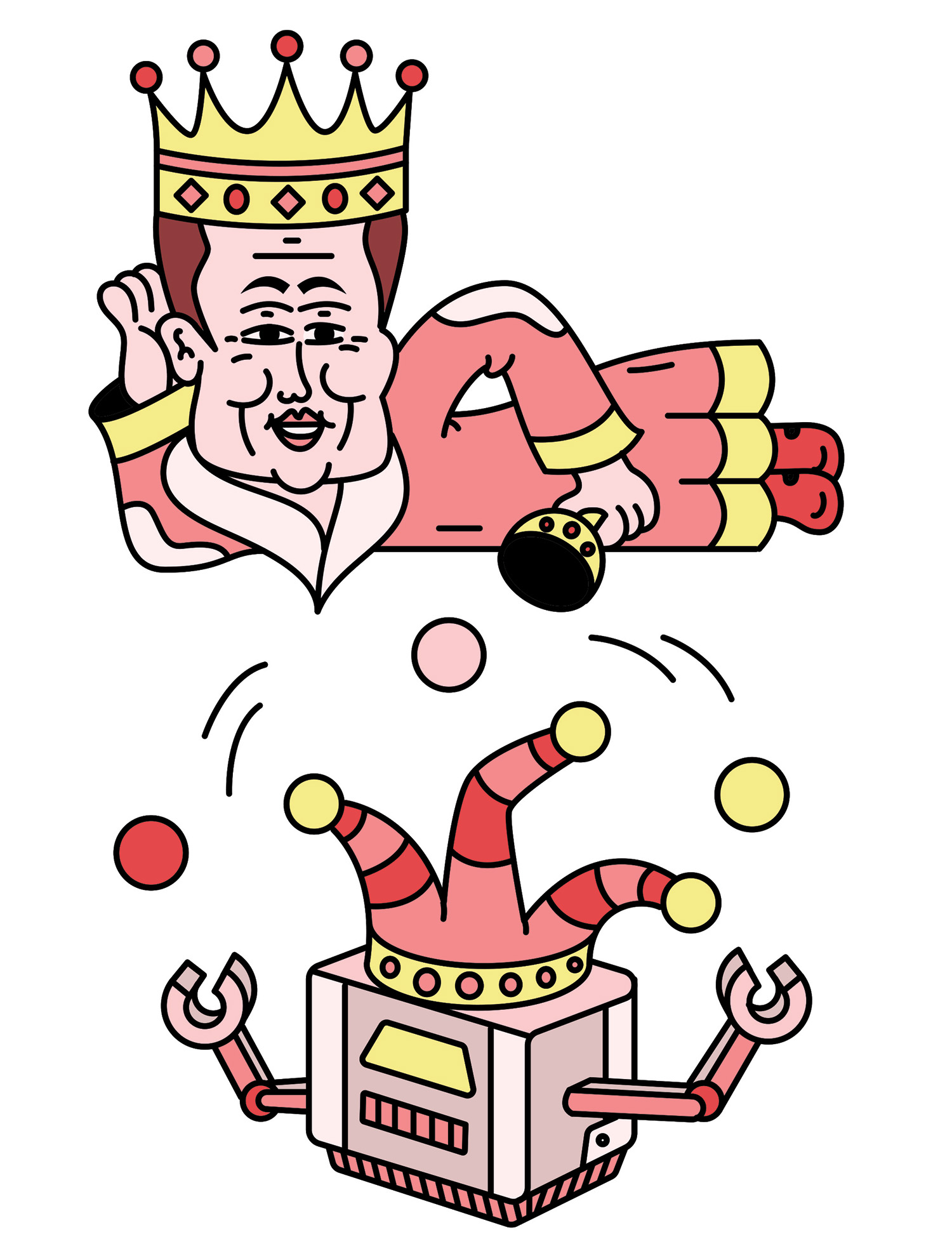
Illustration by Hunter French
On November 4, 2023, billionaire and free-speech crusader Elon Musk graced the world with his latest creation: a “spicy” chatbot called Grok. Intended to counteract “woke” AIs like ChatGPT by offering more “truthful,” less censored answers, Musk’s bot was reportedly inspired by Douglas Adams’s Hitchhiker’s Guide to the Galaxy — a text that, as Ronan Farrow pointed out in the New Yorker, mocked “both the hyper-rich and the progress-at-any-cost ethos that Musk has come to embody.” Grok promises to cure the “woke mind virus,” a condition so controversial and insidious that Musk could only discuss it on national television with his close personal friend Bill Maher.
Grok’s name, meanwhile, derives from Robert Heinlein’s Stranger in a Strange Land, a 1961 libertarian science-fiction novel whose ethos is completely at odds with Adams’s. As Heinlein’s Martian character explains to his human friends, to “grok” something is to “understand it so thoroughly that you merge with it.” Grokking is not, then, the performance of “spiciness” but a form of empathetic active listening. It’s telling that Musk can’t even grok his own literary sources, but ideological incoherence has never stood in his way before.
Musk has a long-standing interest in artificial intelligence and was an early investor in OpenAI. Yet by 2018, according to Farrow, he had grown so “frustrated by his lack of control” over the company that he withdrew financial support. After OpenAI released ChatGPT in late 2022, Musk began complaining that the bot is dangerously “woke.” In April 2023, he told Tucker Carlson, then still with Fox News, that he intended to create an alternative called TruthGPT, a “maximum truth-seeking AI that tries to understand the nature of the universe.” The result is Grok, for now only available to premium subscribers of Twitter/X.