For Kurds, the War in Gaza Shows the Need for a Democratic Reordering of the Middle East
The war in Gaza has split Kurdish opinion, marked by often strong hostility to Islamism as well as Zionism. But Kurds’ responses also draw on their experience of statelessness — and point toward a democratic order not based on rival nation-states.
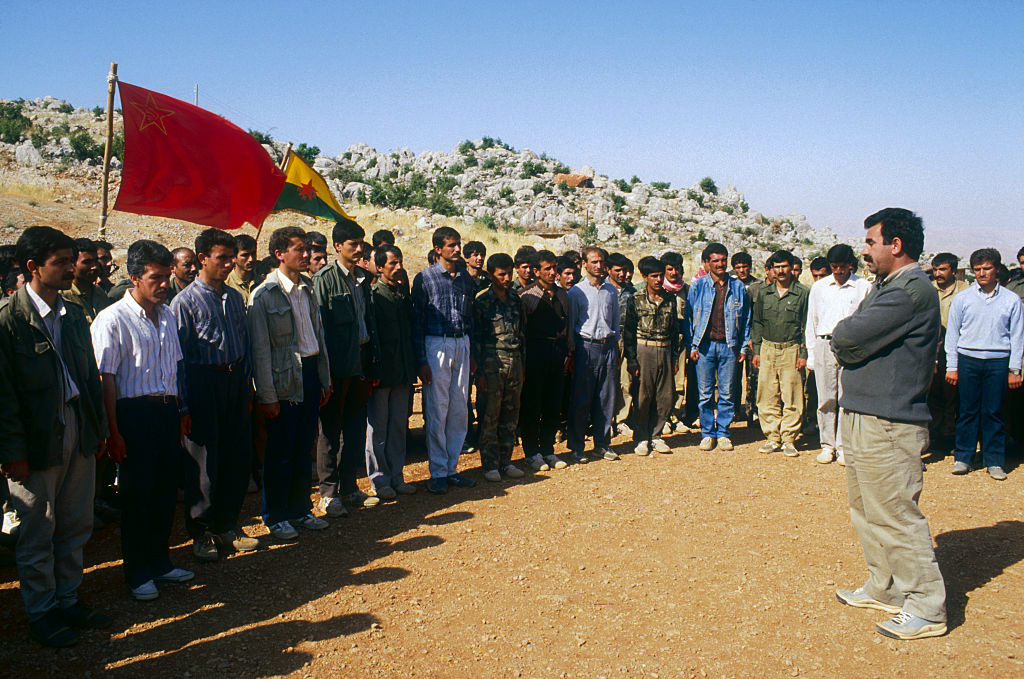
Kurdistan Workers’ Party general secretary and military leader Abdullah Öcalan addresses soldiers at the Mahsun Korkmaz Academy military training camp in Lebanon, June 18, 1988. (Maher Attar / Sygma via Getty Images)
For the Kurds, it’s a familiar scene. Jihadist militants, backed by a notorious state sponsor of terrorism, target members of an embattled minority. They run amok, parading and abusing captured women, trampling their naked bodies in the street.
Another familiar scene: a vastly superior, militarized, authoritarian power skulks behind a foreboding border wall, defended by high-tech sensors and automated machine guns, as drones hum overhead. Settler colonies push deep into ancestral territories, as grandmothers are stripped and humiliated at checkpoints that impose a twenty-first-century apartheid. Armed and abetted by its Western allies, the occupier punishes civilians with lifelong control and incarceration, the total destruction of humanitarian infrastructure, and endless, punitive bombing campaigns, killing civilians in vastly greater numbers.