Electric Vehicle Factories Are Overwhelmingly Nonunion. The UAW Strike Could Change That.
A key conflict in the United Auto Workers strike, which could begin at midnight tonight, is over the electric vehicle industry. The vast majority of EV plants are low-wage and nonunion despite being publicly subsidized — and the UAW is trying to fix that.
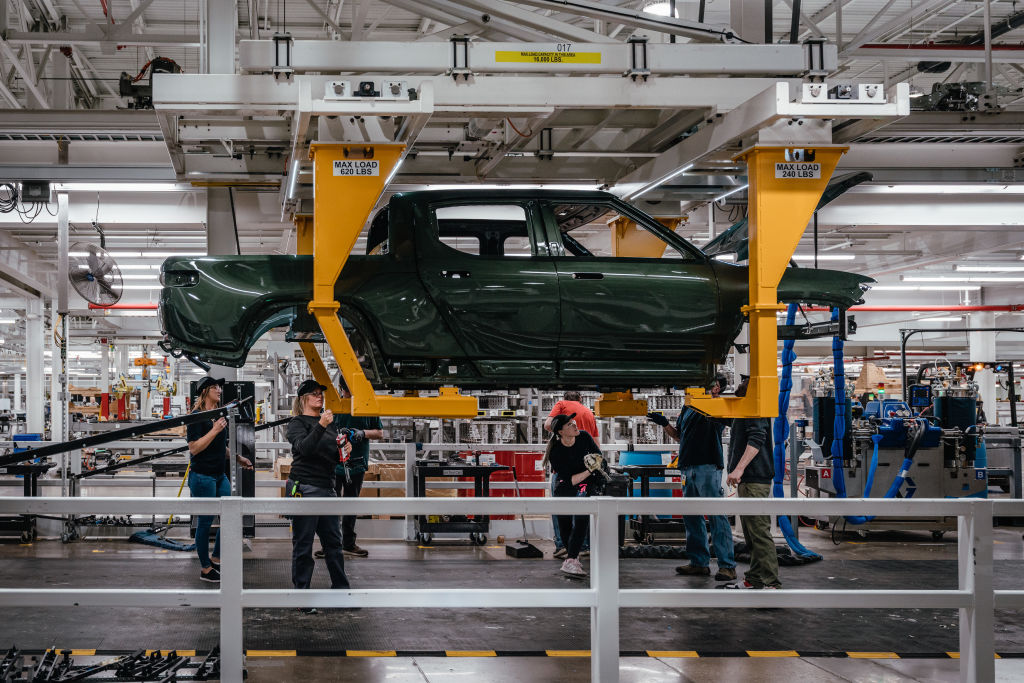
Workers assembly components of a Rivian R1T electric vehicle (EV) pickup truck at the company’s manufacturing facility in Normal, Illinois, on April 11, 2022. (Jamie Kelter Davis / Bloomberg via Getty Images)
In the year since President Joe Biden signed the Inflation Reduction Act (IRA) in August 2022, its incentives and tax credits for electric vehicles (EV) have accelerated the United States’ burgeoning swath of battery plants. The EV industry will receive an estimated $220 billion by 2031, and customers purchasing a vehicle can pocket a tax credit ranging from $3,750 to $7,500. An increasing majority of battery components are to be produced and assembled domestically. While China remains the global leader in battery manufacturing, North America has emerged as the fastest-growing EV battery hub, surpassing Europe.
The IRA also extended additional manufacturing tax credits to the Internal Revenue Code. Companies are reimbursed 10 percent of the cost of producing renewable energy. The section grants a $35 credit for every kilowatt-hour of battery cell production and a $10 credit for those of modules. Various analysts estimate the ten-year tax credit may provide battery cell manufacturers with an extra $135-200 billion.
Amid high-stakes contract negotiations with the Big Three automakers, newly elected United Auto Workers (UAW) president Shawn Fain has criticized Biden’s packages for not tying public spending to worker protections. While the IRA includes prevailing wage standards and apprenticeship programs for the construction industry, it is silent on wages and working conditions in manufacturing. “The UAW supports and is ready for the transition to a clean auto industry,” Fain said in a late August statement. “But the EV transition must be a just transition that ensures auto workers have a place in the new economy.”