Latin America Has Lost One of Its Last Great Revolutionaries
Adolfo Gilly witnessed some of the most dramatic events in Latin American historyand wrote about them with unparalleled clarity. With his recent passing, the LatinAmerican left lost one of its most compelling voices.
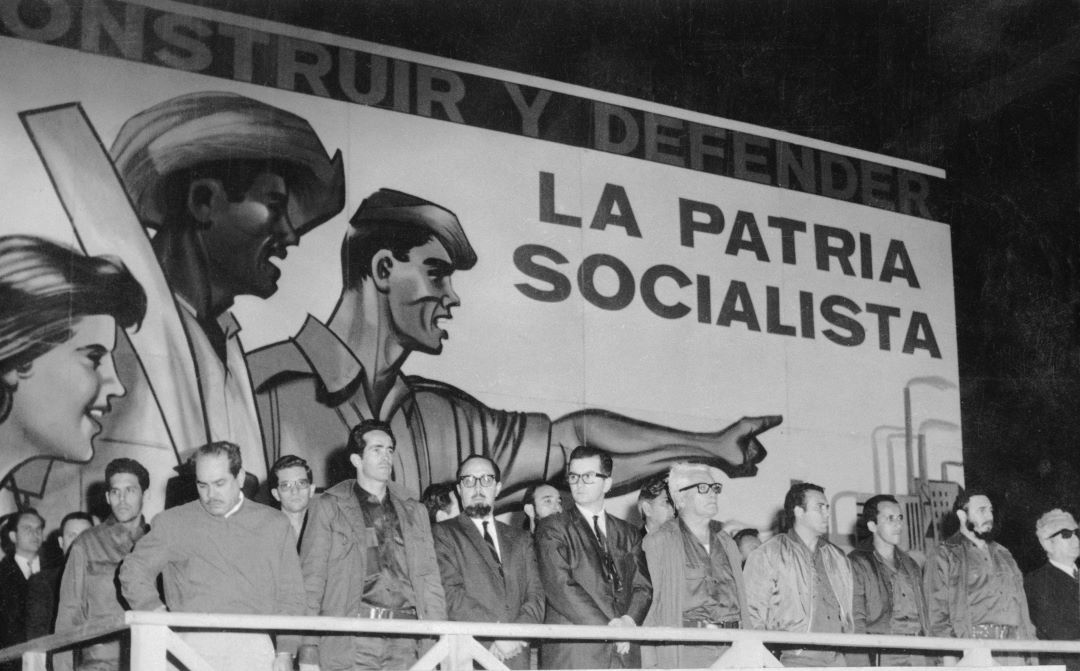
View of the presidential stand at a rally held by Fidel Castro, in Havana, Cuba, 1962. Adolfo Gilly visited Cuba and observed the new Communist government firsthand from 1962 to 1963. (Bettmann / Getty Images)
With the death of Adolfo Gilly on July 4, 2023, the Latin American left didn’t just lose one of its most lucid Marxist thinkers. It also lost a man who directly experienced many of the region’s key events of the past seventy years, from the Bolivian Revolution of the 1950s to the Cuban Missile Crisis, the guerrilla movements of the 1960s to the Zapatista rebellion of the 1990s. His trajectory embodied the kind of roving internationalism that was such a distinctive feature of the region’s radical movements in the twentieth century. After his death, Mexican journalist Luis Hernández Navarro called him “the last of the Mohicans,” and it is hard not to feel that, as well as an individual loss, Gilly’s passing represents the closing of a remarkable chapter in the life of the Latin American left.
Born in Argentina but based in Mexico since the mid-1970s, Gilly is perhaps best known as a historian of the Mexican Revolution, especially thanks to his groundbreaking 1971 book, La revolución interrumpida (The Interrupted Revolution; translated as The Mexican Revolution in 1983). But it was not only his stature as a scholar that made him a renowned public figure in Mexico: Gilly was an articulate and principled voice on the Left, defending popular struggles and criticizing those in power with a rare combination of clarity and moral consistency.
Gilly came of age in Buenos Aires in the mid-to-late 1940s, at a moment when the populist movement of Juan Domingo Perón loomed over Argentine politics. Drawn at first to the Socialist Party, Gilly was expelled for taking too radical a stance against US imperialism. At the end of the 1940s, he gravitated to the Argentine branch of the Trotskyist Fourth International (FI), led at the time by the charismatic Homero Cristalli, better known under his pseudonym “J. Posadas.”