Actually, Voter Shaming Doesn’t Work
Voter shaming has never been an effective tactic, but the fact that it’s being discussed as one by the likes of Pod Save America’s hosts speaks to the increasingly post-democratic sentiments that have become common among elite liberals.
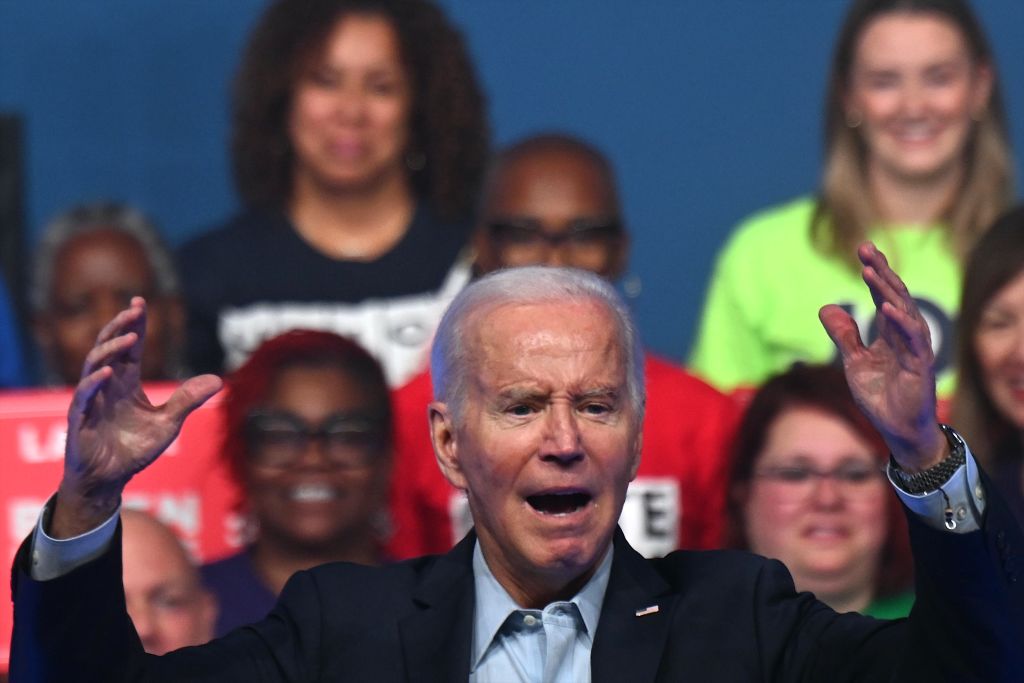
President Joe Biden speaking at a reelection rally on June 17, 2023 in Philadelphia, Pennsylvania. (Mark Makela / Getty Images)
On a recent episode of the influential liberal podcast Pod Save America, hosts Jon Favreau and Dan Pfeiffer agitated over the primary challenges being mounted against Joe Biden and the possibility that a third campaign might help throw the 2024 presidential election to Donald Trump. Here’s how the exchange begins:
FAVREAU: How much of a threat are these potential third-party candidates to Joe Biden’s reelection and what, if anything, can be done?
PFEIFFER: They’re an absolutely huge threat. Donald Trump has never received more than 47 percent in either of his two elections. And, the more people are on the ballot getting votes . . . it lowers his win number from 50.1 to something closer to 47. He won in 2016 largely because, in the battleground states of Pennsylvania, Michigan, and Wisconsin, the combined third party vote from Jill Stein and Gary Johnson — who was running on the Libertarian ticket — exceeded the margin by which he beat Hillary Clinton. So it is a big problem . . .
FAVREAU: . . . I mean, all people need to know is that, if the people who voted for Jill Stein in Michigan, Wisconsin, and Pennsylvania had voted for Hillary instead, Donald Trump would have never become president. That’s it, right? And so, you know, I’m sure there’s a lot of Cornel West fans out there [who] live in a swing state. [But if] you vote for Cornel West, you’re helping Trump become president. That’s it. And you can say “Oh well it’s Joe Biden’s fault . . . ” No, no, it’s your decision. You get to decide whether you want to help Donald Trump become president or you don’t.
In many ways, of course, the whole thing is just a tiresome relitigation of 2016. Some of the claims made by both hosts, moreover, fall apart when subjected to even basic scrutiny. For one thing, it’s untenable to assume that all or most of the United States’ relatively small third-party electorate would automatically vote Democrat if there were only two options. The average enthusiast for Gary Johnson, a Libertarian and former Republican governor, probably wouldn’t have counted Hillary Clinton as their second choice. Moreover, one could argue that Johnson’s 9 percent showing in New Mexico actually helped Clinton win there.