The Supreme Court’s Affirmative Action Ruling Is Not the End of Race-Conscious Admissions
Rather than ending affirmative action, as many headlines have stated, yesterday’s Supreme Court ruling has created new rules about how race can be considered in university admissions — and they might be more in line with left-wing rationales for affirmative action.
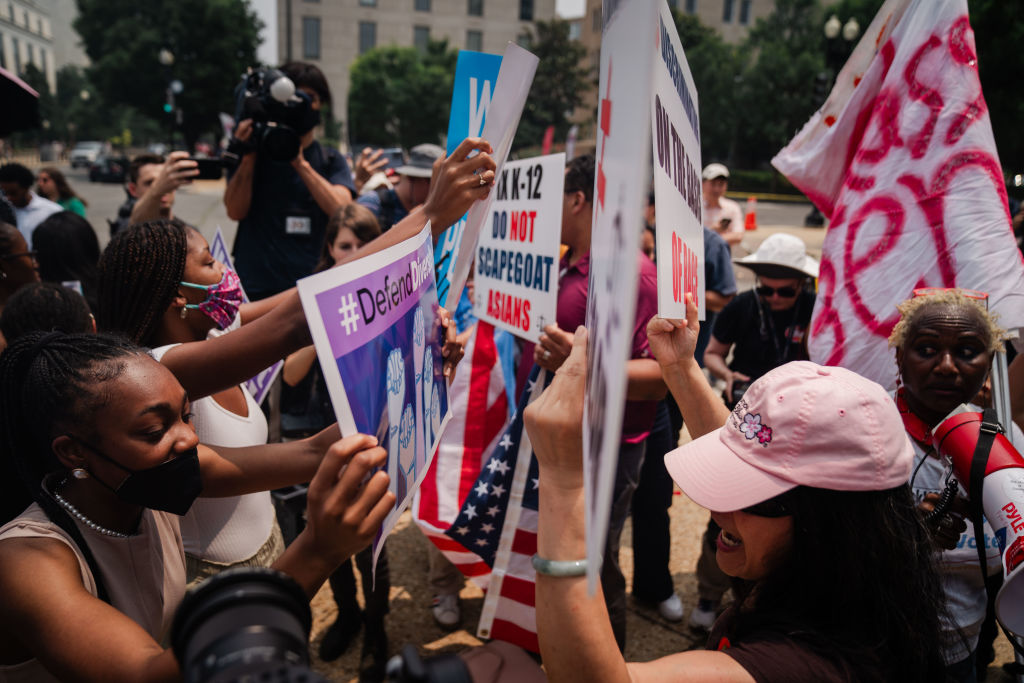
Affirmative action supporters and counterprotesters shout at each outside of the Supreme Court of the United States on Thursday, June 29, 2023 in Washington, DC. (Kent Nishimura / Los Angeles Times via Getty Images)
The Supreme Court ruled yesterday on the constitutionality of using race as a factor in determining who is admitted to selective universities. Most coverage of the ruling has stated that the court has ended affirmative action, but this is not really true.
Instead, the court has created new rules about how race can be considered in admissions. Under the old rules, race could be considered in service of the goal of creating a racially diverse student body in order to promote better education through exposure to different kinds of people. Under the new rules, race can be considered in the context of how it affected a particular applicant’s life, and how those effects reflect on the person’s character and unique abilities:
For the reasons provided above, the Harvard and UNC admissions programs cannot be reconciled with the guarantees of the Equal Protection Clause. Both programs lack sufficiently focused and measurable objectives warranting the use of race, unavoidably employ race in a negative manner, involve racial stereotyping, and lack meaningful end points. We have never permitted admissions programs to work in that way, and we will not do so today.
At the same time, as all parties agree, nothing in this opinion should be construed as prohibiting universities from considering an applicant’s discussion of how race affected his or her life, be it through discrimination, inspiration, or otherwise. But, despite the dissent’s assertion to the contrary, universities may not simply establish through application essays or other means the regime we hold unlawful today.