In Turkey, the Real Opposition Is on the Left
- Julia Damphouse
Today’s Turkish election will test whether President Recep Tayyip Erdoğan can hold on to power. His opponent, Kemal Kılıçdaroğlu, has made a pact with ultranationalists — showing that left-wing and Kurdish movements have to build an opposition of their own.
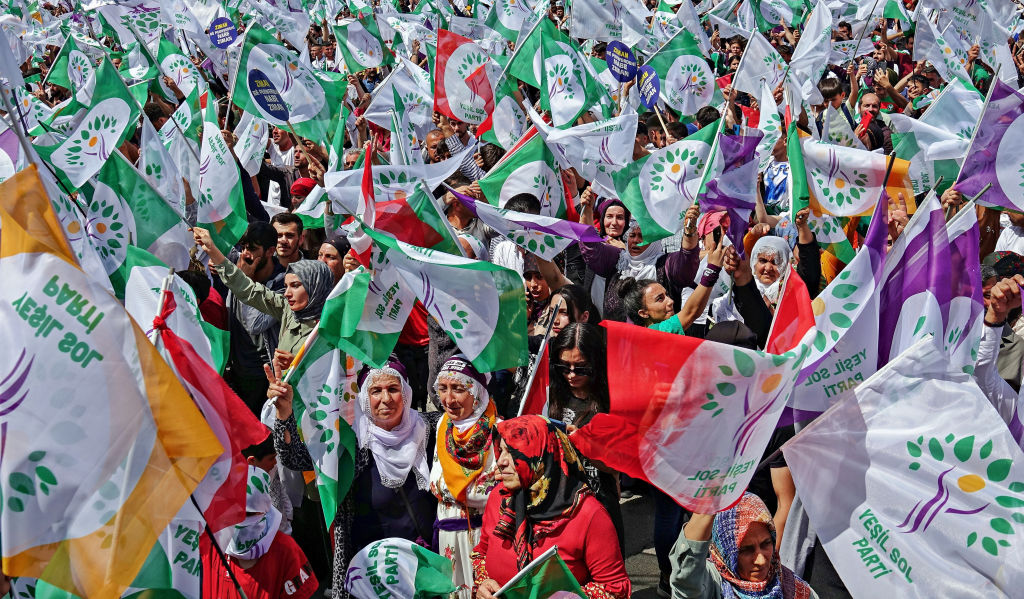
Supporters wave flags during a rally for the Green Left Party (YSP) in Diyarbakir, Turkey, May 13, 2023. (Mehmet Masum Suer / SOPA Images / LightRocket via Getty Images)
Turkey’s elections this May 14 were widely considered the most important in the country’s recent history. At stake was not only the future composition of the parliament, but a decision on the country’s political system and the legacy of President Recep Tayyip Erdoğan’s two decades in power. After an unusually short election campaign marked by repression and state censorship, voter turnout was nevertheless close to 90 percent.
President Erdoğan’s main opponent was Kemal Kılıçdaroğlu of the Republican People’s Party (CHP). He campaigned on the defense of democratic norms such as the separation of powers, and a return to the rule of law and a parliamentary system. Yet, he fell short of predictions, with his 44.9 percent of the vote placing him substantially behind Erdoğan, who scored 49.5 percent. The incumbent thus goes into today’s runoff vote with every chance of victory.
The result was even clearer in the parliamentary election, where the People’s Alliance — a coalition of Erdoğan’s Justice and Development Party (AKP) and far-right nationalist and religious parties — won an outright majority. By contrast, the progressive Alliance for Labor and Justice, led by the Green Left Party (YSP), took just 10 percent. It had run in the election in place of the Peoples’ Democratic Party (HDP), which would have been threatened with exclusion if it had stood under its own name.