WIRED’s Gushing Pete Buttigieg Profile Is an Embarrassment to Journalism
Is journalism’s job to afflict the comfortable? Or is it to kiss the ass of the powerful with hosannas to how smart, talented, and charming they are? In the case of WIRED’s recent profile of Pete Buttigieg, it’s clearly the latter.
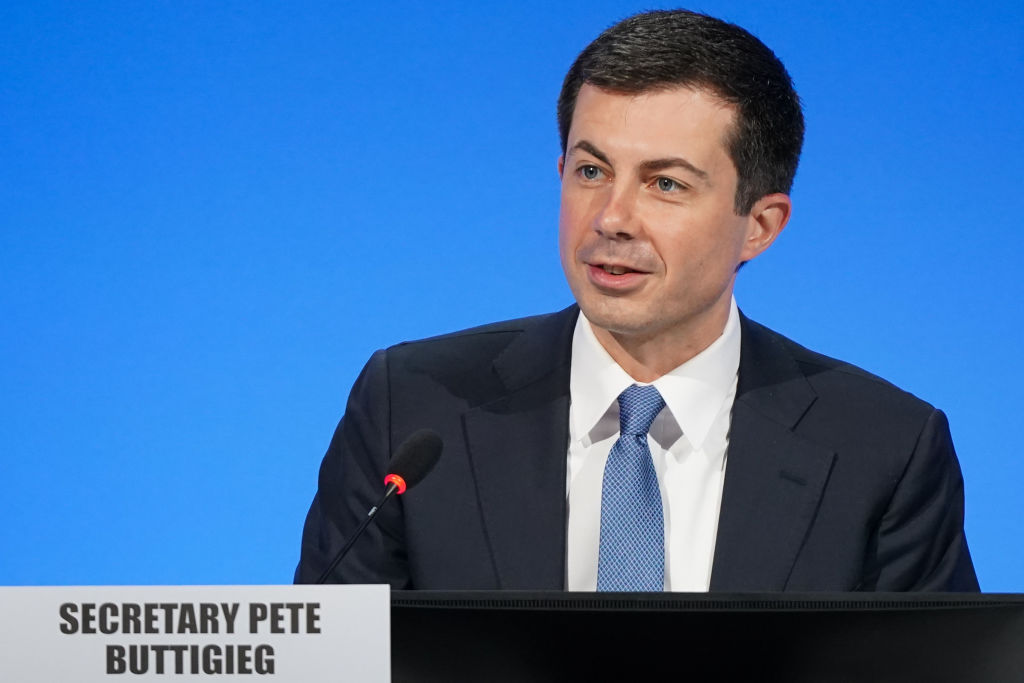
Secretary of Transportation Pete Buttigieg speaking in Glasgow, Scotland, November 10, 2021. (Ian Forsyth / Getty Images)
When I saw a WIRED piece on my Twitter feed this week emblazoned with the title “Pete Buttigieg Loves God, Beer, and His Electric Mustang,” I assumed that only one of two things could possibly be happening. Either this was a piece of vintage Butti-ganda from circa 2019 that was remaking the rounds, or I had inadvertently bitten into an accursed Proustian madeleine and been swept back in time. But the interview/adulatory write-up on America’s secretary of transportation is indeed, somehow, from the Year of Our Lord 2023.
To call it hagiographic would be something of an undersell. The piece — incidentally penned by someone who in 2016 described Hillary Clinton as “an idea, a world-historical heroine, light itself” — opens with two stanzas that similarly make the former mayor of Indiana’s fourth-largest city sound like a fusion of Jesus Christ and Aristotle:
The curious mind of Pete Buttigieg holds much of its functionality in reserve. Even as he discusses railroads and airlines, down to the pointillist data that is his current stock-in-trade, the US secretary of transportation comes off like a Mensa black card holder who might have a secret Go habit or a three-second Rubik’s Cube solution or a knack for supplying, off the top of his head, the day of the week for a random date in 1404, along with a non-condescending history of the Julian and Gregorian calendars.
As Secretary Buttigieg and I talked in his underfurnished corner office one afternoon in early spring, I slowly became aware that his cabinet job requires only a modest portion of his cognitive powers. Other mental facilities, no kidding, are apportioned to the Iliad, Puritan historiography, and Knausgaard’s Spring — though not in the original Norwegian (slacker). Fortunately, he was willing to devote yet another apse in his cathedral mind to making his ideas about three mighty themes — neoliberalism, masculinity, and Christianity — intelligible to me.