Germany Believes in Free Speech, but Not for Palestinians
This month, Palestinians mark the Nakba, the wave of ethnic cleansing that began their decades of displacement. But in Germany, trumped-up antisemitism allegations are being used to suppress the commemorations — showing that speech isn’t free for all.
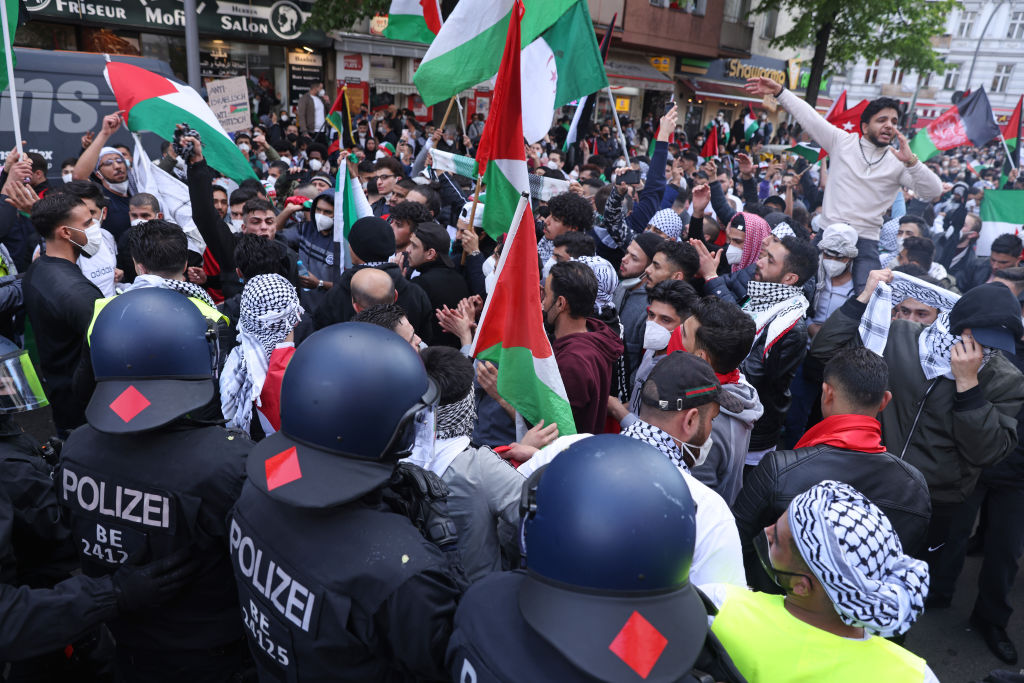
Protesters face riot police as they march on Nakba Day to demonstrate for the rights of Palestinians on May 15, 2021 in Neukölln, Berlin, Germany. (Sean Gallup / Getty Images)
Every year on May 15, Palestinians around the world commemorate the Nakba, the Arabic word for “catastrophe.” It refers to the events of May 1948, when, in the chaos of the Arab-Israeli war, Zionist paramilitaries carried out a campaign of mass ethnic cleansing against Arab Palestinians. The attacks resulted in the expulsion of an estimated 750,000 people — about 75 percent of the native population of what is now the State of Israel — from their land and homes. This was a key, albeit often overlooked, event in Israel’s founding, and continues to be central to Palestinian history and collective identity.
Long a taboo in the Israeli public sphere, the events of the Nakba have since been conclusively established, often by Israeli historians working in Israeli archives. Following the formal end of the British Mandate of Palestine on May 14, 1948, armed militias like the Irgun, the Haganah, and the Stern Gang launched attacks on Palestinian communities, killing about fifteen thousand people and destroying nearly five hundred towns and villages. The same militias are also notorious for mass killings such as the Deir Yassin (April 9, 1948) and Tantura (May 22–23, 1948) massacres, designed to intimidate and force people to leave their homes.