The US Supreme Court Is Putting Israel’s Interests Before the First Amendment
Laws across the United States are targeting the Boycott, Divestment, and Sanctions movement against Israeli apartheid. The Supreme Court is refusing to hear a challenge to those laws, even though they’re in clear violation of Americans’ First Amendment rights.
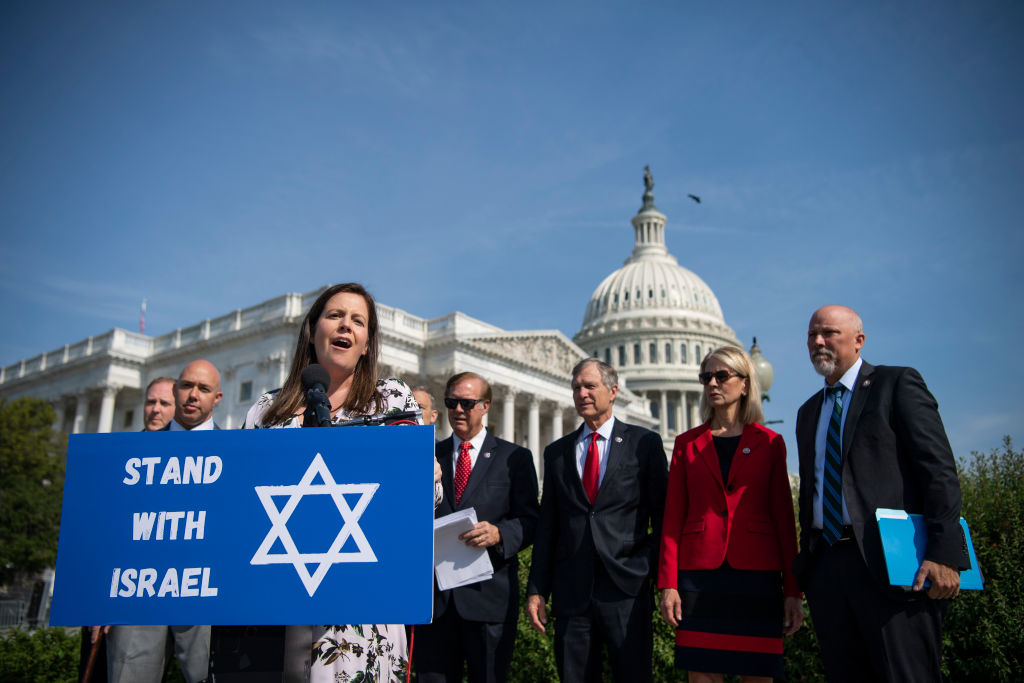
Republican House Conference Chair Elise Stefanik (R-NY) joined by fellow House Republicans, speaks on Israel in Washington, DC, on May 20, 2021. (Caroline Brehman / CQ-Roll Call, Inc via Getty Images)
On February 21, the United States Supreme Court revealed its cowardice when it refused to hear a case challenging an anti–Boycott, Divestment, and Sanctions (BDS) law in Arkansas.
BDS is a movement led by Palestinians calling on people to boycott Israeli products, divest institutions from the State of Israel and companies that uphold the occupation of Palestine, and impose sanctions banning business with Israeli settlements and ending military trade with Israel. The Arkansas law prohibits public employees from engaging in BDS — despite the fact that economic boycotting is a form of freedom of speech.
BDS, according to precedent, is protected by the First Amendment, but the Supreme Court refusing to hear the case allows the Arkansas law to stand. Although the Supreme Court’s refusal to hear the decision does not equate to a precedent that this law is constitutional, it nevertheless runs the risk of passively giving the green light for similar legislation in the future.