Nobody Loves You Is a Surreal Drama About Working-Class Britain
Nobody Loves You and You Don’t Deserve to Exist, the debut film by director Brett Gregory, offers an unsparing critique of the false promises of social mobility. It is the best film about working-class Britain in years.
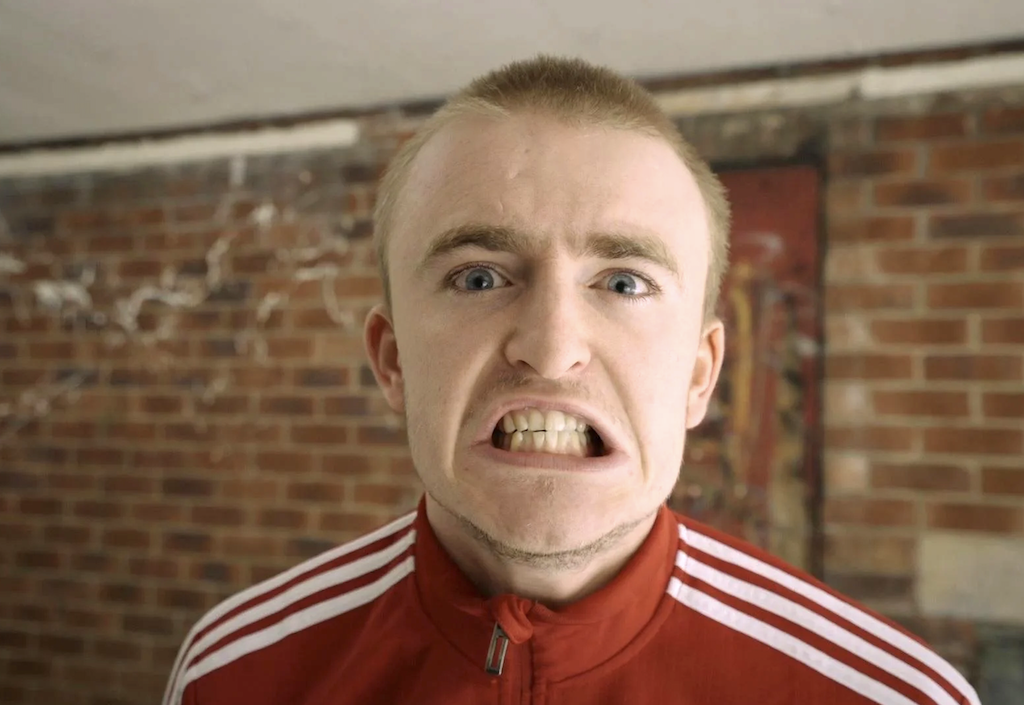
Still from Nobody Loves You and You Don’t Deserve to Exist. (Serious Feather)
Nobody Loves You and You Don’t Deserve to Exist (NLY) is not an easy film to watch. Brett Gregory’s debut feature follows the life of protagonist Jack, from a tough childhood under Margaret Thatcher’s Conservative government to adulthood as an unemployed teacher isolated throughout Boris Johnson’s mishandling of the COVID-19 pandemic. Set in the North of England “in a land that God forgot,” NLY’s overtly antiestablishment tone is delivered through a thousand cuts. The opening scene showcases monarchical iconography amid derelict public spaces and expensive high-rises looming over aging council housing. The message is subtle but clear: this is a film about poverty amid plenty.
In this sense, NLY is a film of the moment. The UK is currently experiencing the biggest cost-of-living crisis in a generation: typical household incomes will fall by their largest amount in half a century this year and, with the rich getting richer, income inequality is set to reach a record high. In Greater Manchester, where the film is almost entirely shot, 42 percent of children are living in poverty. It is in this context — unspoken but clear from the voiceover and set — that NLY opens, with an elderly Jack confined to his room in early 2020. Yet while NLY highlights the impact and isolation of those early pandemic days, the film is a much wider critique of the current economic and social order.
Dreams Denied
Jack’s life is told through a combination of personal monologues — young Jack in 1984, student Jack in 1992, and old Jack in 2020. While these are supplemented by a variety of characters throughout the film, it is often the protagonist who steals the show. These scenes — spoken directly to camera — allow the viewer to trace Jack’s journey from an abusive yet aspirational childhood through to the present in which he struggles with depression and alcoholism.