Japanese Socialism Was a Powerful Force Until It Lost Its Political Bearings
For most of Japan’s postwar era, the Socialists were the second force in the country’s political system and the main challenger to conservative rule. But when they ditched their left-wing, anti-militarist principles in the 1990s, they collapsed into minor-party status.
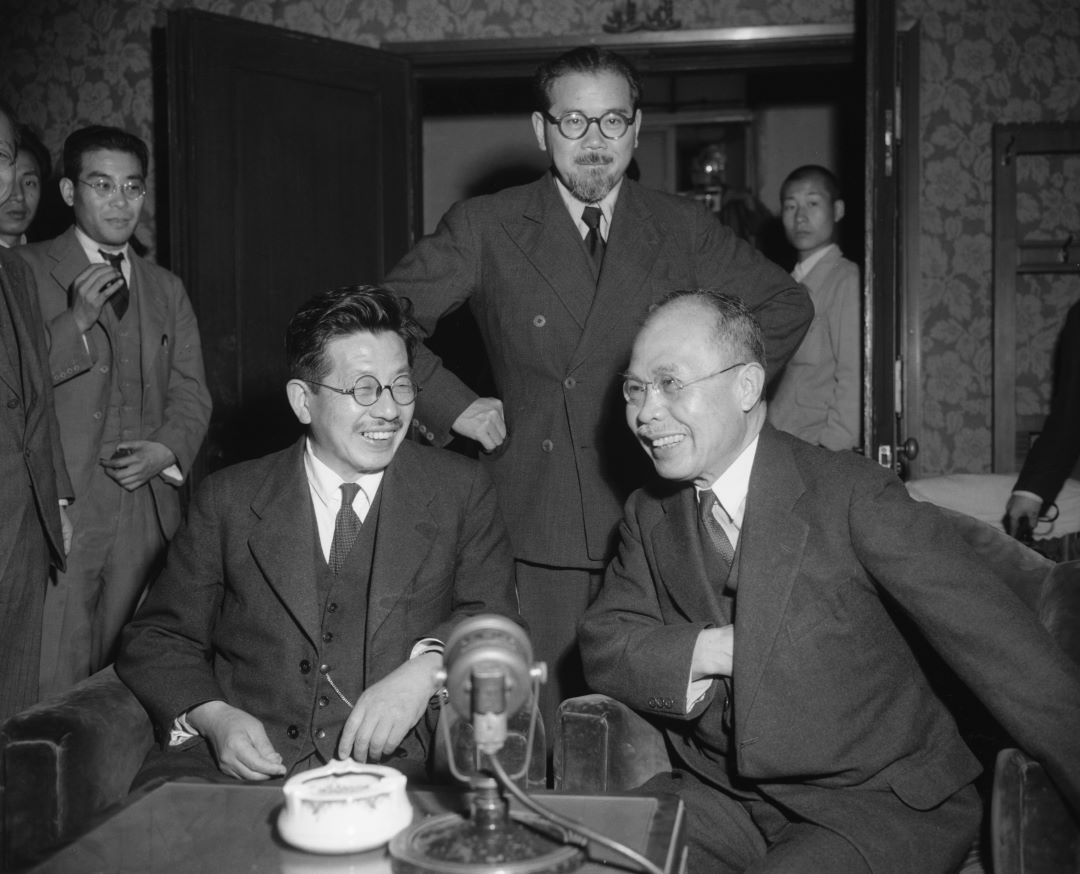
Following the resignation of his cabinet and his subsequent appointment as leader of the Progressive Party, Baron Kijuro Shidehara (right) confers with Tetsu Katayama, chairman of the Japan Socialist Party. At center is Wataru Narahashi also of the Socialist Party. Tokyo, Japan, April 30, 1946. (Bettmann / Getty Images)
When Japan became a capitalist democracy after World War II, the Japan Socialist Party (JSP) established itself as a major force in the country’s political system. In 1947, it won the largest number of seats in the House of Representatives, Japan’s lower house. Although it never repeated this achievement in subsequent years, the JSP was the second-largest party in every lower-house election between 1958 and 1993.
As late as 1990, the JSP could still win a quarter of the vote and appeared to be a serious challenger to the ruling Liberal Democratic Party (LDP) as its hegemony began to fray. Yet within a few years, it had virtually disappeared as a political force.
The JSP’s successor group, the Social Democratic Party, received less than 2 percent of votes cast in last year’s House of Representatives election and has just one seat in the chamber, with another in Japan’s upper house. Ironically, it was the Japanese Communist Party that proved to be much better equipped for survival in the aftermath of the Cold War.