Strikes Work Better When They’re Organized Democratically
Kindergarten teacher Tyler Dupuis went on strike with Oakland teachers in 2019 and Seattle teachers this fall. It’s not a coincidence that Oakland won more than Seattle: when it comes to strikes, militancy and member mobilization get the goods.
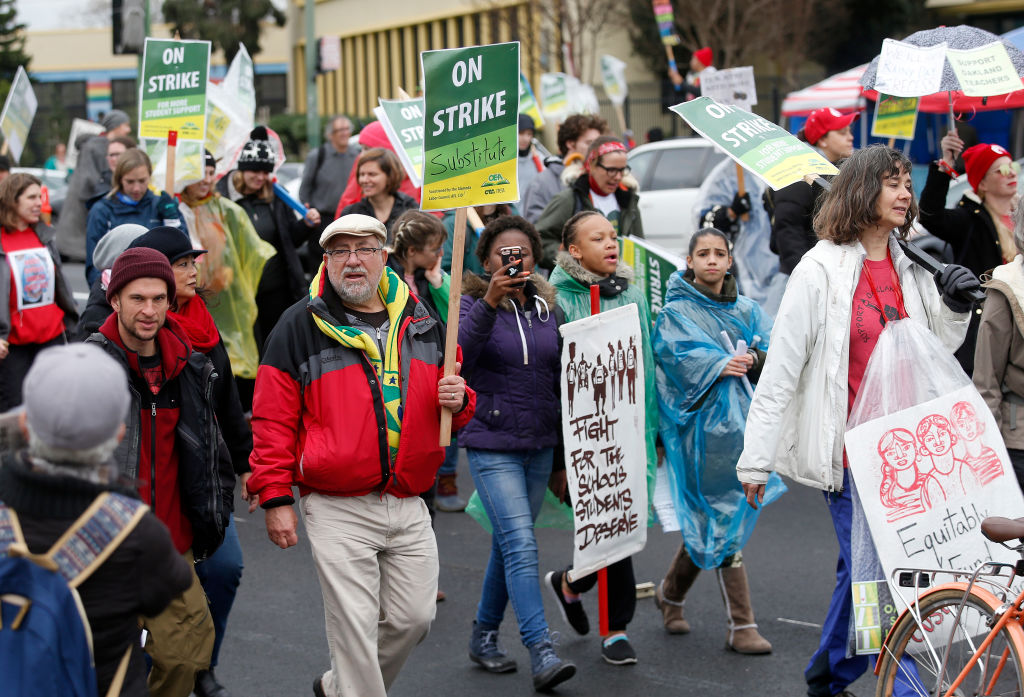
Teachers, students, and supporters march down International Boulevard toward a rally at Roots International Academy in Oakland, California, on February 26, 2019. (Jane Tyska / MediaNews Group / Mercury News via Getty Images)
I’ve been a teacher for six years now, long enough to get familiar with the problems in our education system. I’ve taught combination grade classes, and classes filled with twenty-seven students where I was the only adult and the only one who knew how to tie shoes. I’ve taught in schools where the nurse was only present once a week, where many of the students were newcomers to the country and still learning English, and where administrative support generally amounted to “just do your best.”
In the last three years, I’ve also gone out on strike twice, first with the Oakland Education Association and then with the Seattle Education Association. Both times, our demands were for better supports for students, more nurses and psychologists, supports for multilingual and special education students, and better pay for ourselves. The demands at the heart of the two strikes were similar, but the experiences were very different — and the differences impacted the results. In Oakland, we were militant and confrontational on the picket line, but in Seattle, we could have pushed much harder, and it shows in what we won and what we didn’t.
Before moving to Seattle, I lived in Oakland, where educators went on strike in the beginning of 2019. While our wins were modest in Oakland compared to what we really need, the approach to striking was very different from what I experienced this year in Seattle. In Oakland, the union leadership made a clear enemy of the district, whose underfunding of our schools meant we had the lowest pay of all surrounding districts, packed class sizes, and only eleven nurses for nearly thirty thousand students. We began preparing for a potential strike months in advance, and we pushed back hard against a district that was not only refusing our demands but intending to gut the system even further by closing several neighborhood schools.