How Nazi Billionaires Thrived in Postwar Germany
In Nazi Germany, industrialists built vast fortunes from slave labor and stolen Jewish property. In postwar West Germany, they were allowed to keep them — with denazification doing little to trouble those who had profited most from the regime.
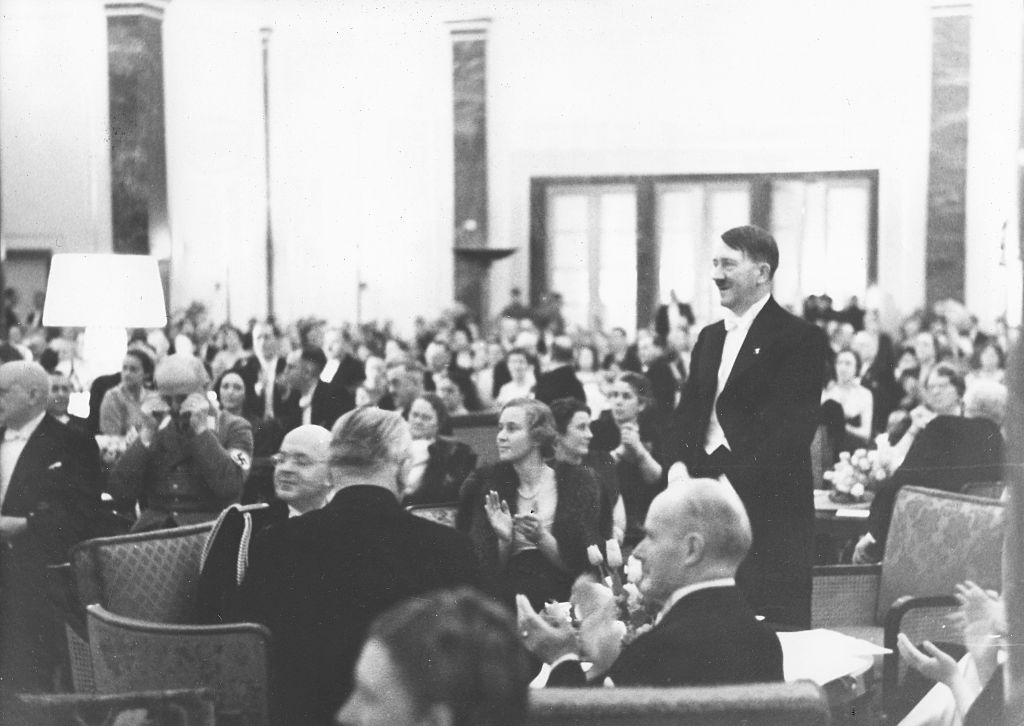
Adolf Hitler holds a reception for leading figures in German business, including Dr Gustav Krupp (foreground), 1939. (Ullstein Bild via Getty Images)
In 2019, the German tabloid Bild published shocking revelations about one of the country’s most powerful companies. Bild discovered that Albert Reimann — creator of a family business whose investment firm, JAB Holding, has majority stakes in brands from Dr Pepper to Jacobs Douwe Egberts — was a devoted Nazi who sexually abused, tortured, and humiliated slave workers in his business during World War II. The Reimann family fortune is estimated at €33 billion. The family decided to confront its dark past and donated millions of euros to nonprofit organizations devoted to helping religious and national minorities and seeking out the families of the war prisoners forced to work for the grandfather’s firm.
This was just one recent case showing how Nazi tycoons had been able to cover up their dark pasts in postwar West Germany. One of the journalists who dug into the archives to find out about this history was David de Jong. His new book, Nazi Billionaires, follows the story of men who became part of the Third Reich’s business and financial elite, making their fortunes by stealing Jewish-owned firms, banks, and other assets, as well as exploiting forced and slave labor in concentration camps during World War II. Companies like Siemens, Volkswagen, BMW, Daimler-Benz, Dr. Oetker, Porsche, Krupp, IG Farben, and many more cooperated with the SS, which built “satellite concentration camps” near these private companies’ factories and mines where slave laborers toiled in the most appalling conditions. While, after 1945, legal proceedings were launched against Nazi businessmen, almost none would be punished. Industrialists like Günther Quandt, Friedrich Flick, and Ferdinand Porsche were even allowed to keep their assets and continue business as usual. During the “economic miracle” of the 1950s in Germany, they made even bigger fortunes, and their family businesses remain among the most powerful in Germany. Some have even continued to support far-right political parties.
But how did the relationship between Adolf Hitler and the business and financial elite develop during the interwar period? And why were Nazi businessmen set free after the war, even though their activities were key to the regime’s operations? Jacobin’s Ondřej Bělíček spoke to De Jong about the fate of the Nazi billionaires.