How the 1905 Revolution Inspired Rosa Luxemburg’s Vision of Emancipation
In 1905, revolt across the Russian Empire threatened to topple the tsar — but also prompted a formidable reactionary backlash. For Rosa Luxemburg, it showed the need for working-class leadership in the fight to democratize society.
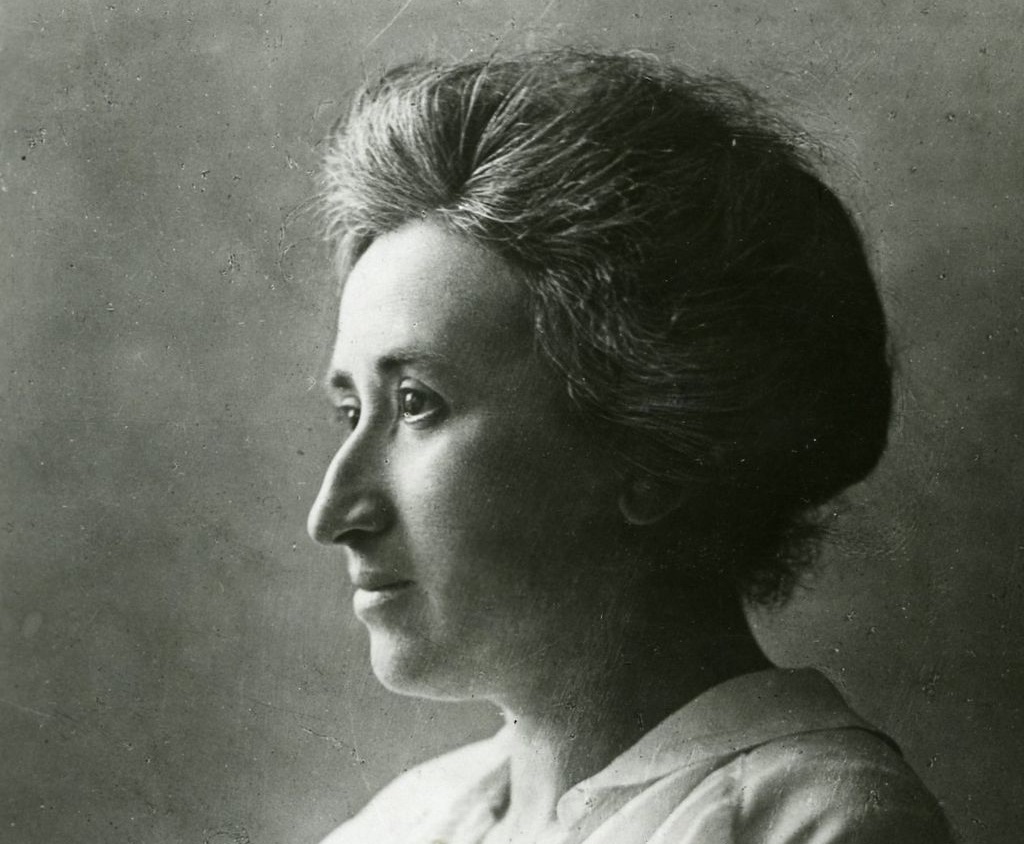
Free expression was at the core of Rosa Luxemburg’s revolutionary philosophy. (Deutsches Historisches Museum)
Reflecting in his memoirs on the death of Rosa Luxemburg, Victor Serge wrote that she was “the only figure in Western Socialism that was capable of equaling [the Russian revolutionaries] or even perhaps of surpassing them so far as intelligence and the spirit of freedom were concerned.” This sentiment was later echoed by Isaac Deutscher in his biography of Leon Trotsky: “Of all the personalities of European socialism, nobody was in origin, temperament, and political and literary gifts more akin to Trotsky than Rosa Luxemburg.” Such praise, however, runs the risk of paying Luxemburg a backhanded compliment, as if her brilliance were best measured against the light of her male contemporaries. Far from it, “Red Rosa” (to her admirers) or “Bloody Rosa” (to her enemies) was arguably the most gifted and original revolutionary of her era.
Luxemburg possessed rare qualities, escaping many of her comrades’ limitations; in particular, she had an acute sense of irony and an ability to recognize contradictions within her own position. And her commitment to revolutionary socialism didn’t restrict her intellect, nor did it hobble her appreciation for the arts. Though Trotsky possessed a Renaissance-like intelligence and could write insightfully about poetry and painting, his works like Literature and Revolution show the flexing of a manacled mind, a great talent of self-shackling rigidity. Luxemburg stands in even sharper contrast with Vladimir Lenin, who famously distrusted the humanizing influence of the arts (lest it threaten revolutionary focus) and had a priestly adherence to Marxism. (Bertrand Russell observed upon meeting him that he seemed “quite incapable of supposing that there could be anything in Marx that wasn’t right.”) The same cannot be said of Luxemburg, whose writings reveal a deep unease with systematic certainties and a refusal to seek the comfort of clichés. She was, in the most complimentary sense, unorthodox.
Alive to the ironies of history, Luxemburg understood that these contradictions characterized not only the tension between competing social forces under capitalism between Left and Right but also the dialectics of the Left itself. It is perhaps because of this that Luxemburg’s work lacks a decidedly prescriptive quality, and instead seems dominated by what G. W. F. Hegel called “the labor of the negative.” The absence of a prescriptive element is also seen as one of the reasons why Luxemburg’s ideas are considered less influential, not having been picked up with the same fervor and intensity as those of her contemporaries. This led J. P. Nettl, in his excellent biography, to concede that “unlike Lenin, she made no original contributions to the tactics or methods of revolution” and did not “produce anything that could be adopted for use.” However, the depth and latitude of thinking on display in the latest installation in Verso’s The Complete Works of Rosa Luxemburg, titled “On Revolution,” shows that this assessment is untrue.