Chile’s New Constitution Could Guarantee Neoliberalism Dies Where It Was Born
Today Chile votes on a new constitution. Chileans have a chance to replace Pinochet’s document with one that guarantees social, economic, and environmental rights, and to bury the legacy of neoliberalism once and for all.
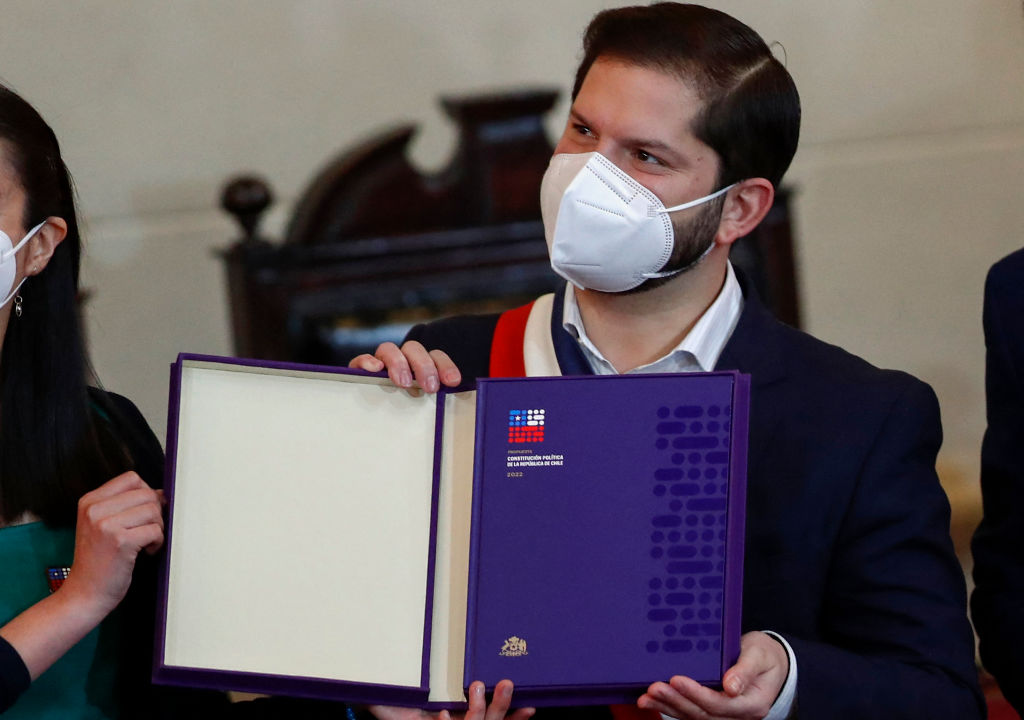
Chilean president Gabriel Boric holds the final draft of the constitutional proposal during its presentation at the National Congress in Santiago, July 4, 2022. (JAVIER TORRES/AFP via Getty Images)
Today the people of Chile will decide, by way of a national referendum, whether to approve or reject the recently drafted new constitution. After an excruciating month of campaigning both for and against the draft, it is nearly crunch time for this historic moment in the country.
Chileans are turning out to vote as part of the first mandatory ballot in over a decade, which has generated some uncertainty in regard to predicting the result. The Rechazo (reject) option has been leading in all the polls, but this week the closing rallies for Apruebo (approve) were massively attended in cities across the country, with hundreds of thousands attending last night’s closing rally in Santiago. The mainstream media and social media have played an important role in communicating the content of the constitutional draft, but fake news and deliberate misinterpretations of the document have dominated the narrative, making the communication process much harder for those leading the Apruebo campaign. After all, what is at stake is more important than any other election in the last thirty years.
The new constitution aims to establish a social pact that will build new foundations for the country’s future. The document, written by a democratically elected convention, includes a series of progressive principles, such as the right to nature, reproductive rights, and sexual diversity. However, it is the definition of the state that will reshape how Chile sees itself in the coming years. In the current constitution, written during the dictatorship, in 1980, and somewhat amended during democracy, the state is defined as a subsidiary, meaning that its role is reduced to only intervening in cases where private life (or the private sector) cannot. This interpretation of the subsidiary state has enabled the expansion of neoliberalism as an economic model that has infected all aspects of people’s lives, such as education, health, and housing, with little space left for government to attempt progressive reform over the years. Article 1 of the draft being voted on replaces this idea of the subsidiary state with one that sees Chile as