The Civil Rights Movement Was Radical to Its Core
Today is the 59th anniversary of the March on Washington, so get ready for plenty of whitewashed history. Here’s the truth: the Civil Rights Movement was a radical struggle against Jim Crow tyranny whose early foot soldiers were Communists and labor militants.
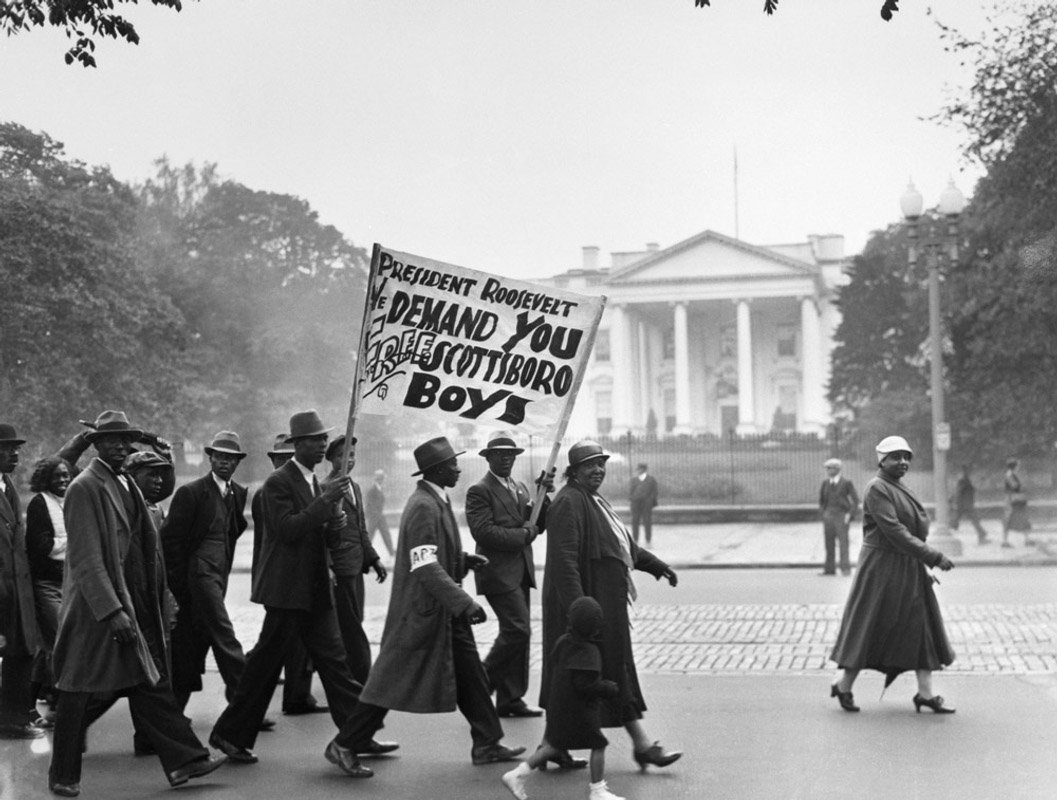
Communists defend the Scottsboro Boys, accused of the rape of two white women and denied due process, in the early 1930s.
In Defying Dixie: The Radical Roots of Civil Rights, 1919–1950, historian Glenda Gilmore turns our attention to the decades before the “classic” Civil Rights Movement of the 1950s and 1960s. Her focus is on the Southerners — Pauli Murray, Lovett Fort-Whiteman, Harry Haywood, Junius Scales, and many others — who left the region to conduct the fight against Jim Crow segregation from beyond its borders. These figures were radicals of various stripes — Communists, Socialists, labor militants — and served as the leaders and foot soldiers of the struggle against racial and economic tyranny. Only “Cold War anti-Communism,” Gilmore asserts, was able to snuff out their singular contributions from the history books.
Gilmore’s narrative follows a path of struggle through Southern, American, and world histories that links together the Russian Revolution, the rise and fall of fascism, and the “long civil rights movement” in the United States. Lovett Fort-Whiteman, a Texas native and dedicated Communist, educated his comrades abroad about the “Negro Problem.” Fellow Communist Harry Haywood promoted his controversial “Black Belt thesis” — which held that black Americans in that part of the Deep South constituted a “nation within a nation” with the right to self-determination — before the Communist International in the late 1920s and early 1930s.
While such ideas were being debated within the Communist Party USA (CPUSA) and Comintern, Communists in the US South gradually found themselves on the front lines of a Southern Popular Front that included Socialists and Southern liberals who opposed Jim Crow segregation and what many saw as its international ally — fascism.