The Kurds Aren’t a “Security Threat” — They’re the Ones Being Attacked
Turkey’s president Recep Tayyip Erdoğan has pushed Sweden and Finland to crack down on Kurdish groups in exchange for NATO membership. He cites his country’s “legitimate security concerns” — but it’s the long-oppressed Kurds who have most to fear.
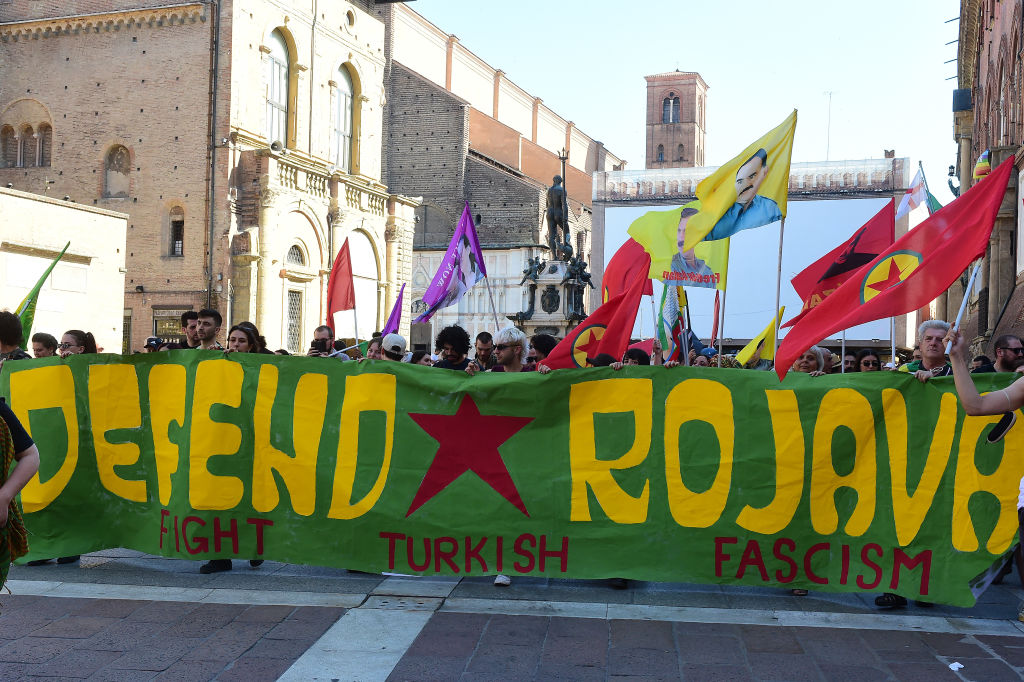
Kurdish people take part in a demonstration against the Turkish invasion and bombing in Syria and Iraq, on June 11, 2022, in Bologna, Italy. (Roberto Serra / Iguana Press via Getty Images)
Finland and Sweden are moving closer to North Atlantic Treaty Organization (NATO) membership — but only thanks to Turkish president Recep Tayyip Erdoğan giving up his veto to their joining the military alliance. This came with conditions: citing “security concerns,” he extracted a string of concessions from the Nordic countries, the United States, and NATO — accepting them only after signing a memorandum that would again turn the Kurds into victims.
The memorandum promises a lot for Turkey, to the detriment of the Kurds. After the NATO summit in Madrid on June 29 and 30, the ultranationalist Devlet Bahçeli — Erdoğan’s unofficial coalition partner — termed it a “strategic gain for our country and at the same time a national success.” In a sense he is right: this is, indeed, a step forward in Turkey’s war against the Kurds and for a government that needs such “successes” to prop up its domestic rule.
I am the European representative of the Peoples’ Democratic Party (HDP), Turkey’s second biggest opposition force and the biggest left-wing party. It is my sad experience that people will talk about the Kurds but without the Kurds being part of the talks. And once again, instead of listening to the Kurds, the West is caving in the face of Erdoğan’s blackmail.