In Los Angeles, Tenants Just Secured a Historic Victory Over Landlords
The Hillside Villa Tenants Association has successfully forced a municipal government to approve the public purchase of a building to preserve affordability. The victory, a historic first in the US, creates a blueprint that can be followed across the nation.
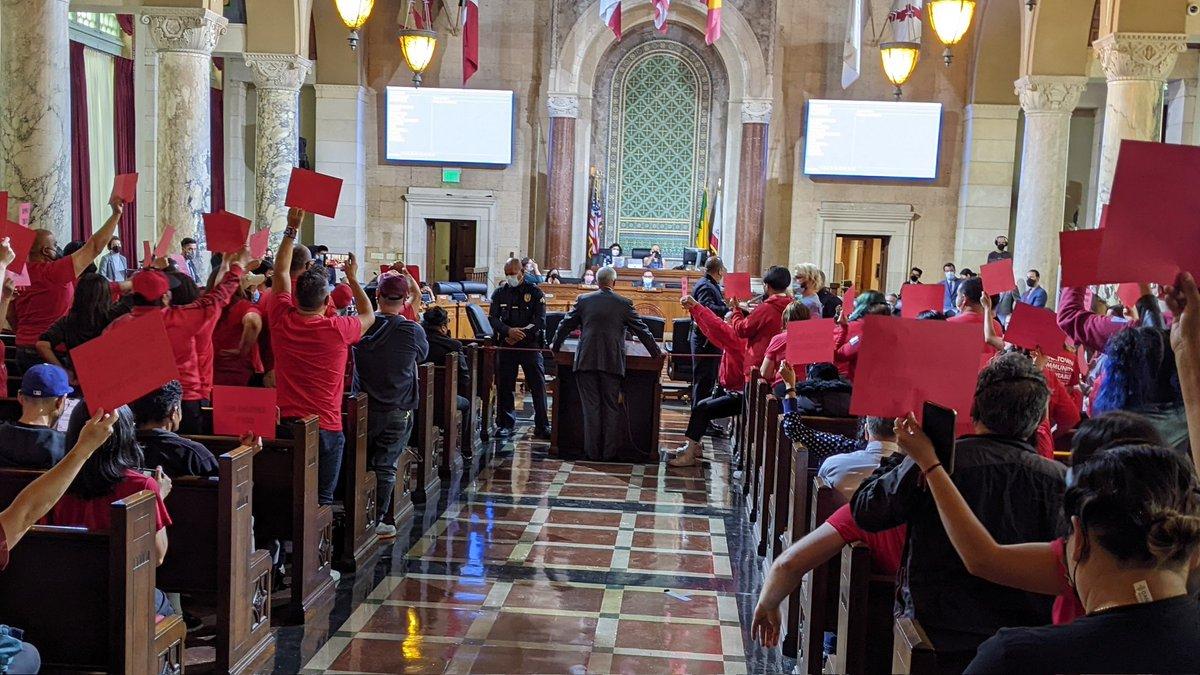
Hillside Villa tenants hold up signs while the lawyer for their landlord speaks in front of the Los Angeles City Council. (Hillside Villa Tenants Association)
On Friday, May 27, members of the Hillside Villa Tenants Association and their supporters, who had packed the Los Angeles City Council chambers dressed in red shirts and holding signs that read “EMINENT DOMAIN NOW” and “PUBLIC MONEY PUBLIC USE,” erupted in cheers and began chanting “Sí se puede! Sí se puede!” The tenants had just secured a historic win, becoming the first tenants’ association in the United States to successfully force a municipal government to approve the public purchase of their building to preserve affordability.
In a unanimous vote, the LA City Council resolved to take out a loan from the city’s General Reserve Fund to acquire Hillside Villa, a 124-unit affordable housing complex in Chinatown. The building’s affordability covenant — a condition of the loan and subsidies granted to the developer in the 1980s — expired in 2019. In the years since, Hillside Villa’s landlord, Tom Botz, has issued up to 300 percent rent increases that would effectively displace most tenants. (They’ve remained housed due to a COVID-related eviction moratorium set to expire in 2023.) Yet after an extraordinary three-year fight, the unprecedented victory puts Hillside Villa Tenants Association on the verge of securing the right to stay put and preserving affordability — decommodifying their homes and exposing the inherent flaws of the United States’ neoliberal affordable housing program in the process.
Since the 1970s, when Richard Nixon instituted a moratorium on public housing construction, the provision of low- and moderate-income housing has been outsourced to private developers and operators through subsidized programs like the Low-Income Housing Tax Credit (LIHTC) and Section 8. Under LIHTC, the federal government issues tax credits to developers who, in exchange, provide temporary affordability in a percentage of units of a usually for-profit development. (States are only required to award ten percent of LIHTCs to nonprofits.) Once the affordability covenant expires, as in the case of Hillside Villa, the landlord can raise rents to market rate, while the working-class tenants who cannot afford the increases are forced out — displaced by mechanisms of the housing policy that provided them with affordable homes in the first place.