A Better Foreign Policy Abroad Requires a Strong Labor Movement at Home
Polling shows that most Americans oppose their country’s forever wars, but this dispersed opposition has done little to alter the United States’ foreign policy. For the antiwar movement to be successful, it must build its base in organized labor.
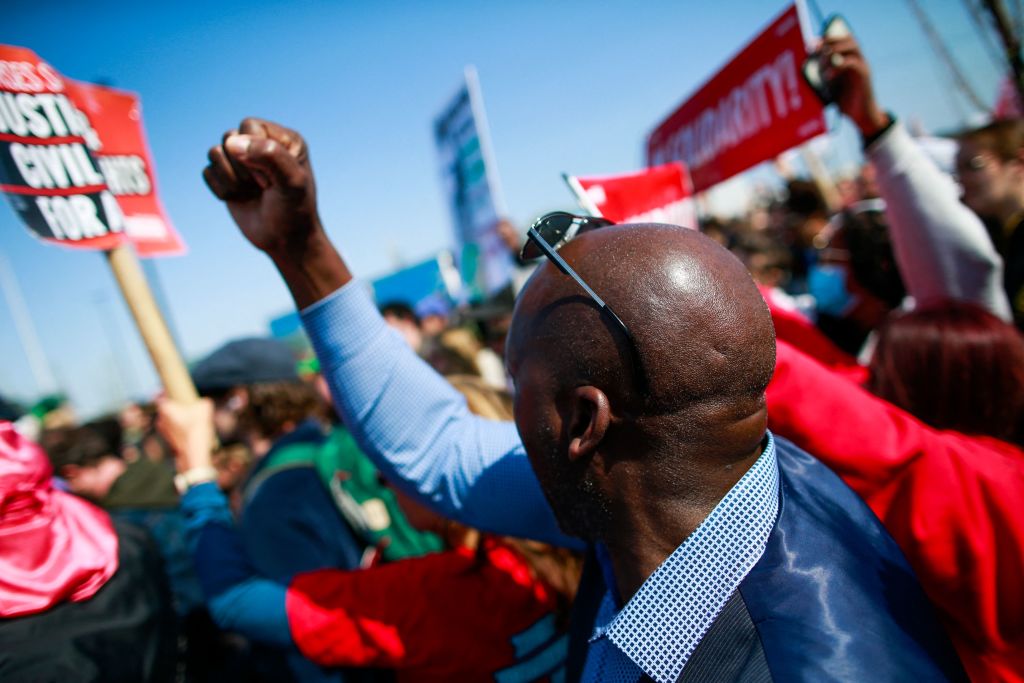
Amazon workers attend a union rally outside the company’s Staten Island facility, April 24, 2022. (Kena Betancur / AFP via Getty Images)
Despite a number of dramatic changes in the international distribution of power over the past three decades, the United States has not fundamentally abandoned its grand strategy of primacy (also called “liberal hegemony” or “deep engagement”). During the so-called unipolar moment, the United States faced no peer competitors, and yet remained in a state of near-constant war, attempting to impose its preferences on large parts of the world. As new powers rise, the United States seeks to maintain primacy despite finding itself in a state of severe strategic overstretch, facing growing challenges with diminishing relative resources, and possessing many protectorates but few independently capable allies.
Some foreign policy experts have questioned why “the Blob” has not pursued a corresponding strategic readjustment. The rough answer, as Stephen Walt has pithily summarized, is that “liberal hegemony is a full employment program for the foreign policy establishment.” The foreign policy establishment enjoys particular autonomy within the government and, while shielded from public oversight or accountability, remains mainly answerable to the corporate beneficiaries of US primacy abroad.
The intransigence of the foreign policy elite is due to a general deficit of democratic control over American government. A revitalized labor movement is necessary in order to both replenish democracy at home and to act as a powerful institution to channel otherwise diffuse public interests and influence policymakers.