The State Organizes the Capitalist Class. The Working Class Will Have to Organize Itself.
To sustain capitalism, otherwise competitive businesses have to do something unnatural: cooperate with each other. The state plays a crucial role in fostering this class discipline. We, on the other hand, have to build our own power.
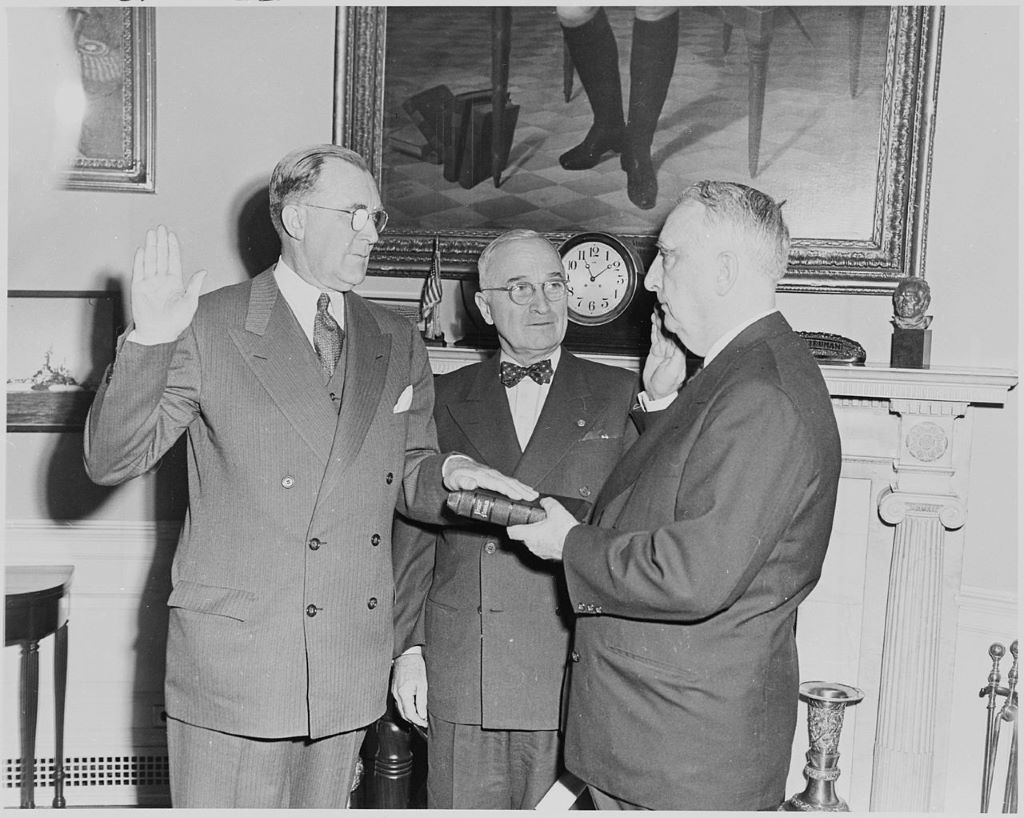
Charles E. Wilson, formerly president of General Electric, taking the oath of office as director of the Office of Defense Mobilization, as Chief Justice Fred Vinson administers the oath and President Harry Truman looks on, in the Oval Office. (US National Archives and Records Administration / Wikimedia Commons)
It seems everyone agrees: American democracy has been corrupted by corporate lobbying. Donald Trump’s promises, however disingenuous, to take on the role of money in politics by “draining the swamp” resonated with his frustrated followers. Meanwhile, progressive liberals like Elizabeth Warren have focused on addressing “corruption” by limiting the influence of business over our elected leaders. Though radically different, both apparently see corporate power as a bug, not a feature, of our political system.
Academics, searching for an explanation for the explosion of inequality in recent decades, have also identified business lobbying as the culprit. Thus, in their widely influential book Winner-Take-All Politics, Jacob Hacker and Paul Pierson contend that an explosion of lobbying since the 1970s has overpowered labor and other interest groups. This has resulted in the policy shifts that have facilitated the upward distribution of wealth, and the erosion of the middle class, during the neoliberal era.
The main effect of this framing is to narrow the focus of our political critique. If class power is primarily an outcome of business lobbying, then the main objective of progressives and the Left should be to restore “normal” pluralist democracy by limiting the influence of business on elected representatives. This will allow the policy “pendulum” to swing back toward labor and permit the enactment of pro-worker policies. The state, from this point of view, is essentially an impartial referee, balancing the interests of competing interest groups.